Moxa Product Cost Breakdown in China: From Raw Leaf to DDP Delivery
While our Moxa Quality Journey explains how moxa is physically made, our Moxa Product Builder examines the exact same product from a pure cost perspective. Here is every single cost layer between raw Chinese mugwort leaves and landed overseas delivery—so you know exactly where every dollar goes.
Custom moxa costs combine net weight, raw-leaf yield, storage carrying cost, refining fee basis, forming loss, packaging, tooling/QC, freight chargeable weight, import duties, and supplier margin.
Moxa Sourcing · China Mugwort Category Sourcing Partner
Ready to turn these standards and cost checks into a verified order?
Even if you know exactly what you want to buy, we help you find the right supplier in China, compare samples and quotes on the same basis, and follow through on the specifications you approve—across both ready-made wholesale and private-label/custom OEM.
Instead of burying markup inside raw-material prices—or posting misleading generic prices online—we model every line openly and tie final quotes to approved samples and written briefs.
Open Moxa Product Builder to enter your target form, quantity, and currency, lock mandatory specs, and export a supplier-confirmation brief.
1. Why understanding cost structure matters as much as understanding craft
When two factories quote widely different numbers for “500 g 3-year moxa wool” or “54-count moxa cylinders,” the higher quote is not automatically better wool—and the lower quote is not automatically more efficient. Without opening the black box, a buyer cannot tell whether the price difference sits in raw leaf yield, processing method, testing, packaging, freight boundary, or hidden supplier markup.
Transparency note: We never publish fake universal factory prices online because custom specifications, packaging, quantities, and destinations vary dramatically. The cost architecture below—mirrored in Moxa Product Builder v3.0.3—gives you the exact mathematical framework to audit real dated supplier quotes.
2. All 6 cost layers inside a China moxa product quotation
| Cost layer | Exact inputs modeled | Why buyers must check it explicitly |
|---|---|---|
| Layer 1: Product & Net Weight | Format (wool / stick / cylinder / cake / heat pack), order quantity, net content mass (unitG), moxa share %, allocated packaging mass (packG) | Prevents comparing a 400 g unit against a 500 g unit; separates net product weight (cost basis) from gross weight (shipping basis). |
| Layer 2: Raw Material & Carrying Cost | Costing route, raw price (CNY/kg), future prep/aging loss %, holding years, warehouse rate, simple capital carrying rate | Prevents double-charging past aging loss when buying already-aged leaves, while quantifying real warehouse & capital costs if you store stock yourself. |
| Layer 3: Refining, Forming & By-Products | Input-to-wool ratio (X:1), refining fee denominator (input kg / output kg / flat batch), unrecovered forming loss %, realizable net by-product recovery | Catches the 10× refining-fee denominator error and stops factories from claiming unverified “free by-product credits.” |
| Layer 4: Packaging, QC & Order Fixed Costs | Packaging materials/unit, other herbal ingredients, lab QC/testing fee, setup/tooling allocation, procurement/admin overhead | Fixed batch charges (testing, molds, setup) amortize heavily at small quantities (50–300 units) and drop rapidly at scale (1,000–5,000+ units). |
| Layer 5: Delivery & Import Boundary | Ex-Factory handover vs. China forwarder (gross kg × local rate) vs. DDP (flat quote or max of gross vs. volumetric chargeable weight + single-counted import charges) | Ensures two quotes are compared on the exact same Incoterms boundary and avoids double-counting import duties/VAT. |
| Layer 6: Visible Supplier Profit & FX/Fees | Supplier profit method (markup on production cost vs. margin on invoice), payment/FX fee %, dated settlement exchange rate | Keeps supplier profit transparent instead of disguising it inside inflated material prices; clarifies FX conversion timing. |
3. Layer 2 deep dive: Three raw-material costing routes (avoid double-counting aging)
In real Chinese procurement, cost starts at one of three distinct entry points—and mixing them up distorts every downstream figure:
- Route A — Buy prepared dry input (already sorted & aged): Past preparation and storage weight loss are already baked into the supplier’s dated leaf quote. You must NOT add historical storage loss a second time.
- Route B — Buy raw harvest, then prepare & store yourself: Here, future sorting loss (
preLoss), future storage mass loss (ageLoss), multi-year warehouse fees (CNY/kg/year), and capital carrying costs belong explicitly on the ledger. - Route C — Buy ready-made moxa wool: Bypasses upstream leaf yield and refining calculations entirely; costing begins directly at the wool price per kg plus forming, packaging, QC, and delivery.
Even public regional harvest reports (such as Qichun’s seasonal dried-leaf procurement announcements) apply only to specific fresh-harvest categories—never as a universal price floor for multi-year aged stock.
4. Layer 3 deep dive: Yield math, the refining-fee denominator & by-product reality
Three arithmetic rules govern refining cost:
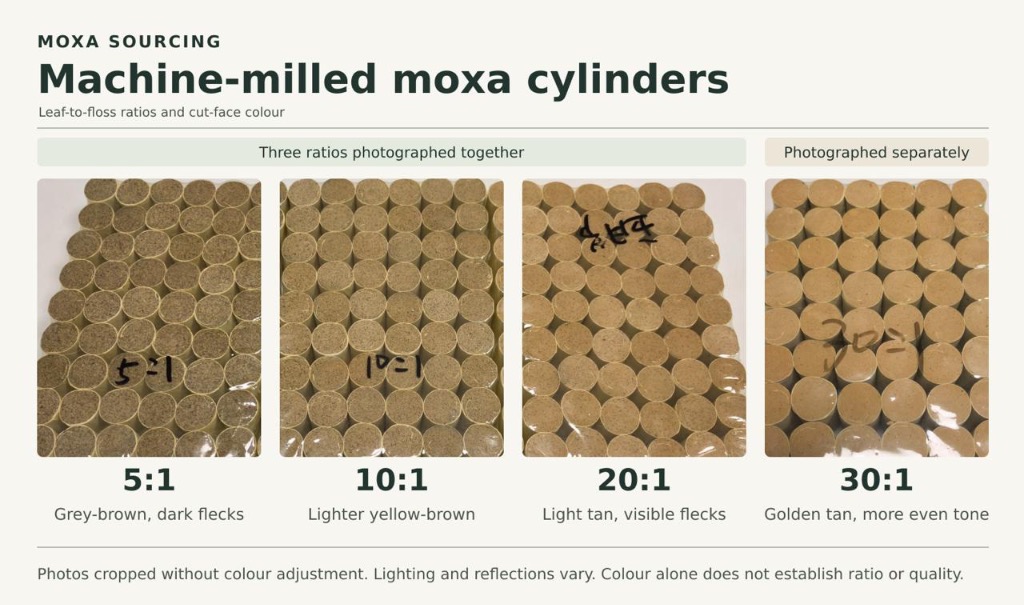
- Raw-leaf mass scales linearly with ratio: Producing 100 kg of finished moxa wool requires 500 kg of dry leaf at 5:1, 1,500 kg at 15:1, and 3,000 kg at 30:1 (before any unrecovered forming loss). Raw leaf input alone doubles from 15:1 to 30:1.
- The refining-fee denominator trap: Always verify whether a factory’s processing quote is charged per kg of mill input, per kg of usable wool output, or as a flat batch fee. At 10:1, 12 CNY per input kg equals 120 CNY per finished wool kg—a 10× difference from 12 CNY per output kg.
- Honest by-product accounting: Processing fines (艾粉) and coarse residue (艾渣) only reduce order cost if the factory actually realizes incremental net cash receipts after sorting, bagging, and selling—never assume every remaining kilogram has guaranteed resale value.
5. Layers 5–6: Delivery boundaries, volumetric weight & transparent supplier profit
Moxa products are light and bulky—meaning international freight often bills on volumetric (dimensional) weight rather than actual gross kilograms (chargeable kg = max(gross kg, volumetric kg)). Comparing an ex-factory Nanyang quote against a door-to-door DDP quote to London or Paris is comparing apples to oranges.
Finally, separating markup on production cost (which does not mark up third-party freight) from invoice margin keeps commercial negotiations clean and respectful on both sides.
Want to put two real quotes head-to-head and prevent hidden downgrades during negotiation? Read our next guide: How to Compare Two China Moxa Supplier Quotes Fairly.
Costing FAQ
What are the main cost layers inside a Chinese moxa quotation?
Six layers: net-weight specification, raw-leaf purchase/carrying cost, refining & forming loss (minus verified by-product net credit), packaging/QC/tooling/admin, delivery & import boundary, and explicit supplier profit plus payment/FX fees.
Why separate net product weight from allocated packaging weight?
Net content mass governs fair unit-price comparison (price per net kg), while gross and volumetric weight govern domestic and international shipping charges.
Why is a per-input-kg refining fee so different from a per-output-kg fee?
At a 10:1 ratio, 10 kg of input are processed per 1 kg of wool—so 12 CNY/input kg equals 120 CNY/output kg, ten times higher than 12 CNY/output kg.
Are the default figures in Moxa Product Builder binding factory quotes?
No. They are editable arithmetic examples designed for transparent scenario modeling; real quotes require sample confirmation, written specs, quantity, and agreed delivery terms.