Read Chinese enterprise-publicity records
What does a Chinese enterprise-publicity record actually tell a buyer?
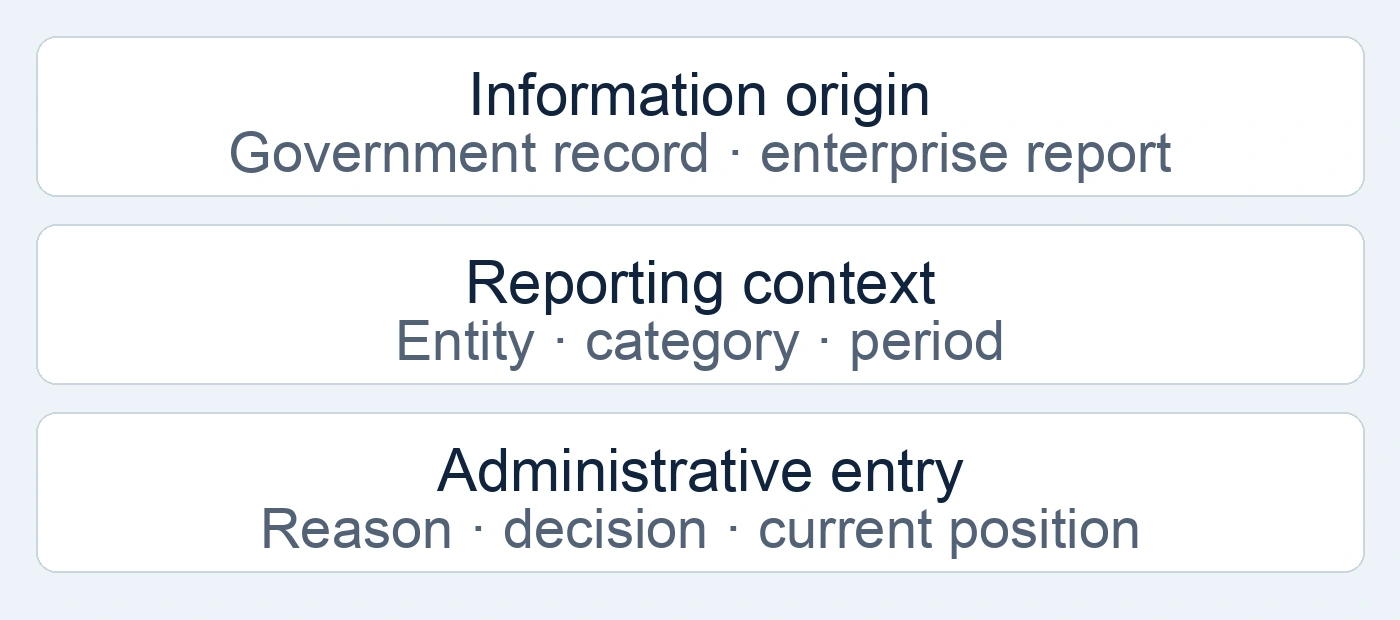
Read the information category before interpreting the record. China’s enterprise-information publicity regulations distinguish information produced by government departments from information published by enterprises themselves. Both can appear through the National Enterprise Credit Information Publicity System, but their appearance on the same platform does not make their origin identical. The buyer should note which category is being viewed, which entity it concerns and what the entry states. A registration entry, an enterprise annual report and an administrative-penalty entry answer different questions. Treat the system as a source of defined records rather than a single certificate that all aspects of a supplier have been independently approved.
Government-produced information under the published regulations includes registration and filing information, specified security-interest registrations and administrative penalties. Other government departments publish relevant licensing and penalty information, either through the enterprise-publicity system or through other systems. The practical implication is to follow the record appropriate to the question. A registration record can help establish the entity information it records; a permission or penalty needs its own issuer, subject and scope. Do not assume that every relevant departmental record will be represented by the same type of entry or that a company-registration view is a complete product or operating-permission file.
Annual reports have a reporting period. Article 8 describes reporting the preceding year’s annual report between 1 January and 30 June, while an enterprise established during the year begins reporting from the following year. For a buyer comparing a report with a proposal, identify the report year as well as the date it was obtained. A historical annual report is not a live description of every operating condition. A newly established entity may also need to be considered under the reporting timetable applicable to it rather than being criticized merely for not displaying an earlier report. Use the period to frame the next question accurately.
The annual-report fields are broader than a company name. Article 9 includes correspondence and contact information, the enterprise’s stated operating or liquidation status, investment in other enterprises, specified shareholder contribution information, equity changes and websites or online shops. These fields can help the buyer identify a relationship or inconsistency requiring clarification. They do not automatically establish the manufacturing location of a selected product or the role of every company displayed in a group catalogue. Keep the relationship being investigated explicit: the proposed seller, a related enterprise and a manufacturing operator can each require a separate match to the relevant record.
Some annual-report financial and workforce information is optional for public disclosure under Article 9. The listed category includes workforce numbers, assets, liabilities, guarantees, equity, revenue, profits and taxes. Consequently, the absence of a public figure in that optional category should not be treated as proof that the figure is zero or that the enterprise has refused a mandatory public disclosure. The regulations also describe access to information not publicly disclosed with the enterprise’s consent. For a purchasing review, identify the actual information gap and seek appropriate, authorized evidence if it is material. Do not invent revenue or capacity from a blank field.
Distinguish an annual report from event-related disclosures. Article 10 addresses enterprise publication of specified changes, including contribution and equity information, licensing, intellectual-property pledges and administrative penalties. The buyer should therefore avoid assuming that the annual-report tab is the only place where a relevant change could appear. Identify the event, the entity and the category of entry that might address it. A document collected earlier in the project may need comparison with a later applicable record. That is a question about the evidence for a particular change, not a reason to infer an undisclosed event merely because two documents look different.
Keep responsibility for the information attached to its source. Article 11 makes government departments and enterprises respectively responsible for the truthfulness and timeliness of the information they publish. An enterprise-published statement remains enterprise-published even when accessed through an official system. The regulations also provide for checks of disclosed information and publication of inspection results. Where an inspection result is relevant, read that result and its scope rather than assuming that every field has already undergone the same independent examination. A publicity record should support the claim it actually contains, not an expanded claim about every product in a catalogue.
Read corrections and differing versions with their dates. Article 12 addresses correcting inaccurate information and provides for displaying the information before and after correction in enterprise annual-report publicity. For the buyer, a difference can therefore require attention to chronology and the recorded correction, rather than choosing whichever version looks more impressive. Establish whether the records concern the same entity, reporting period and information category. Ask for an explanation of a material unresolved difference and retain the relevant versions privately. A corrected contact or report field does not by itself establish either product conformity or a history of dishonest conduct.
Use the result to close an identity or information question, then continue the product-specific review. The registration and disclosure framework is useful precisely because it separates entities, reporting periods and types of information. It should not be asked to establish sample quality, current production availability or suitability for an overseas sales claim. Record which factual question has been answered and which one still needs another source. Exact supplier names, identifiers, addresses, contact details and original screenshots remain in the authorized private purchasing file; public explanations can describe the method without publishing the selected supplier’s identifying records.
How should a buyer interpret an abnormal-operations entry?
Read the reason for inclusion rather than treating the list’s name as a complete explanation. SAMR’s consolidated measures published in November 2025 describe the abnormal-operations list as an administrative publicity mechanism. The stated grounds include failure to publish an annual report within the prescribed period, failure to publish specified information within the required period after an order to do so, failure to make a required enterprise-name change and inability to contact the enterprise through its registered domicile or business premises. Those are different recorded circumstances. The buyer needs the applicable reason and the supporting entry before deciding what question the record raises for the proposed purchase.
Match the decision to the enterprise. Article 5 specifies the enterprise name, Unified Social Credit Code, inclusion date, reason and deciding authority as contents of the inclusion decision. These fields help distinguish the entry from another company with a similar translated name or related brand. Keep the exact record in the private file and compare it with the proposed counterparty information. A search-result snippet or a copied warning icon is less informative than the underlying dated decision. Do not attribute an entry to a manufacturer, seller or group company merely because a similar marketing name appears on its catalogue.
An annual-report issue asks a different question from an address-contact issue. In the former case, the relevant enquiry concerns the missing report, its year and the current recorded position. In the latter, it concerns the ability to contact the enterprise through the registered location and the current evidence addressing that issue. Neither reason alone states what a selected physical sample will do. Equally, a satisfactory sample does not resolve an identity or contact problem recorded against the contracting entity. Keep the issue tied to the commitment it could affect rather than allowing unrelated positive evidence to replace the needed clarification.
A name-change issue also requires its actual recorded context. The amended measures include failure to complete a required enterprise-name change as a possible ground. The buyer should therefore not assume that every abnormal-operations entry concerns missing financial information or a failed product test. Obtain the actual reason and compare the identity and current documents relevant to the proposed agreement. If the names differ, establish which entity the documents concern and what evidence explains the difference. The method is to clarify the record; it does not authorize the buyer to rewrite another party’s legal name or treat an unresolved relationship as established.
Read removal as a separate recorded decision. Article 10 provides for a removal decision, specifies its information and states that publicity of the corresponding inclusion information stops. Article 11 describes circumstances in which the enterprise may apply for removal after addressing the relevant issue. A supplier’s statement that it has submitted materials is therefore different from evidence of the resulting decision and current public position. Use the actual record available for the relevant date. An old screenshot may no longer describe the current display, while a missing historical entry is not enough by itself to reconstruct the complete earlier sequence.
An objection or dispute should not be silently treated as a completed correction. The measures provide routes for objection, correction of erroneous inclusion and administrative review or litigation. For a purchasing file, distinguish the existence of a challenge from its outcome, and seek the relevant current record if the issue matters to the proposed commitment. Do not present a disputed entry as an adjudicated finding beyond its stated scope. Do not present the supplier’s disagreement as proof that the public entry has already been removed. Preserve the evidence and uncertainty until the applicable question can be resolved.
Translate the administrative term accurately. An abnormal-operations entry is not automatically a criminal-fraud finding, a declaration that every product is defective or proof that the enterprise has stopped all activity. Those conclusions require their own evidence. The entry can still be material: its actual reason may affect the reliability of entity information or the ability to reach the counterparty. The buyer should identify that relevance and the evidence needed next. A neutral, scoped account of the record is more useful than either an unsupported accusation or an unexplained assurance that the issue is harmless.
FAQ
What does a Chinese enterprise-publicity record actually tell a buyer?
Read the information category before interpreting the record. China’s enterprise-information publicity regulations distinguish information produced by government departments from information published by enterprises themselves. Both can appear through the National Enterprise Credit Information Publicity System, but their appearance on the same platform does not make their origin identical. The buyer should note which category is being viewed, which entity it concerns and what the entry states. A registration entry, an enterprise annual report and an administrative-penalty entry answer different questions. Treat the system as a source of defined records rather than a single certificate that all aspects of a supplier have been independently approved.
How should a buyer interpret an abnormal-operations entry?
Read the reason for inclusion rather than treating the list’s name as a complete explanation. SAMR’s consolidated measures published in November 2025 describe the abnormal-operations list as an administrative publicity mechanism. The stated grounds include failure to publish an annual report within the prescribed period, failure to publish specified information within the required period after an order to do so, failure to make a required enterprise-name change and inability to contact the enterprise through its registered domicile or business premises. Those are different recorded circumstances. The buyer needs the applicable reason and the supporting entry before deciding what question the record raises for the proposed purchase.