Check management-system certificates
Document and authority
Begin by identifying the kind of certificate being presented. A management-system certificate concerns the system within its stated scope; it should not be silently treated as a certificate approving every finished product. IAF CertSearch describes its database as covering accredited management-system certification, rather than product certification or certification of persons. That coverage matters when choosing a verification route. If the document presented belongs to another kind of certification, establish the appropriate issuer and verification method for that document. A familiar standards name or logo is insufficient to establish which claim the supplier is actually making.
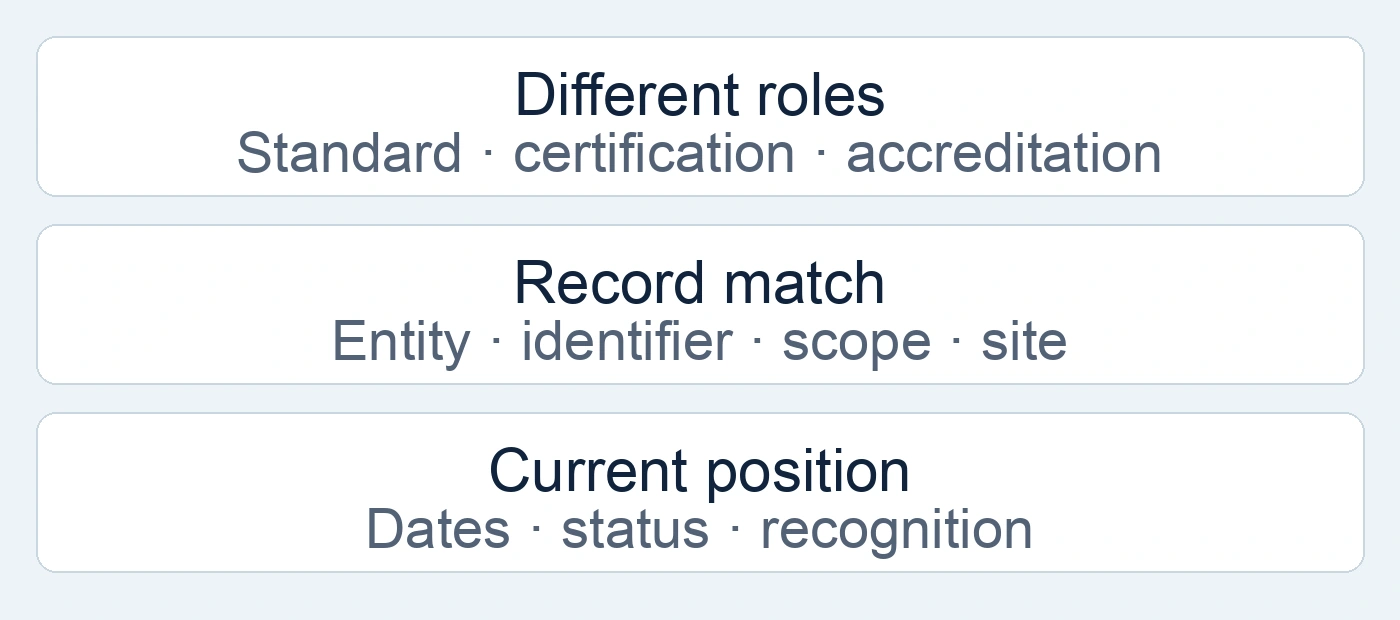
Separate the standard, the certification body and the accreditation body. They perform different roles. ISO develops standards and does not itself certify companies; an external body issues the certification. Accreditation concerns the competence of the certification body within the applicable scope. In a buyer’s check, identify the issuing body and the accreditation arrangement being claimed rather than treating several logos as interchangeable authorities. The enquiry should follow the relevant certificate and its issuer. An accreditation claim adds another relationship to examine; it does not convert management-system evidence into a test result for the chosen product.
Start the search with the known certificate or certified organization. The CertSearch service describes exact certificate-number searching and company-name searching followed by selection of the relevant certificate. Use the complete identifier when available and compare the returned entity with the document being reviewed. A result for another company with a similar English name does not close the check. If searching by name produces several possible records, resolve which one belongs to the proposed supplier before relying on a status or scope. Keep the original certificate and the matched record together in the private purchasing file.
Identity, scope and dates
Keep database identifiers distinct from legal-entity identifiers. The provider’s field glossary distinguishes identifiers for the certified entity and for the certification, alongside company registration and other optional identifying fields. A certificate identifier locates a certification record; it should not be substituted for the legal name or registration identifier needed in the supplier file. Trading and English names can also appear as separate optional fields. A different display name therefore calls for a match, not an immediate assumption of either fraud or equivalence. Use the available identifiers and original documents to establish the relationship.
Compare the activities and locations actually covered. The glossary separates a business registered address from main-site information and describes the certification scope separately from the standard or scheme. A headquarters address on an entity profile does not by itself establish that the proposed manufacturing operation is covered. Read the relevant scope and site information and compare them with the work being proposed. If the relationship is unclear, ask for the applicable certificate or confirmation from the appropriate body. A broad catalogue, a group-company connection or geographic proximity should not be used to fill an unidentified gap in scope.
Read dates as different fields. Provider documentation distinguishes the original issue date, the issue date and the expiry date. Record the date labels that are actually present rather than turning one visible date into an unqualified claim about the company’s entire operating history. An original certification date is not the same field as a company-establishment date. An expiry date also does not replace the current-status check. When comparing documents collected at different times, retain the relevant certificate identifier, dates and current result so that the basis of the purchasing assessment can be understood.
Status and recognition
Check the status in addition to the printed validity period. The provider describes an active, up-to-date record as part of confirming validity. Its status documentation separately identifies suspended, cancelled, withdrawn and expired records, alongside other data states. Those terms should not be collapsed into ‘certificate held’ merely because a PDF has a future end date. Read the displayed status and obtain clarification of a material inconsistency through the relevant body. Do not invent a reason for suspension or cancellation from the label alone, and do not treat a certificate-status issue as evidence of a particular product defect.
A missing search result leaves a question to resolve. The provider’s documentation distinguishes data states that are publicly searchable from states that are not, and its stated coverage is limited to the certifications the service covers. Check the search identifier and document type before drawing a conclusion. Where the result remains unresolved, verification can be pursued with the relevant certification or accreditation body. Record that the check is unresolved until suitable evidence is obtained. This approach neither declares an absent record valid nor treats absence from a search as sufficient proof that a supplier has fabricated a certificate.
Account for current recognition arrangements when examining accreditation documents. Global ACI’s 2026 FAQ explains that permitted transition use of the former IAF MLA or ILAC MRA marks can continue on accreditation certificates, within the approved arrangements and recognition scopes. An old mark on such a document is therefore not, by itself, a sufficient authenticity test. This point concerns the accreditation-document transition described by the official FAQ; it does not grant general permission to reuse logos or establish that any selected supplier’s certification is valid. Follow the applicable record, scope and current recognition information.
Close the check at the level the evidence supports. Record the matched organization, document identifier, relevant standard or scheme, scope, site, status, dates and verification route. State any material point still requiring confirmation. Then keep product composition, sample acceptance, batch performance and destination-market decisions in their respective records. A positive management-system certificate check can answer the defined certification question while leaving those product questions open. Public material should describe the method and relevant evidence scope without reproducing a supplier’s identifying certificate or presenting its marks as a catalogue-wide badge.
FAQ
How do you check a management-system certificate without turning it into product approval?
Begin by identifying the kind of certificate being presented. A management-system certificate concerns the system within its stated scope; it should not be silently treated as a certificate approving every finished product. IAF CertSearch describes its database as covering accredited management-system certification, rather than product certification or certification of persons. That coverage matters when choosing a verification route. If the document presented belongs to another kind of certification, establish the appropriate issuer and verification method for that document. A familiar standards name or logo is insufficient to establish which claim the supplier is actually making.
Which findings should the certificate check record?
Close the check at the level the evidence supports. Record the matched organization, document identifier, relevant standard or scheme, scope, site, status, dates and verification route. State any material point still requiring confirmation. Then keep product composition, sample acceptance, batch performance and destination-market decisions in their respective records. A positive management-system certificate check can answer the defined certification question while leaving those product questions open. Public material should describe the method and relevant evidence scope without reproducing a supplier’s identifying certificate or presenting its marks as a catalogue-wide badge.
Sources and scope
- CertSearch: Certificate search service guide
- CertSearch: Certification Fields Glossary
- CertSearch: Certification Status documentation
- CertSearch: General FAQ, selected operational and database-scope sections
- Global ACI: FAQ on transition marking of accreditation certificates (2026)
- ISO: Certification overview, roles and verification routes