Use a mugwort product brief template to define format, samples, packaging, evidence, shipping and responsibilities before RFQ, trial order or private label.
A useful brief lowers friction; it does not turn every new inquiry into a consulting sale. For mature product platforms such as pure or carbonized moxa rolls, stick-on units and bamboo moxa boxes, the first commercial route can be simple: clarify the requirement, confirm sample cost and actual courier, evaluate the right version, and decide whether to proceed to a trial order. Complex private-label or custom development should be separated and scoped only when the work actually requires it.
This guide provides the buyer-facing structure behind the proposed Mugwort Product Evaluation & Sample Program. It is a procurement article and template, not a public price list or a statement that sample-fee credits are already available.
Use the Request a Quote page when you are ready to submit a reference and request the working documents. This article owns the detailed procurement method; the RFQ captures the concise intake. The separate Product Evaluation & Sample Plan landing page is not linked here until it is publicly available.
What should a mugwort product brief decide first?
Start with the commercial decision, not a factory catalog. Record the buyer type, destination, channel and intended product job. A specialist distributor may need repeatable pack formats and replenishment. A clinic group may be comparing smoke, ash, holder fit or staff handling. A private-label brand may need an English pack and claim-safe positioning. Those are different briefs even when the supplier shows the same product.
The brief should also identify the exact product format.
Moxa roll can refer to a traditional roll, a carbonized
stick or another construction. Stick-on moxa does not
define the base, unit dimensions, ventilation, inner count or
instructions. Bamboo moxa box does not define the opening,
retainer, screen, lid, strap or compatible consumable. The mugwort product
taxonomy can help separate category names before the buyer selects a
reference.
Use this minimum intake table:
| Brief block | Buyer provides or confirms | Supplier or coordinator resolves | Decision enabled |
|---|---|---|---|
| Buyer and market | country, buyer type, channel, intended use | missing-data questions | relevant route and owner |
| Product identity | format, reference photo/SKU, must-have attributes | candidate identity and source record | sample scope |
| Specification | size, weight, count, construction priorities | measurement method and available tolerances | comparable RFQ |
| Packaging | neutral, label, box, insert, language, barcode | component route and separate MOQs | sample and pack plan |
| Claims and documents | proposed wording, prohibited wording, requested records | evidence status and responsibility gaps | hold or market review |
| Commercial scope | sample/trial quantity, timing, target price or budget, must-keep and adjustable fields | current MOQ, fees and lead-time basis | trial-order route |
| Logistics | destination, courier account or preference | packed dimensions, gross weight and options | actual courier quote |
Unknown fields should stay visible. Do not fill an importer, classification, formula, warning or certificate field by copying another brand’s page.
If a buyer has a target price, record it as a decision constraint, not an instruction to copy a lower quote. Keep the product identity, reference unit, quantity, Incoterm, pack and included services comparable. State what can change—such as material grade, pack components, order quantity or lead time—and what cannot: product safety, truthful claims, prohibited-material controls, target-market requirements and agreed critical specifications. A material change creates a new specification or packaging version and may require a new sample.
How does the brief become a sample plan?
The sample plan translates questions into physical units and recorded decisions. It should identify the sample state, supplier, proposed manufacturer where known, SKU or version, quantity, packaging state, receipt date and intended comparison.
Separate five sample states:
- Catalog or stock reference: useful for an early direction, but not necessarily production representative.
- Appearance or packaging mock-up: useful for visual and fit decisions, but not for product performance or shelf-life claims.
- Functional or formula sample: useful for a defined observation under a recorded method.
- Pre-production sample: proposed materials, process, product and pack before release.
- Retained approved sample: a coded physical reference connected to the written specification.
For each planned check, state the question, sample count, method, result field, decision owner and next action. Use the same recorded evidence framework only after the brief has made the candidates comparable; a scorecard is not a substitute for the brief.
Which fields change across the three first-test product platforms?
The common template needs product-specific branches. Moxa Sourcing’s first commercial test uses three platforms, not an unrestricted catalog.
Pure and smokeless moxa rolls
For the pure moxa roll reference, MB2B-0001 / supplier SKU AT10030 currently records a 3:1 supplier grade, 18 × 200 mm, 10 rolls per box and 100 boxes per carton. These are supplier-catalog fields, not approved export measurements or current MOQ.
For the smokeless moxa-stick reference, MB2B-0002 is tied to the public GreenYing offer 626007826301. The source identifies a gold-powder smokeless format; exact dimensions, pack, export specification and performance remain sample-required.
The brief should choose traditional, carbonized or both. The sample
plan can then record diameter and length, unit weight, wrapping, density
proxy, ignition, timed burning, ash, visible smoke or odor observations,
holder fit, inner pack and retail pack. Do not rank the two products
without traceable samples reviewed under the same stated conditions.
Smokeless is a format name, not a guarantee of zero smoke,
zero odor or suitability for every indoor environment.
Stick-on moxa units
The stick-on moxa reference MB2B-0003 / AT90152 records approximately 8 × 35 mm and 50 units per box in the source catalog. The brief should identify the unit structure, base, intended application context, inner protection, retail count, instructions and private-label scope.
The sample plan should record multiple-unit dimensions and weight,
base construction, attachment and removal observations under named
conditions, ventilation structure, pack seal, instruction consistency
and any residue or visible damage. These are proposed checks, not
results for AT90152. No hypoallergenic, medical outcome or
absolute-safety wording belongs in the brief without exact-product
evidence and market review.
Bamboo or wood moxa boxes
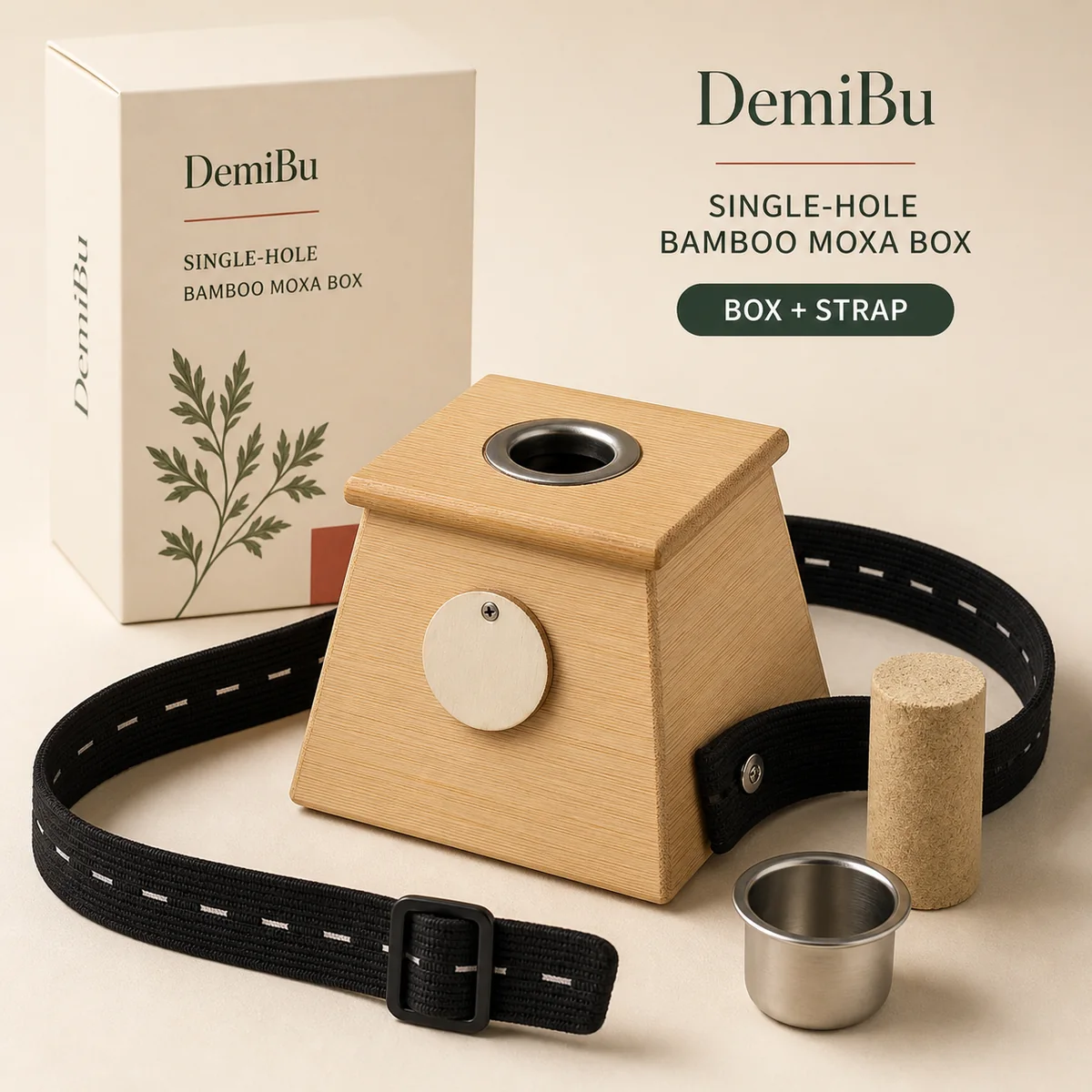
The single-hole bamboo moxa-box reference MB2B-0031 / JQ30099 currently records bamboo, a box and black strap, and 100 units per carton as supplier information. The product brief must connect the box to a named consumable rather than using a generic compatibility promise.
The sample plan should cover outer and chamber dimensions, opening or
retainer, screen, lid, strap, surface, edges, component count, named
roll diameter, insertion and retention, ash path, cooling, cleaning and
protective packaging. A hole count does not prove compatibility. Until a
box and consumable are matched, the project remains an evaluation route,
not a clinic-ready kit.
What should buyers pay for at the sample stage?
For a mature reference product, the low-friction operating hypothesis is that the buyer pays the actual sample cost and actual courier. It is not a promise that every sample is free, and it does not include testing, artwork, packaging prototypes or regulatory work unless those items are separately scoped.
Ask for a dated breakdown:
| Cost line | Basic sample route | Complex development route |
|---|---|---|
| Product sample | exact current sample cost | prototypes and revisions by approved scope |
| Domestic movement | actual supplier-to-consolidation cost | multi-supplier or specialist movement |
| International courier | actual packed shipment quote | route chosen for the development plan |
| Packaging | existing neutral pack if available | label, box, insert, tooling or mock-up costs |
| Testing or inspection | not assumed | selected laboratory or inspection scope |
| Coordination | ordinary clarification and sample route | scoped development deposit or Sample-to-Spec |
Do not publish a fixed price before product, destination, packed weight, service work and payment route are known. DHL’s official chargeable-weight guidance, accessed 2026-09-06, explains that carriers compare actual and volumetric weight and may charge the greater figure; ratios vary by mode, location and carrier. A courier estimate therefore needs the packed dimensions, gross weight, package count, destination and selected service.
A sample-fee credit after an agreed first order is only a commercial hypothesis. Before it appears in buyer copy, define the qualifying order, creditable cost lines, maximum credit, time limit, SKU changes, canceled projects and accounting treatment. International courier, testing and third-party costs should not be silently promised as refundable.
When should the project move to scoped development?
A basic sample route is not adequate when the buyer requests material, formula, structure, adhesive, dimensions, critical component or packaging-system changes. It may also be inadequate when several factories must follow one complex specification, or when laboratory, regulatory, artwork, inspection and logistics parties require coordinated deliverables.
Use a scoped development deposit or Sample-to-Spec route when the project includes:
- custom structure, formula, material or component work;
- several packaging prototypes or artwork rounds;
- multi-supplier development against one controlled brief;
- a custom kit with interface testing between products;
- a target-market document or claim review requiring qualified support;
- repeated changes beyond ordinary sample clarification.
The scope should name deliverables, revision rounds, third-party pass-through costs, cancellation, confidentiality, sample ownership and the gate into production. The deposit pays for defined work; it should not disguise a routine product quotation.
How should claims, classification and market responsibility appear?
The brief needs a proposed-claims field even when the initial copy is non-medical. The U.S. FTC’s Health Products Compliance Guidance, accessed 2026-09-06, explains that advertising must be truthful and not misleading and that objective claims need substantiation before dissemination. It also treats packaging, websites, social content and materials passed through intermediaries as marketing contexts.
That source does not decide the classification of a mugwort SKU. It supports a procurement rule: list express and implied claims early, remove unsupported treatment, safety and efficacy wording, and assign the remaining market decision to the buyer or importer with qualified support.
For EU consumer products within its scope, Regulation (EU) 2023/988, accessed 2026-09-06, includes safety, traceability, economic-operator and distance-sales information requirements. A brief for the EU should therefore collect product identification, manufacturer and responsible economic-operator information, warnings and traceability fields early. Product-specific legislation may also apply, so GPSR is not a universal classification answer.
The classification-before-claims guide explains the wider responsibility split. The supplier provides truthful product and manufacturing information; Moxa Sourcing coordinates the brief, samples and agreed China-side services; the buyer or importer confirms destination classification, label, claims, registration, importer details and market release.
When is the brief ready for an RFQ and trial order?
The brief is ready for a comparable RFQ when each field is marked
confirmed, supplier response required,
sample-required or buyer-market decision. Send
the same controlled version to each candidate supplier. Ask each
quotation to state the quote date, currency, price unit and sellable
pack, quantity/MOQ, tax status, Incoterm, included and excluded services,
carton assumptions, lead time and validity. Compare only like-for-like
versions.
After evaluation, the selected configuration moves into the approved-sample-to-bulk workflow. The coded sample, written specification, packaging BOM, artwork and open market decisions should be frozen before the trial order is released.
ISO 2859-1:2026, accessed 2026-09-06, describes AQL-indexed sampling schemes for lot-by-lot inspection by attributes. That is a later batch-acceptance control; it does not select a development sample. Buyers should first approve the product reference and specification, then define order-specific defects, sampling and acceptance rules.
The production file should retain supplier statements, measurements, sample observations, quotations and approvals separately. The quality and supply network describes how evidence and inspection connect without implying that every supplier or SKU is already verified.
Which results should the two-week commercial test measure?
Do not measure this content only by page views. Track whether named buyers request the Product Brief or Sample Plan, provide enough information to create a sample route, accept actual sample and courier costs, review the samples, and proceed toward a trial order.
The minimum Lead record should include buyer type, target market, channel, product platform, sample needed, packaging scope, proposed claims, sample status and next gate. A complex development opportunity can add paid-entry status; a routine product-sample lead should not be mislabeled as a consulting prospect.
Useful test signals are:
- Product Brief or Sample Plan requests;
- briefs complete enough for a sample route;
- buyers accepting actual sample and courier costs;
- samples sent, held, rejected, re-sampled or approved;
- trial-order discussions and replenishment questions;
- repeated missing fields that should update this page;
- complex projects willing to discuss a scoped development deposit.
Sources and evidence notes
Public sources help frame terminology, specifications and buyer questions. They do not prove that every factory, formula or destination-market requirement is identical.
- [1]ISO 2859-1:2026 — Sampling procedures for inspection by attributesInternational Organization for Standardization · industry · accessed 2026-09-06
Official current standard page used narrowly to distinguish AQL-indexed lot inspection from development-sample selection; protected tables are not reproduced.
- [2]Health Products Compliance GuidanceU.S. Federal Trade Commission · regulator · accessed 2026-09-06
Official U.S. advertising guidance supporting truthful, non-misleading and substantiated express or implied claims; it does not classify a mugwort product.
- [3]Regulation (EU) 2023/988 on general product safetyEuropean Union · regulator · accessed 2026-09-06
Official EU legal text used for product identification, traceability, economic-operator and distance-sales planning where applicable.
- [4]Calculating Chargeable WeightDHL · industry · accessed 2026-09-06
Official carrier guidance showing that actual and volumetric weight affect chargeable weight and that ratios vary; it is not a project quotation.
How this guide was prepared
Moxa Sourcing Editorial Team
The team translates supplier references, product samples and China-side sourcing workflows into practical English guidance for overseas buyers.
Moxa Sourcing Supply Review Team
The review team checks supplier attribution, commercial boundaries, product specifications and statements that require sample or market-specific verification.
Product availability, MOQ, price and production specifications are reconfirmed against the selected supplier reference. The buyer / importer remains responsible for destination classification, registration, final claims and customs clearance.