Configuration Control: Approved Product Baselines
NASA describes five configuration-management elements: planning, identification, change management, status accounting and verification.
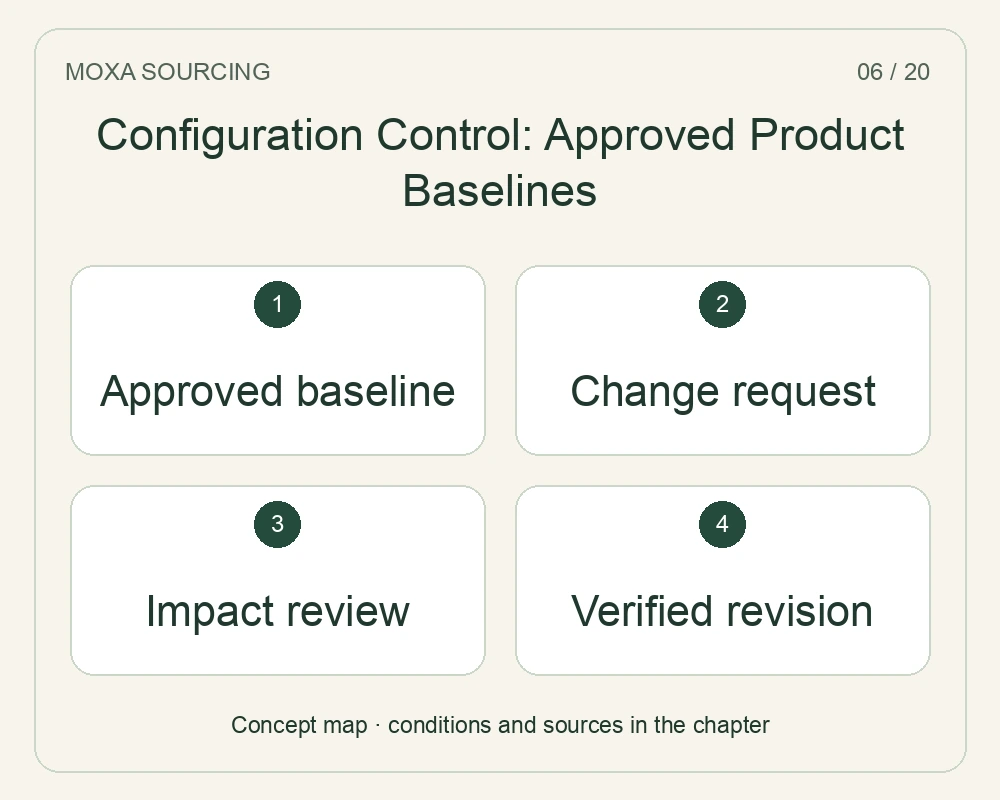
| Evidence or term | What it means here |
|---|---|
| Change approval | Authorization to alter the controlled baseline. |
| Implementation verification | Evidence that the authorized change was carried out correctly. |
| Configuration audit | Comparison of the product and its records with the applicable baseline. |
What does the evidence explain?
What work is missing if version control only means renaming files?
NASA describes five configuration-management elements: planning, identification, change management, status accounting and verification. They perform different work. Identification establishes what is controlled; change management governs proposed modifications; status accounting preserves what happened to each proposal and configuration; verification checks the relationship between the actual product and its documentation. A new filename performs none of these functions by itself.
The source treats configuration management as a life-cycle discipline that keeps approved attributes, the product and the information used by participants consistent. In a commercial sample-to-production file, the practical adaptation is to define a small set of controlled objects and responsibilities. The project need not imitate NASA’s organizational structure. It does need to distinguish an approved record from a working draft and a documented change from an unexplained replacement. The method provides visibility and control; citing it is not proof that a supplier has implemented it.
What should a configuration plan communicate inside and outside the project?
The handbook gives the configuration plan both an internal and an external role. Internally it guides and monitors the management activities and their timing. Externally it tells contractors how controlled information and changes will be handled. The plan may stand alone or be combined with other project planning documents. Its purpose does not depend on creating a separate large manual.
For an adapted sourcing project, explain how a baseline is created, who approves a technical change, how the parties receive released information and how the final product-document match is checked. A supplier and buyer using different assumptions about approval can each believe they followed the process while working from different versions. Communicating the rules before a change occurs addresses that risk. The document should describe the actual agreed workflow; an impressive generic procedure that nobody uses does not establish configuration control.
Why do a controlled product and its documents both need identifiers?
Configuration identification selects the items under control and the documentation associated with each item. NASA calls for unique identifiers for both the items and their documents, a defined change authority, released documentation and established baselines. Identifying only a document leaves the physical object ambiguous; identifying only the object leaves its governing information ambiguous.
An adapted record can therefore connect the product or component identifier to the exact specification, drawing, artwork or other controlled file that defines it. The connection should state the released revision rather than rely on “latest version.” Different participants may possess different files with that description. If a component is common to several configurations, identify which configurations use it before approving a change. That relationship supports impact review without assuming that a change relevant to one order is automatically suitable for all other orders.
What does an approved baseline establish at a point in time?
A baseline is an agreed and documented description of the controlled item’s attributes at a point in time. The current approved baseline supplies the basis against which a proposed change is evaluated. NASA describes several baselines across design and deployment, each with a different purpose. They are not simply successive filenames for the same undifferentiated information.
For a commercial adaptation, distinguish the performance expected, the detailed configuration released for production and the configuration actually delivered. A production definition can include form, fit, function and selected acceptance requirements. The delivered record should incorporate the changes that actually took effect. These distinctions help answer whether a shipment differs from the original concept, the production release or a later authorized modification. NASA’s phase names and review milestones are not imposed on the sourcing project; the useful principle is to identify which agreed state is being compared.
Why is approval of a change different from verification of its implementation?
The source describes a sequence of proposing, justifying and evaluating changes, incorporating approved changes, and verifying their implementation. Approval is therefore one stage, not evidence that every affected file and item has been updated. A change can be approved but not yet applied, partly applied, or applied differently from the approved description.
The adapted change record should preserve those states. Connect the decision to the released documents and the product configuration on which the change was implemented. Then retain the evidence that the implementation matches the decision. This is particularly important when a drawing, component order and finished product are updated at different times. “Approved” should describe the authorization; “implemented” should describe the actual state; and the verification result should show whether the two correspond. Keeping these distinctions prevents an email approval from being mistaken for proof about a delivered batch.
Why can a small-looking change need several affected parties to review it?
NASA distinguishes major and minor changes by their effects, not by how many words change in a document. A major change can affect the baseline specification, safety, cost, delivered items, compatibility or training. Its description of a minor change excludes an effect on interchangeability. A short revision can therefore have a substantial technical consequence.
The source specifically calls for changes affecting external interfaces to be coordinated and approved by affected stakeholders. Adapted to an assembled commercial product, a change to one component can affect its mating parts or the completed configuration even if the component’s name is unchanged. Record the interface affected and the parties responsible for the connected items. Do not label a change minor solely because it looks small or because the supplier considers it convenient. The NASA classification is a method reference; the actual order must define its own agreed change authority and scope.
Does an authorized exception rewrite the baseline automatically?
In the NASA configuration-management description, a waiver is a documented agreement releasing the project from meeting a requirement, and an authorized waiver does not itself change the baseline. Some organizations use different terminology before and after implementation. The important record distinction is between changing the requirement and authorizing a defined departure from it.
For a commercial order, record the exception’s affected product, quantity or lot, condition and approving authority. Keep the continuing specification separate unless a specification change is also approved. The source principle does not make contractual or legal obligations waivable by any reviewer. It helps prevent a limited concession from silently becoming the standard for future shipments. When reviewing a later order, the baseline and any applicable exception should both be available, with their scopes clear.
What should a configuration-status record preserve beyond the latest file?
Configuration status accounting records and reports the information needed to manage controlled items. NASA includes current and historical documentation and identifiers, the progress of proposed changes and exceptions from initiation to implementation, and the status and disposition of discrepancies and audit actions. A folder containing only the latest drawing cannot show this history.
A useful adapted record can answer which revision was current when an order was released, what change was proposed, whether it was approved, whether it took effect, and what discrepancy remained open. Historical traceability supports later investigation of differences between deliveries without guessing from modification dates. Preserve rejected and superseded decisions as history rather than confusing them with the released instruction. This is a record function; it does not require purchasing new software or creating a separate administrative system for every sample.
What does a configuration audit compare?
NASA describes configuration verification through inspection of documents, products and records, together with review of the relevant procedures and operations. It asks both whether the product has the required performance and functional attributes and whether its design is documented. Functional and physical configuration audits may be distinguished. The work is broader than checking whether a folder contains a document with the right title.
For the adapted specification workflow, compare the actual item with its released description and compare the description with the approved requirements. If they disagree, identify which object needs correction rather than changing both silently to make them appear consistent. An audit result should retain discrepancies and corrective actions. It is evidence about the configuration examined, not a universal supplier certification. Separate a review of documentation completeness from evidence that the actual manufactured configuration corresponds to those documents.
What information controls matter when several parties exchange revisions?
Among the source’s considerations for configuration-support software are secure information sharing, version comparison, checkout and check-in, tracking who changed an item and when, workflow, supplier compatibility, migration support and a single source of released information. The underlying issue is controlled access to a consistent released state. These are capabilities to evaluate, not proof that a particular software brand is necessary.
For a small sourcing project, the same functions can be assessed in the existing document route before choosing additional tools. Can the recipient identify the released revision? Can a proposed edit be distinguished from an approved instruction? Is the earlier state recoverable, and is the decision history accessible to authorized participants? These questions concern the reliability of the information exchange. They do not authorize publishing private supplier mappings or give every participant access to all project files. The controlled release should distribute the information needed for the agreed task.
FAQ
What work is missing if version control only means renaming files?
NASA describes five configuration-management elements: planning, identification, change management, status accounting and verification. They perform different work. Identification establishes what is controlled; change management governs proposed modifications; status accounting preserves what happened to each proposal and configuration; verification checks the relationship between the actual product and its documentation. A new filename performs none of these functions by itself.
What information controls matter when several parties exchange revisions?
Among the source’s considerations for configuration-support software are secure information sharing, version comparison, checkout and check-in, tracking who changed an item and when, workflow, supplier compatibility, migration support and a single source of released information. The underlying issue is controlled access to a consistent released state. These are capabilities to evaluate, not proof that a particular software brand is necessary.
Sources and scope
Source: NASA Systems Engineering Handbook 6.5, paraphrased for general configuration and change-record methods. NASA phase reviews, flight baselines, boards and agency-specific standards are not adopted as sector requirements. An exception remains subject to the actual order authority and applicable obligations. No NASA endorsement or audited supplier process is claimed. NASA configuration management