Gauge Studies: Repetitions, Operators and Time
A gauge study investigates the measuring system, rather than treating every difference between readings as a difference between products.
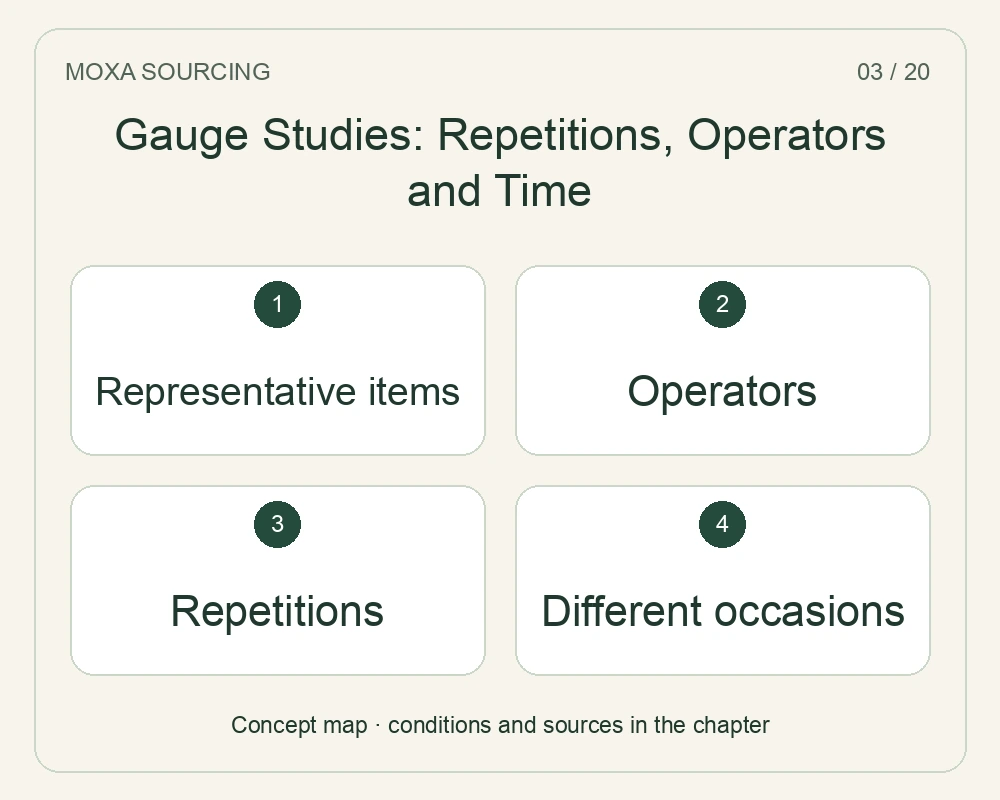
| Evidence or term | What it means here |
|---|---|
| Immediate repetitions | Short-term behavior under the specified repeated-reading conditions. |
| Operator comparison | Differences associated with the operators included in the study. |
| Measurements across occasions | Variation that an immediate repetition sequence may not represent. |
What does the evidence explain?
Which measurement differences should a gauge study investigate?
A gauge study investigates the measuring system, rather than treating every difference between readings as a difference between products. NIST identifies repeatability, reproducibility, stability and bias as the basic issues. It also asks whether instruments have different precision, whether instruments or operators in the same environment produce equivalent results, and whether a gauge responds differently after a change in geometry, configuration or setup. These questions separate several possible reasons why two inspection sheets disagree.
For a sample-comparison project, state which of those questions the study is intended to answer. A study of several operators using one instrument does not automatically answer whether two instrument models agree. A short sequence on one setup does not establish behavior after configuration changes. The result should name the tested instruments, operators, conditions and configurations. “Measurement checked” is too broad to show which source of disagreement was investigated. This is a way to interpret and scope measurement evidence, not a claim that a gauge study has already been performed for a listed product.
How should check items represent the measurements being compared?
The study’s artifacts are check standards or test items of the kind normally measured by the gauges. NIST notes that an instrument with several response or parameter levels may need check standards at different levels. Choosing only one convenient item can leave the relevant measurement range unrepresented. The study record should explain the relationship between the selected check items and the measurements the production team actually makes.
NIST’s design discussion specifies more than two artifacts for its study design and treats the check standards as needed for the limited study period. These are measurement-study design choices, not an instruction to inspect three saleable units or a rule for accepting a production lot. Keep the two quantities distinct: study artifacts characterize the measurement process, while an order’s sampling plan selects product units for a disposition decision. The check items should remain identified throughout the study so that differences associated with an item are not silently mixed with differences associated with a gauge or date.
Who should take part in an operator comparison?
NIST recommends trained, experienced operators for the gauge study. Where only a small number are familiar with the gauges, its design includes all of them. Where the intention is to represent a much larger pool, it calls for a random sample of more than two operators. If only one operator is available for the gauge type, the alternative described is measurement over more than two days. These arrangements investigate different sources of variability; they are not interchangeable labels for the same evidence.
A single operator working on several days supplies information about behavior across those days, but not a direct comparison among several operators. Likewise, a study deliberately limited to experienced users should not be described as evidence that untrained staff will obtain equivalent results. For a sourcing comparison, identify the actual user group and the measurement task the study represents. If the supplier and buyer use different operators or procedures, preserve that difference in the comparison instead of merging the results under one anonymous “QC measurement” column.
Why should an initial gauge study limit configurations and levels?
The handbook distinguishes studying a small known set of gauges from representing a large population. It includes all gauges when only a few exist, and describes a random selection of more than three when a larger pool is to be represented. It also recommends beginning at one or two parameter levels and one or two configurations before enlarging a study where instruments have several operating choices. This limits the initial problem while preserving a stated scope.
The scope limit must remain visible in the conclusion. Evidence at one parameter level does not establish equivalence over every level, and evidence for one fixture or configuration does not establish equivalence after a setup change. A later extension should identify the additional conditions tested rather than simply replacing the original date. For sample approval, this helps explain why a measurement method should name its configuration. A claim that “the same instrument was used” can still hide a material difference in the way it was set up or operated.
Why are immediate repetitions different from measurements over days or months?
NIST separates three time-related levels in its measurement study discussion. Level one uses measurements over a short period to capture the gauge’s basic precision. Level two uses measurements over days, or another appropriate time increment. Level three compares runs separated by months. These intervals are examples to adapt to the actual measurement situation, rather than a universal timetable for every inspection. The purpose is to expose effects that a short consecutive series cannot show.
Repeating a reading many times in one sitting adds observations at the first level. It does not create independent evidence about how the system behaves on different days or in later runs. Preserve the grouping of repetitions within days and runs when collecting the data. The handbook indicates that two levels can characterize many systems, while a third is useful where sources of error are poorly understood or have not previously been studied. Selecting the level is part of designing the study; it should follow the uncertainty being investigated, not the desire to fill a large spreadsheet.
When can repeated-reading variability be pooled?
Repeatability describes the gauge’s basic precision. NIST computes a short-term standard deviation for each group of repetitions and recommends examining whether it depends on the check standard, operator or gauge. Its suggested graphical views compare repeatability standard deviations across check standards with day or gauge identified. If gauges differ in precision, a separate estimate for each gauge is appropriate. Combining their data without examining that difference can hide the measurement behavior the study was intended to reveal.
Where pooling is appropriate, the handbook combines weighted variances across days, runs and potentially check standards to obtain a more reliable estimate than a single short series. It does not take a simple arithmetic average of standard deviations and call that the pooled result. Each contribution is weighted by its degrees of freedom, the sums of squares and degrees of freedom are added, and the square root of their ratio gives the pooled standard deviation. Retain the grouping and repetition counts needed to understand that calculation; a column containing only overall averages cannot reconstruct it.
What does the handbook repeatability example actually illustrate?
The worked example is a resistivity measurement study, not a test on mugwort material. Its displayed subset uses one check standard and one probe, six repetitions per day, six days in each of two runs. Each daily short-term standard deviation therefore contributes five degrees of freedom. Across the twelve daily groups, the table gives sixty degrees of freedom and a sum of squares of 0.37176. The square root of 0.37176 divided by sixty is approximately 0.07871, the reported pooled repeatability standard deviation.
The useful lesson is how the repeated measurements, grouping and pooling are connected. The numeric value belongs to that study’s measured property and units. It is not a tolerance, a precision requirement or an acceptable error for a caliper, scale or product test in a sourcing project. When another report quotes a pooled precision figure, ask which individual groups contributed, how many repetitions they contain and whether combining them was justified. That information allows the calculation to be interpreted without transferring the resistivity study’s numbers to an unrelated measurement.
How is between-day behavior separated from immediate repeatability?
For the time-based design used here, NIST examines daily check-standard values averaged over the repetitions. Plotting those values against day, separately for each check standard, shows behavior that is different from the spread of readings within one day. The level-two standard deviation is computed from daily values and can be pooled over runs where appropriate. It includes contributions associated with the short-term measurement precision as well as the day-related behavior.
The handbook’s variance-component relation subtracts the short-term variance divided by the number of daily repetitions from the level-two variance to estimate the between-day component. This explains why the standard deviation of daily averages is not simply renamed the “day effect.” In applying the method, retain the number of repetitions and the definition of each group. A comparison that replaces several daily observations with one overall average removes the structure needed to distinguish the components. The interpretation is tied to this time-based study design; it is not a universal definition covering every use of the word reproducibility.
Does a negative estimated variance prove there is no day effect?
No. A variance itself is not negative, but subtracting estimated contributions can produce a negative estimate of a variance component. In NIST’s displayed small subset, the between-day component calculation is negative and is interpreted as a zero component for that calculation. The source immediately cautions that the level-two estimate has only ten degrees of freedom and may be unreliable. It also reports that the larger database shows a significant day component.
These qualifications belong together. Retaining only the zero interpretation would turn a small-data estimation issue into an unsupported statement that the measurement system has no day-to-day variation. For a comparison file, preserve the component estimate, the handling rule, the amount of information supporting it and the study’s limitation. If a report suppresses a component because it was negative, that is an analysis treatment to understand, not evidence that future days cannot differ. Any conclusion should describe the available study, rather than claim that a source of variability has been physically eliminated.
Why is long-term stability difficult to estimate from two runs?
NIST evaluates run-to-run variability using check-standard averages plotted against time, with a separate trace for each standard and a combined view of the measurement situation. Its level-three standard deviation is computed from run averages. With only two runs for a check standard, there is only one degree of freedom for that estimate. The handbook therefore discusses using several check standards to support pooling, rather than treating one pair of run averages as a highly reliable stability estimate.
The level-three spread also contains contributions from shorter time scales. In the stated nested design, the between-run component is obtained after accounting for the level-two contribution and the number of days in a run. The distinction prevents the full spread of run averages from being attributed to one long-term cause without adjustment. Preserve the hierarchy of repetitions, days, runs and check standards in the records. A study that removes that hierarchy can still display an overall range, but it cannot support the same component interpretation. Long-term stability evidence describes the interval and conditions studied; it does not promise that later performance cannot change.
FAQ
Which measurement differences should a gauge study investigate?
A gauge study investigates the measuring system, rather than treating every difference between readings as a difference between products. NIST identifies repeatability, reproducibility, stability and bias as the basic issues. It also asks whether instruments have different precision, whether instruments or operators in the same environment produce equivalent results, and whether a gauge responds differently after a change in geometry, configuration or setup. These questions separate several possible reasons why two inspection sheets disagree.
Why is long-term stability difficult to estimate from two runs?
NIST evaluates run-to-run variability using check-standard averages plotted against time, with a separate trace for each standard and a combined view of the measurement situation. Its level-three standard deviation is computed from run averages. With only two runs for a check standard, there is only one degree of freedom for that estimate. The handbook therefore discusses using several check standards to support pooling, rather than treating one pair of run averages as a highly reliable stability estimate.
Sources and scope
Sources: NIST/SEMATECH gauge-study sections 2.4.1–2.4.3 and 2.4.4.1–2.4.4.3. Study design, time-based variability and reported resistivity example; editorial applications to the interpretation of sample measurements. No current product measurement, universal acceptance threshold or completed supplier study is claimed. NIST MPC41 NIST MPC42 NIST MPC43 NIST MPC441 NIST MPC442 NIST MPC443