Compare the Full Cost of a First Order
Separate first-order cash, allocation per saleable unit and repeat-order spending before comparing a price per mask. A German buyer asked for prices at 1,000, 2,000 and 5,000 masks. Before comparing those tiers, I would clarify the units: masks, not boxes or sets of packaging. I would then check whether each tier means the same product, fragrance, packaging and delivery terms. If one uses neutral pouches and another printed pouches, quantity is not the only variable.
Peter Chen / Moxa Sourcing ·
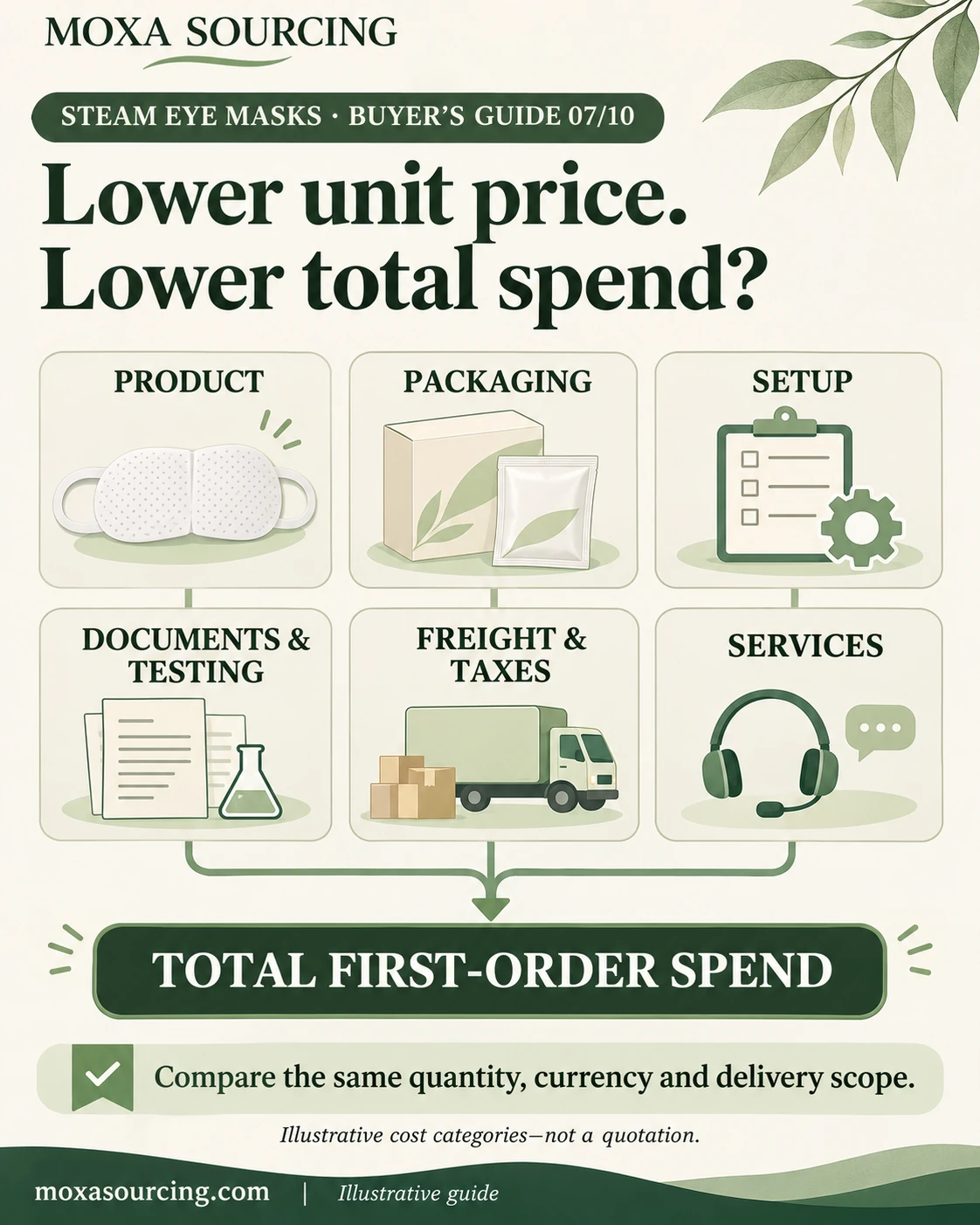
Which three cost views help a buying decision?
I find three columns useful when comparing quotations.
First: actual cash needed for the initial order. What will you pay now for goods, packaging, setup, samples and validation, logistics, taxes and agreed services? Do not add items already included elsewhere.
Second: the amount allocated to each saleable unit in the first batch. Which expenses are being allocated? Does that include one-off validation or unused packaging? Unused boxes remain inventory and tied-up cash, not automatically consumed materials.
Third: the indicative outlay for a repeat order of the same specification. What preparation need not be repeated? What packaging remains usable? Have pricing or freight conditions changed? This is a decision-making approach, not a universal accounting definition.
The bigger price gaps often come from connected variables. A fabric change may affect material MOQs, construction, samples and test evidence. More fragrances may split one order into smaller SKUs. Printed pouches and heavier boxes add more than printing and material costs: they may change freight charging. Choosing air to meet a launch date may affect document acceptance and logistics spending. Each effect needs checking; not every change triggers every possible charge.
What does the hypothetical CNY example show?
Here is a purely illustrative calculation, entirely in Chinese yuan, CNY. These are not our actual costs or quotations.
Assume a quoted product price of CNY 2 per mask, packaging and assembly of CNY 1 per mask, and setup of CNY 2,000. Assume freight of CNY 1,000 for 100 masks or CNY 2,000 for 1,000 masks:
- 100 masks: 100 × 3 + 2,000 + 1,000 = CNY 3,300, or CNY 33 allocated per mask.
- 1,000 masks: 1,000 × 3 + 2,000 + 2,000 = CNY 7,000, or CNY 7 allocated per mask.
You spend more in total, but the allocation per unit falls. If an upgraded box adds CNY 1 per mask plus CNY 500 to shipment freight, the increase is CNY 6 per mask at 100 units, or CNY 1.50 at 1,000. It is not just that extra CNY 1 of material.
This assumes no unused packaging or unsaleable units. It also excludes unlisted import charges, additional testing and sourcing services. It is not an all-inclusive delivered price. Quotations generally already include each provider’s costs and margin; there is no need to add another unlisted profit amount on their behalf.
How should services and unused packaging be compared?
Ask the same clear questions about services. Screening suppliers, verifying documents, coordinating samples and freight, and handling problems are real work. But “professional” does not automatically make a fee reasonable. Know the deliverables, included revision rounds and additional charges. Do not pay twice for the same work.
Buying more is not necessarily better either. If you need 100 boxes but buy 1,000, ask who owns the other 900, how they are stored and what happens after a design change. A tight budget may justify fewer fragrances, simpler packaging or staged testing, not the omission of safety checks, required labels or accurate declarations.
On equal scope, a lower price that meets your needs deserves consideration. A higher price without evidence of a useful difference deserves questions. This is not a defence of expensive offers. It is about knowing what you are paying for.
Would you rather reduce the cash needed for the first order, or optimize the unit price of later reorders?
A quick comparison checklist
| Check | Confirm |
|---|---|
| First-order cash | All included product, setup and delivery spending |
| Unit allocation | Cost divided by saleable units; stock kept separate |
| Repeat order | What must be paid again for the same specification |
FAQ — Quick answers
What is the main buying lesson?
Separate first-order cash, allocation per saleable unit and repeat-order spending before comparing a price per mask.
What should be written down?
First-order cash: All included product, setup and delivery spending; Unit allocation: Cost divided by saleable units; stock kept separate; Repeat order: What must be paid again for the same specification.