Financial evidence, liquidity and information timing
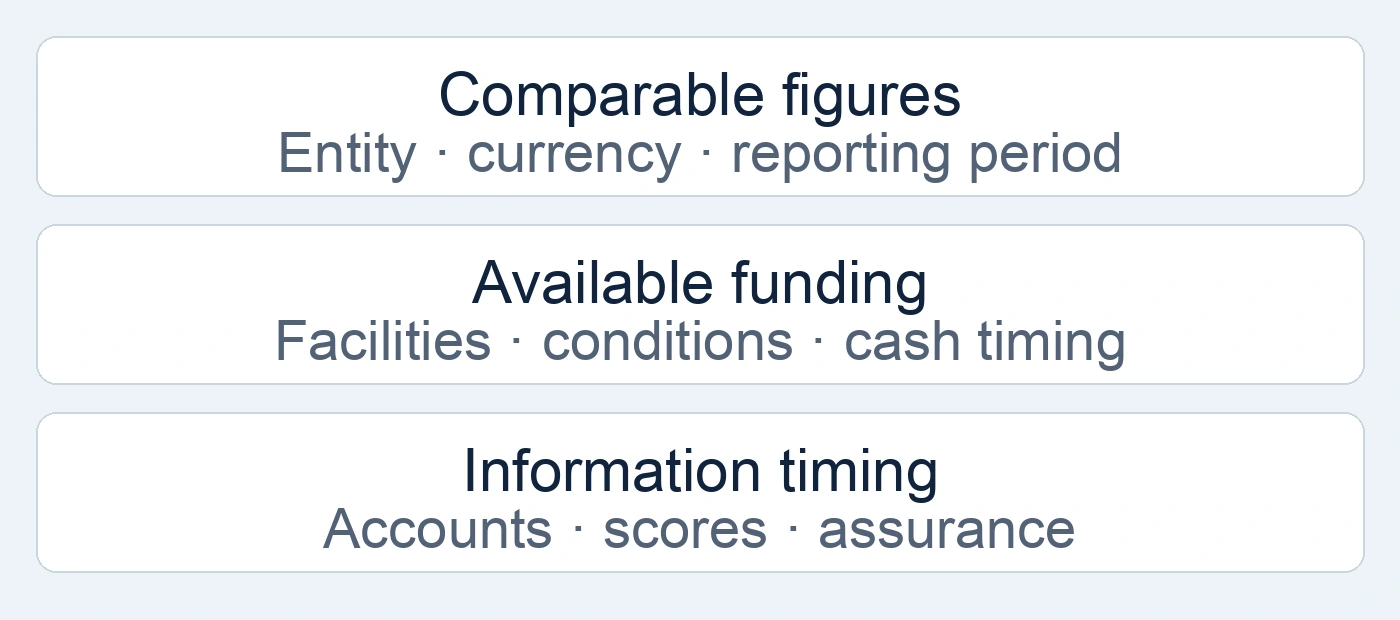
What makes suppliers’ financial figures comparable?
Financial figures need a common basis before they can support a meaningful comparison. The UK Government’s supplier economic and financial standing guidance discusses the reporting entity, financial-statement terminology, currency, accounting periods and adjustments to reported results. Its rules concern public services and works procurement. For a commercial sourcing enquiry, the useful method is to identify what each figure represents before drawing a conclusion from it. A spreadsheet containing several suppliers’ figures is not yet evidence that those figures describe comparable entities, periods or accounting items.
Identify the reporting entity as well as the proposed counterparty. The guidance notes that bidding entities may be registered in different countries, have similar names to subsidiaries or have changed names. Its financial-method notes also distinguish consolidated figures where consolidated statements are prepared. Establish which organization or group the supplied accounts describe. Group results and the accounts of a particular operating entity answer different scope questions, so their relationship needs to be understood before the financial information is attributed to the proposed supplier.
Keep the currency-conversion basis visible. The guidance asks the purchasing organization to specify the exchange-rate basis used in its financial comparison, including the relevant date. The transferable point is consistency and traceability, rather than adopting sterling as the currency for every purchase. Record which figures were converted and the rate and date used for that comparison. Otherwise, a difference caused by conversion choices could be read as a difference in supplier performance. No current exchange rate or preferred contract currency is supplied by this method explanation.
Distinguish a figure measured over a period from a figure measured at a date. The guidance’s accounting-period note discusses using a twelve-month basis for period measures to allow for seasonality and comparability, and involving finance teams where adjustments are needed. A short or extended accounting period can therefore require explanation before comparison with an annual result. Identify the period actually covered and how any adjustment was developed. This does not prescribe a conversion formula for a supplier’s accounts or remove the need for appropriate financial interpretation.
Treat exceptional-item adjustments as an evidence question. The guidance starts from reported accounting-framework figures and discusses adjustments where items are material and outside the ordinary course of business. A description such as one-off is therefore not sufficient on its own to establish how a figure should be changed. Identify the item, its nature and the information supporting the proposed treatment. The distinction is between the reported result and an explained analytical adjustment, with both remaining identifiable to the reviewer.
An adjustment can change the apparent risk in either direction. The guidance discusses considering relevant exceptional items, explaining proposed changes to the bidder and allowing a response. This helps prevent the analysis from silently retaining only adjustments favourable to a preferred conclusion. Keep the proposed treatment and the supplier’s explanation available to the qualified reviewer. A sourcing coordinator should not alter financial figures merely to make a supplier pass a comparison, nor treat a disputed adjustment as an agreed accounting fact.
Events after the balance-sheet date may affect the relevance of an earlier assessment. The guidance allows such events to be raised when explaining a different financial-risk interpretation. Its examples elsewhere include acquisitions, capital changes and newly announced results. Identify the event and the reliable information available about it before considering an updated analysis. A later development is neither automatically reflected in an old statement nor automatically a reason to discard it; the reviewer needs to understand how the event changes the question being assessed.
Read audit qualifications and additional disclosures for their actual content. The guidance calls for examining the nature of an auditor’s qualification or emphasis and deciding whether more assurance is needed, particularly where going-concern commentary is involved. Keep the relevant report and accounting period clear. An audit label alone is too broad to describe the conclusion.
Which funding conditions affect access to money for delivery?
Access to usable funds deserves a closer question than the amount of revenue or profit reported. The UK guidance’s liquidity section examines the funding strategy and borrowing arrangements behind delivery. For a sourcing enquiry, ask what funding is available, under what conditions and when it may need to be repaid or replaced. These are method questions for financial review. A strong sales history or an accounting profit does not itself answer every question about access to cash for the proposed work.
Check whether a credit facility is committed or uncommitted. The guidance notes that a lender may withdraw an uncommitted facility if it considers the supplier’s risk to have deteriorated. The existence of a stated credit line therefore needs to be understood alongside the conditions under which it remains available. Identify what the supplied evidence actually establishes about access. This does not establish that any lender will withdraw funding; it distinguishes a financing arrangement from an unconditional promise that funds will remain available throughout the project.
Distinguish the total facility from the amount already drawn. The guidance considers how much of a credit line the supplier has received and notes that using it to the maximum can indicate a concern. The total limit and the remaining access are different quantities. A reviewer needs the relevant facility information before assessing what funding is still available for future needs. A credit limit quoted in a presentation should not be treated automatically as unused cash available for a new order.
Ask about funding headroom in relation to expected peak cash needs. The guidance examines the space between potential future requirements and borrowing arrangements already in place. This directs the enquiry toward the timing and scale of the business’s needs, not merely the existence of funding. The assessment depends on the underlying cash information and financing evidence. The method provides no minimum headroom for a moxa factory or a private-label project, and a buyer should not invent one from the general explanation.
Borrowing conditions can affect continued access to funds. The guidance discusses covenants, including conditions expressed through financial ratios, and the concern created by approaching a breach. Covenant headroom concerns distance from a financing condition; it should be understood in that context when the term headroom appears in a financial discussion. Identify the actual condition and the information relevant to compliance. This explanation does not specify a covenant, determine a breach or authorise access to confidential loan terms.
Look at when borrowing falls due and how repayment is structured. The guidance distinguishes the maturity profile from the pattern of capital and interest repayment. Regular repayment and a large amount due at maturity create different timing questions for the funding review. Identify those dates and obligations in the actual financing arrangement. This helps the reviewer understand whether replacement funding or a concentrated repayment need is relevant during the proposed supply period, without assuming a particular loan structure for the supplier.
Identify whether liquidity depends on another group entity or has restrictions on its use. The guidance includes both questions when examining access to funds. Money elsewhere in a group and funds reserved for a specified activity may not answer the same funding question as money available to the operating supplier for the proposed work. Establish the relevant arrangement and permitted use. This is an enquiry into availability, rather than a claim that all group resources are inaccessible or that every restricted balance is a problem.
Understand the timing of cash received and cash required in the operating cycle. The guidance distinguishes businesses that collect cash before it is needed from those with a continuing working-capital funding requirement. That timing affects the liquidity question even where both businesses report sales and profit. Identify which pattern the supplier’s financial information supports and how it relates to the proposed work. The explanation does not determine payment terms; those remain a separate commercial decision involving the actual order and parties.
Some borrowing information may be commercially sensitive. The guidance recognises that reluctance to disclose facility details can reflect confidentiality concerns as well as possible financial difficulties. Understand the reason and the evidence route before interpreting refusal as a financial conclusion. An appropriate specialist and authorised information arrangement may be needed. This general principle supports the specific liquidity questions above; no request for private borrowing records or new disclosure agreement is made here.
How do scores, accounts and forecasts differ as supplier evidence?
Distinguish a credit rating from a commercial credit score. The UK guidance describes them as different types of information and notes that scores can be produced through algorithms using the earlier performance of businesses with similar characteristics. Identify the product, source and date before interpreting a number or label. Similar-looking financial labels need not express the same judgement or use the same information. This explanation selects an evidence-handling distinction; it does not recommend a scoring provider or assign a rating to any supplier.
Consider how current the information behind a score is. The guidance highlights the limitations of scores dependent on backward-looking published accounts and uses them to corroborate analysis or identify questions for investigation. A score can therefore direct attention while leaving the underlying financial question open. Examine the other evidence needed to understand the business’s present circumstances. An absent score or a single unfavourable label does not explain the whole delivery-capacity question, and the guide’s public-procurement decision rules are not being adopted as commercial selection rules here.
The accounting reference date can matter more than the day a document was downloaded. The guidance notes the delay between the period described by published accounts and the time of an assessment, and discusses more recent management accounts where appropriate. Identify the period each source covers when considering whether it describes current circumstances. A freshly retrieved file can contain old financial information. Further material should answer a defined recency question, rather than being treated as inherently more reliable simply because it is newer.
Forward-looking material has a different status from published results. The guidance discusses financial projections and simplified business plans as possible information about private suppliers’ future position. Read the period, assumptions and supporting evidence with that status in mind. A projection can help examine a funding plan while remaining a forecast. Receiving it does not establish that the forecast is realised, and the information arrangement must fit the supplier and the intended use rather than assuming that all forward-looking information is freely shareable.
Third-party analyst research is another distinct source. The guidance notes that such reports express an outside view, are generally prepared without the supplier’s internal budgets and forecasts, and are written for investors rather than customers. A buyer should therefore identify whose question the report was prepared to answer. It may provide context without supplying the internal evidence required for a particular sourcing enquiry. This distinction concerns the use of research, with no investment judgement or recommendation about the supplier’s shares.
Identify what supports management information and projections. The guidance discusses written board representations and independent assurance, with the acceptable evidence depending on the procurement’s criticality. These forms of support describe different sources of confidence in the information. A management statement and an independent examination should remain distinguishable in the sourcing record. The method does not establish a universal assurance requirement for every small supplier or imply that a board representation verifies a product, a factory inspection or the future outcome of an order.
Keep financial monitoring connected to the delivery relationship. The guidance examines trends and wider business context over time rather than only a single assessment date. Where an updated enquiry is justified, use the evidence to identify the concern and the relevant response with the appropriate people.
FAQ
What makes suppliers’ financial figures comparable?
Financial figures need a common basis before they can support a meaningful comparison. The UK Government’s supplier economic and financial standing guidance discusses the reporting entity, financial-statement terminology, currency, accounting periods and adjustments to reported results. Its rules concern public services and works procurement. For a commercial sourcing enquiry, the useful method is to identify what each figure represents before drawing a conclusion from it. A spreadsheet containing several suppliers’ figures is not yet evidence that those figures describe comparable entities, periods or accounting items.
Which funding conditions affect access to money for delivery?
Access to usable funds deserves a closer question than the amount of revenue or profit reported. The UK guidance’s liquidity section examines the funding strategy and borrowing arrangements behind delivery. For a sourcing enquiry, ask what funding is available, under what conditions and when it may need to be repaid or replaced. These are method questions for financial review. A strong sales history or an accounting profit does not itself answer every question about access to cash for the proposed work.
How do scores, accounts and forecasts differ as supplier evidence?
Distinguish a credit rating from a commercial credit score. The UK guidance describes them as different types of information and notes that scores can be produced through algorithms using the earlier performance of businesses with similar characteristics. Identify the product, source and date before interpreting a number or label. Similar-looking financial labels need not express the same judgement or use the same information. This explanation selects an evidence-handling distinction; it does not recommend a scoring provider or assign a rating to any supplier.
Sources and scope
Edited and adapted by Moxa Sourcing from selected methods in UK government guidance for public services and works procurement. Contains public sector information licensed under the Open Government Licence v3.0, Crown copyright 2026. Original explanatory diagram by Moxa Sourcing. Statutory duties, numerical benchmarks and model contract obligations are not adopted; these explanations do not assess a particular supplier.