Compare supplier markets and alternatives
How do you investigate the supply market before building a shortlist?
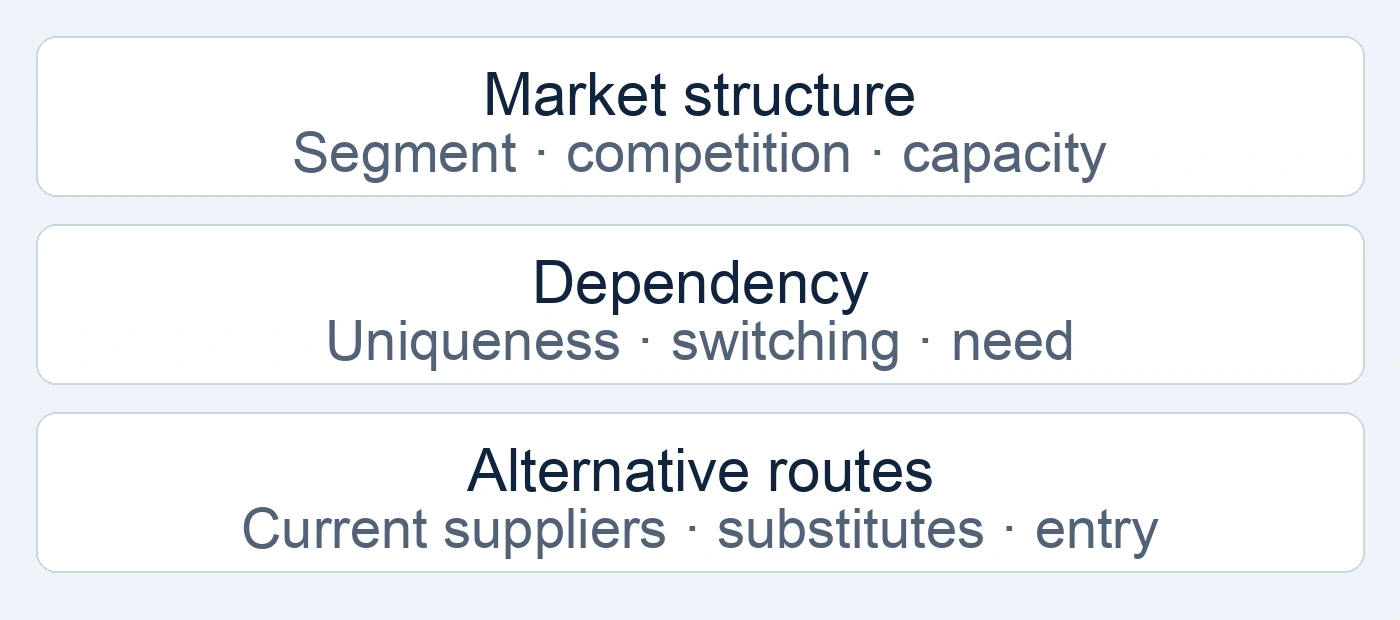
A shortlist identifies possible suppliers; a supply-market analysis asks what kind of market those suppliers operate in and how the proposed purchase fits it. The World Bank’s PPSD guidance separates market structure, competition, capability, capacity, pricing influences and participation. For a private purchasing project, use that distinction to frame the investigation before asking which factory is best. A list of companies does not yet explain whether there are alternative production routes, what constrains participation or whether the proposed package fits the suppliers who could perform it. The useful output is an explanation of the purchasing options supported by the available information.
Define the segment at the level where suppliers actually compete for the proposed work. The source notes that markets can differ by scale, specialization and geography and that the supply chain contains different markets at different points. In a hypothetical assortment enquiry, finished goods, printed packaging and a specialist processing service may therefore require different market questions. Do not assume that companies appearing under the same botanical search term compete for the same scope. Identify the operation or package under consideration and ask which suppliers could offer that scope directly or through a disclosed arrangement. This is a segmentation exercise, not evidence that any particular arrangement is available.
Separate capability from capacity when recording what the market might offer. Capability concerns whether the required type of work can be undertaken; capacity adds the amount and availability relevant to the proposed purchase. The World Bank includes both total and available market capacity in its analysis. A market can contain firms that understand the process while leaving the buyer uncertain about available resources for the intended period. Conversely, a broad output claim may concern a different product segment. Carry those questions into supplier discussions separately. Avoid replacing the availability question with a count of marketplace listings, industrial buildings or regional enterprises.
Investigate how competition is organized rather than treating the number of offers as the whole answer. The source’s market-influences table includes specialists, generalists, niche firms, strategic alliances, new entrants and differences in market power. Ask what makes an alternative genuinely different for the proposed requirement: a different relevant process, a different supply arrangement or another way to achieve the purchasing outcome. Several differently branded offers can still leave the same important dependency unresolved. Equally, a supplier outside the first geographic search may merit investigation when the work is not intrinsically tied to that location. Establish the actual structure before claiming either broad competition or a shortage of options.
Treat market change as a reason to update a purchasing assumption. The guidance includes restructuring, mergers, alliances, new products and technology among the influences to investigate. A buyer does not need to predict every industry development. It needs to ask whether a change could affect the routes being compared or the willingness and ability of suppliers to respond. If information suggests that a relevant operation has moved, a supplier has changed its business focus or an alternative process has become available, identify the effect on this purchase and seek current evidence. Do not transform a reported trend into a completed change at a selected factory.
Include other customers and purchasing practices in the investigation where suitable information is available. The World Bank asks who buys in the market, what they procure, how they procure and how their purchases affect the market. For a private buyer, the purpose is to understand relevant operating conditions and established ways of obtaining the needed scope. Comparable past purchases can show useful questions about package size, participation or contract management. They do not establish that another customer’s confidential terms are available to this buyer. Use authorized, properly scoped information and distinguish a documented example from a general impression about how the market normally behaves.
Begin the information search with relevant work already available, then fill the gaps. The guidance points to previous research and comparable experience before adding industry bodies, government information, annual reports, specialist research, supplier discussions and other sources. Assign a question to each source instead of collecting links without a purpose. An industry publication may help identify a segment; accounts may address an entity-level financial question; a supplier discussion may explain a proposed operating route. Cross-check material conclusions where the information permits. When a source cannot answer the question, leave the gap visible and choose the next enquiry accordingly.
Finish with implications for the purchase, not a longer research appendix. The World Bank distinguishes gathering information from analyzing what it means for the requirement and procurement approach. A useful private-buyer conclusion might be to investigate a specialist package separately, reconsider an unnecessarily restrictive requirement, invite an alternative process proposal or obtain better information about availability. State which evidence supports that action and which assumption remains open. If the analysis does not change or support a purchasing decision, reduce it to the information actually needed. The depth of work should reflect the uncertainty and consequence of the purchase.
How do you assess real sourcing alternatives beyond the number of offers?
A large set of offers is useful for discovery, but the buyer still needs to understand what makes the alternatives workable. The World Bank explains Porter’s five forces as a way to examine supplier power, buyer power, rivalry, substitutes and potential entrants. These are related questions about a market, not five scores automatically attached to each factory. Apply them to the scope being purchased. A comparison of finished products may differ from a comparison of a specialized processing service or packaging component. The analysis should explain a sourcing dependency or choice rather than merely replace a supplier list with a diagram.
Supplier power begins with the alternatives and the buyer’s dependence on the requirement. The source highlights uniqueness, the cost of switching and the importance of the supply to the buyer. Ask whether another route could meet the required outcome and what would be involved in changing. A common-looking catalogue item may leave a particular process or component dependent on a narrower set of sources. Conversely, a distinctive marketing presentation does not by itself establish that the underlying supply is unique. Investigate the specific dependency before describing a supplier as powerful or assuming that the buyer has no alternative.
Make the switching question concrete enough to compare routes. If an alternative would require a different component arrangement, a new operating setup or work to establish the suitability of the changed version, identify that work and who can assess it. Do not treat a lower offered unit price as the entire comparison. Equally, do not label every supplier change prohibitively expensive without evidence. The sourcing decision concerns whether an alternative is realistically usable under the buyer’s approved requirements. Detailed product validation and cost calculation remain in their respective workflows; the route comparison needs the relevant dependencies and the basis for judging the switch.
Buyer power involves more than being a serious customer. The World Bank considers the size of the requirement, ease of purchasing from alternatives and the number of other buyers in the market. An order may be significant to one supplier while being small in the wider market. Several credible alternative suppliers can change the buyer’s options, while a supplier with many other customers may have little reason to compete for a particular enquiry. These are questions to investigate, not facts to infer from a buyer’s annual forecast. Keep the proposed order, documented alternatives and information about other demand separate in the analysis.
Rivalry concerns how existing suppliers compete, rather than simply whether two prices differ. The source lists market structure, fixed costs, entry and exit barriers, switching costs, market growth and demand conditions among the factors. These can guide questions about why offers are being made and what kind of competition is plausible. A price comparison alone does not reveal a supplier’s fixed costs, profitability or exit options. Use reliable information where available and retain uncertainty where it is not. The point is to understand the conditions around the purchase without constructing an unsupported story about a supplier’s financial situation.
A substitute is a different way of satisfying the relevant need, not just another supplier name. The published model distinguishes substitutes from rivalry among current competitors. For a purchasing project, first define which outcome and constraints the alternative would need to satisfy. A different product form or process could be an option for investigation if it still addresses that outcome, but a shared botanical ingredient or similar appearance does not establish interchangeability. Where the proposed alternative changes intended use, performance, safety, presentation or destination requirements, have those implications assessed before accepting the substitution. This competition analysis does not establish technical equivalence.
Potential entrants are firms that do not currently compete for the scope but might be able to enter. The World Bank identifies barriers such as scale, brand loyalty, regulation, switching costs, existing cost advantages, distribution and setup investment. For the buyer, an apparent newcomer is therefore a question about entry requirements and readiness, not automatically another available source. Distinguish an expression of interest, a development proposal and an established offer. If the route depends on investment or access that has not been secured, record that dependency. Do not count potential future capacity as current competitive supply.
Market labels require a market definition and supporting evidence. The source distinguishes competition among many suppliers, differentiated competition, a few dominant suppliers, a single supplier and a single buyer. Those categories describe structures, not the result of one short search. Receiving one quotation does not establish a monopoly; receiving many listings does not establish interchangeable supply or effective competition. Before using a category, state the product or service scope, relevant geography, credible alternatives and important limits in the information. If the evidence is too thin to classify the market, use the unresolved question to direct further research instead.
Match the proposed purchasing approach to the competition actually available. The World Bank warns that an approach built around competitive bidding, substantial risk transfer and lowest evaluated cost can be unsuitable when one or very few suppliers hold substantial market power. It discusses negotiated arrangements and other pricing approaches as possible responses in that context. For a private buyer, the lesson is to examine whether the chosen enquiry and comparison process fits the available alternatives. It is not a reason to abandon scrutiny, accept an unsupported price or make a longer-term commitment automatically. Any commercial approach needs its own evidence, terms and authorized decision.
Use the combined analysis to choose the next enquiry. If the main uncertainty is whether an alternative process can satisfy the requirement, investigate that process. If switching work is the constraint, obtain a realistic account of that work. If relevant suppliers are not participating, examine the proposed package and account attractiveness. A different question is needed when the issue is unproven future entry. Keep the evidence for each conclusion visible so that a later change can be understood. The practical result is a clearer sourcing option or an identified dependency; a completed five-forces worksheet is not evidence that supply has been secured.
FAQ
How do you investigate the supply market before building a shortlist?
A shortlist identifies possible suppliers; a supply-market analysis asks what kind of market those suppliers operate in and how the proposed purchase fits it. The World Bank’s PPSD guidance separates market structure, competition, capability, capacity, pricing influences and participation. For a private purchasing project, use that distinction to frame the investigation before asking which factory is best. A list of companies does not yet explain whether there are alternative production routes, what constrains participation or whether the proposed package fits the suppliers who could perform it. The useful output is an explanation of the purchasing options supported by the available information.
How do you assess real sourcing alternatives beyond the number of offers?
A large set of offers is useful for discovery, but the buyer still needs to understand what makes the alternatives workable. The World Bank explains Porter’s five forces as a way to examine supplier power, buyer power, rivalry, substitutes and potential entrants. These are related questions about a market, not five scores automatically attached to each factory. Apply them to the scope being purchased. A comparison of finished products may differ from a comparison of a specialized processing service or packaging component. The analysis should explain a sourcing dependency or choice rather than merely replace a supplier list with a diagram.