Production routing, schedules and critical-path evidence
What is different about a production route and its schedule?
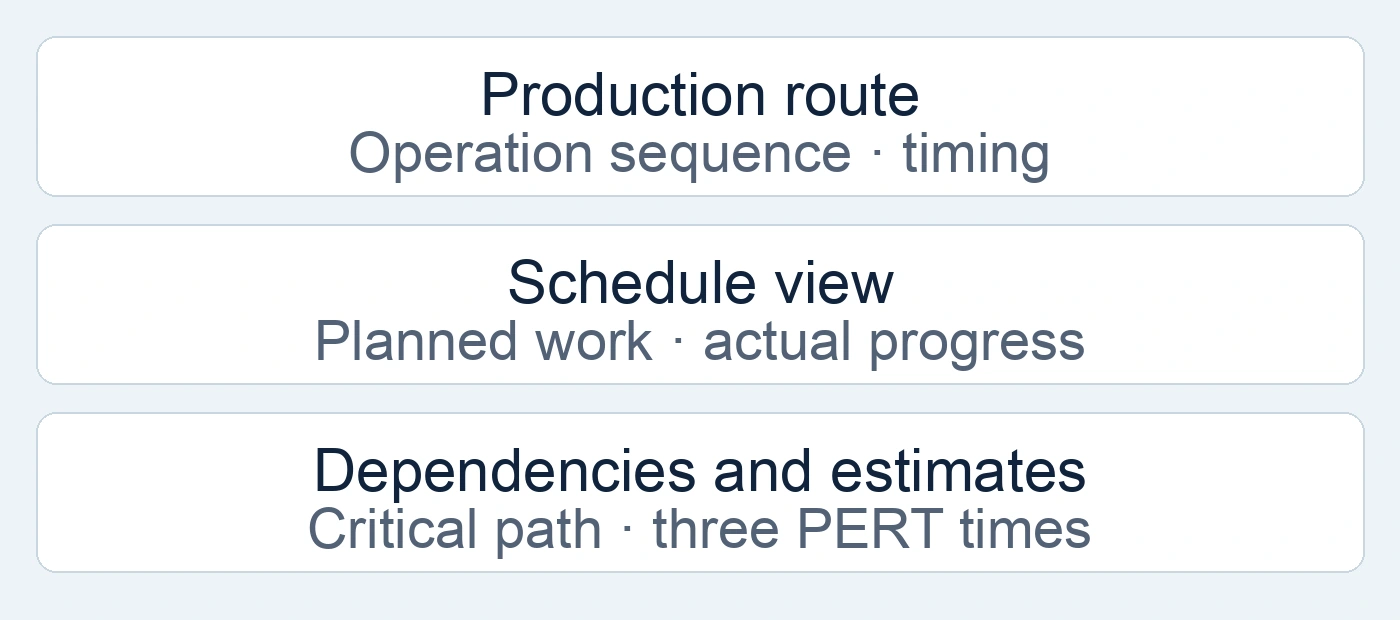
Keep the route through production separate from the timing assigned to it. OpenStax’s production-control explanation distinguishes routing from scheduling. The route identifies the sequence of operations and machines used from the start of the work to its completion; the schedule concerns when the steps occur and the time they require. This supports the existing layout, material-planning and supplier-coordination records. It does not establish that a proposed route is already operating or that the timing shown has been agreed.
Routing relates the product’s required operations to the facility layout. It should explain which operation follows which, rather than supply only a list of machines or departments. Scheduling then adds a time relationship to that operational sequence. When reviewing a supplier’s proposed plan, distinguish an unresolved route question from an unresolved timing question: the team may still need to determine where a job goes, or it may already know the route but need to resolve when the required operations can occur. The two questions call for different clarifications.
A production timetable also has to relate the scheduled work to the resources it needs. The text connects scheduling with having materials and labour at the required place and time. A date assigned to an operation and the availability of its supporting resources should therefore be examined together. Ask which resource condition supports the proposed timing and which part remains to be arranged. This is a way to read the plan’s dependencies; it does not supply a promised production date or replace the supplier’s own scheduling evidence.
What do a Gantt timeline, critical path and PERT estimates tell a buyer?
A Gantt timeline can compare the time scheduled for an activity with the time actually used. In the simple chart described by OpenStax, activities are listed against a time axis and the planned and actual periods are shown separately. This lets the reviewer distinguish a proposed timetable from recorded progress. Ask which bars represent the plan and which represent actual work before reading a chart as evidence of completion. A planned bar reaching the end of the timeline does not, by itself, show that the corresponding work has occurred.
Check where the relationships between tasks are represented. The textbook points out that a simple Gantt chart can show timing without adequately showing how activities depend on one another. A dependency network addresses a different question from the position of bars on a calendar. The buyer should be able to identify which predecessor must finish before another activity can proceed. This is a question about the information actually displayed; modern planning tools can combine views, so the limitation of a simple chart should not be asserted for every Gantt application.
The critical path method identifies activities, their required order and their relationships, then links them in a network. The critical path is the longest-duration chain through those linked activities in the model being examined. It is not simply the single task with the largest duration, and it is not the sum of every task where some can proceed in parallel. A supplier explanation should identify the linked chain that determines the model’s completion time. Its meaning depends on the activities, dependencies and durations used in that particular plan.
A delay on the critical chain affects the completion time in the current network unless the plan is changed. Other activities may have some timing flexibility, but that does not make their delay unlimited or irrelevant. Ask how a proposed change affects the linked sequence and whether the schedule needs to be revised. The method supports examining the effect of a delay; it does not guarantee that moving resources or changing a date will recover the original completion time. Any real recovery proposal still needs its own operational evidence.
PERT makes uncertainty in an activity’s duration explicit through three estimates: optimistic, most probable and pessimistic completion times. OpenStax contrasts this with the single task-duration value used in its CPM explanation. The three values describe alternative timing estimates for the activity, not three stages that must all occur. Keep their labels and the activity they concern visible when discussing a supplier’s plan. They are estimates rather than observed completion, and this explanation assigns no probability, weighting formula or guaranteed delivery date to them.
FAQ
What is different about a production route and its schedule?
Keep the route through production separate from the timing assigned to it. OpenStax’s production-control explanation distinguishes routing from scheduling. The route identifies the sequence of operations and machines used from the start of the work to its completion; the schedule concerns when the steps occur and the time they require. This supports the existing layout, material-planning and supplier-coordination records. It does not establish that a proposed route is already operating or that the timing shown has been agreed.
What do a Gantt timeline, critical path and PERT estimates tell a buyer?
A Gantt timeline can compare the time scheduled for an activity with the time actually used. In the simple chart described by OpenStax, activities are listed against a time axis and the planned and actual periods are shown separately. This lets the reviewer distinguish a proposed timetable from recorded progress. Ask which bars represent the plan and which represent actual work before reading a chart as evidence of completion. A planned bar reaching the end of the timeline does not, by itself, show that the corresponding work has occurred.
Sources and scope
Original buyer-focused adaptation and diagram by Moxa Sourcing, based on selected production-control and scheduling concepts in Introduction to Business (2018), by Lawrence J. Gitman, Carl McDaniel, Amit Shah, Monique Reece, Linda Koffel, Bethann Talsma and James C. Hyatt; ©2018 Rice University/OpenStax, CC BY 4.0 (https://creativecommons.org/licenses/by/4.0/). The wording, structure and diagram have been changed; Arabic translates this adaptation. The 2026 edition, company examples, textbook figures and photographs are not used. Download for free at https://openstax.org/details/books/Introduction-Business.