Supplier roles and joint relationship planning
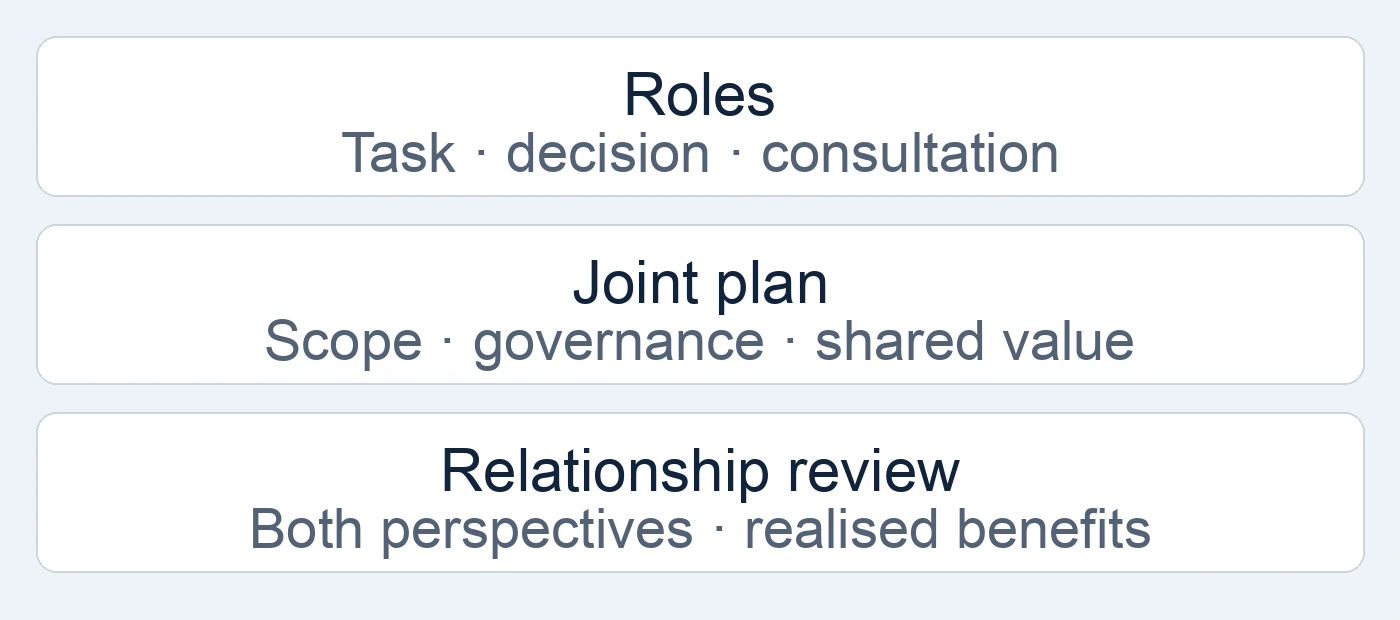
Who performs the work and who owns the supplier relationship decision?
Define roles around the activities in the supplier relationship, rather than relying on job titles alone. New Zealand Government Procurement’s public RACI guidance starts with the interactions and work involved, then assigns the roles needed for each. It treats relationship management as an activity spanning functions and both organizations. For a sourcing project, identify the work that actually crosses that boundary. A contact list identifies people, while a role assignment explains what each person is expected to do when that work takes place.
The RACI method separates completing an activity from owning its final decision. In the NZGP definitions, the responsible role performs the task, while the accountable role makes the final decision and has ultimate ownership. A buyer can use that distinction to ask whether the person coordinating a supplier discussion also has authority to decide the issue being discussed. The answer may involve different roles. Identifying both avoids treating responsiveness in communication as evidence of decision authority, or treating a senior decision-maker as the person carrying out every activity.
Consultation and information also have different places in the activity. The guidance describes consulted people as contributing before a decision or before the activity takes place, usually by supplying relevant information. Informed people receive the decision or completion information and may receive progress updates. Identify whether a person’s input is needed to develop the decision, or whether the person needs to know its result. Sending the same update to everyone does not establish that a required consultation occurred, and a person copied into a message has not necessarily accepted responsibility for the task.
Keep final ownership unambiguous. The NZGP definition assigns the accountable role to one person and prefers one responsible person for an activity. These definitions make it possible to locate the final decision and the person expected to complete the work. They describe a role-design method, rather than establishing a staffing rule for every commercial relationship. Discuss the arrangement that fits the activity and distinguish any contributing people from its agreed owner. The relationship can involve many participants while the responsibility for a particular decision remains understandable.
Treat an internally drafted role map as preliminary where it names supplier-side responsibilities. The guidance recommends preparing an initial view and discussing it with the supplier, including whether the supplier can commit the people and activities proposed. This distinguishes a buyer’s planning assumption from a responsibility accepted by both sides. A buyer cannot establish a supplier’s resource commitment merely by writing a name into its own chart. Resolve the proposed allocation with the relevant participants before using it to describe the agreed working relationship.
Review the role map when the people or organizations change. The guidance treats the high-level RACI as something to revisit so that it remains relevant. A useful review asks whether the current participants still cover the activities, decisions, consultations and information routes originally assigned. It is the role arrangement that needs to stay understandable; retaining an old chart with departed personnel does not preserve that understanding. The same principle applies when the scope of the relationship changes enough to create new activities or alter an existing decision route.
How do buyer and supplier define a joint plan that creates assessable value?
A joint business plan gives the buyer and supplier a place to develop objectives that require work from both organizations. NZGP’s public template describes it as both a planning tool and a reporting tool. The plan therefore needs to connect the intended joint value with the work and progress that will later be reviewed. Its purpose is different from simply collecting all correspondence about a supplier. Identify what the proposed collaboration is intended to achieve and why a shared plan would help the two parties manage that objective.
The template’s introductory workshop focuses on alignment between the organizations’ goals and on opportunities for improvement and innovation. It distinguishes that purpose from an exercise aimed at fixing unsatisfactory service delivery. That distinction helps set an honest meeting agenda: developing a shared opportunity and correcting a failure may require different discussions. Describe which discussion is being proposed. A joint-development label should not obscure an unresolved delivery issue, and an improvement opportunity should not be presented as evidence that the supplier has failed an existing obligation.
Compare possible initiatives through both their potential value and their ease of implementation. The NZGP template uses those two dimensions to help participants prioritise ideas before choosing work for the plan. They answer different questions: a valuable initiative can be demanding to implement, while a straightforward improvement may offer a smaller benefit. Considering both helps the parties discuss resource demands alongside the opportunity. The method does not provide a factual value estimate or an implementation commitment for any particular supplier project; those require the project’s own information and agreement.
Define the scope of the joint plan separately from its ambition. The template asks for purpose, shared vision and scope, including the parts of the organizations or locations involved. A broad aim can otherwise be read as applying to every product, business unit or relationship between the parties. State where the proposed work applies so participants can judge whether they have the relevant knowledge and authority. This also helps a later review distinguish results within the agreed scope from activity elsewhere in the supplier’s business.
Relationship governance identifies how the parties will direct and review the joint work. The template connects it with agreed activities, roles, responsibilities and a review cycle, and separately identifies the stakeholders and resources supporting the plan. These elements describe different parts of participation. The governance arrangement concerns how the relationship is directed; the stakeholder map identifies who contributes to it. Explain the arrangement in terms of the actual proposed work. Reusing the organizational titles shown in an example would not establish that either party has those positions or resources available.
Agree working behaviours as well as work items. The template includes a relationship charter for shared expectations about how the parties work together. Its examples concern matters such as openness, professional conduct, feedback, collaboration and attention to outcomes. The useful step is to discuss what those expectations mean for the relationship being planned. A shared behaviour statement can support the way issues are handled, while the activity plan identifies what is to be done. Neither part should be mistaken for evidence that the other has already been carried out.
For a proposed value opportunity, explain how value would be quantified, which measures both parties would use and how the value would be shared. These are explicit questions in the NZGP template. They help separate an attractive idea from a mutually understood opportunity. The parties might otherwise use the same word, value, while measuring different outcomes or expecting different benefits. An agreed measurement approach makes the proposal more assessable; it does not establish that the expected benefit has occurred, nor does it authorise a particular commercial sharing arrangement.
Turn selected initiatives into identifiable work. The template associates each initiative with activities, dates, an owner and commentary about status, challenges or help needed. It also treats the plan as something that evolves and is reviewed with the supplier. This connects the opportunity discussion to the practical work that follows. The specific review timing and amount of work must fit the proposed relationship. The template’s illustrative planning periods are not evidence of a delivery promise or an established meeting schedule for a new sourcing project.
How do you review the relationship without confusing satisfaction with delivery?
Measure the working relationship from both sides. NZGP’s public balanced-scorecard instructions describe a collaborative review of satisfaction, with the buyer and supplier deciding together how often it will be completed. This gives the relationship itself a place in the review alongside the work being delivered. A buyer’s internal assessment describes one perspective; a collaborative review can make the supplier’s perspective available too. Participation in that review does not by itself establish agreement on every issue, so keep the observations and reasons understandable to both parties.
Use the agreed work as a reference for the relationship review. The scorecard guidance points to the role map, joint business plan and meeting records as useful inputs. It distinguishes progress against initiative milestones from performance against predetermined measures. A milestone asks whether a planned stage has been reached; a performance measure asks how the relevant work is doing. These can move differently. Keep their meanings visible when summarising the relationship, rather than treating a single overall satisfaction score as a substitute for both.
Compare expected benefits with benefits actually delivered. The scorecard gives this a distinct place alongside initiative progress, performance, risk and governance. That distinction matters because completing activities does not establish that the intended value has been realised. Review the benefit using the measurement approach agreed for the initiative and state what has been observed. Where the benefit is still expected, preserve that status. This makes the relationship review useful for deciding whether the current joint work is producing the value that motivated it.
A relationship score needs its reasoning and the issues behind it. The NZGP template asks for an overall impression with a reason and provides space for highlights, concerns, status and next steps across the review dimensions. The number is therefore one part of the assessment. A concern about governance may need a different response from a delay in an initiative or a shortfall in benefits. Describe the relevant dimension so the review can lead to an appropriate discussion rather than reducing every issue to the same undifferentiated score.
Status colours should have a defined meaning. The template distinguishes work progressing as expected, work that remains on course but has emerging issues to watch, and significant problems requiring immediate attention. A colour without that interpretation can conceal very different judgements. The template’s displayed colours are illustrative entries in a blank tool, not observations of a supplier. Any status used for an actual relationship needs to come from that relationship’s evidence and the meaning the participants have agreed to apply.
Choose the next relationship activity in light of the review. The public SRM page links a well-performing relationship with consideration of innovation and describes service improvement planning where delivery remains below expectations. These are possible responses within the relationship-management method. The actual response still needs to be agreed for the particular situation.
FAQ
Who performs the work and who owns the supplier relationship decision?
Define roles around the activities in the supplier relationship, rather than relying on job titles alone. New Zealand Government Procurement’s public RACI guidance starts with the interactions and work involved, then assigns the roles needed for each. It treats relationship management as an activity spanning functions and both organizations. For a sourcing project, identify the work that actually crosses that boundary. A contact list identifies people, while a role assignment explains what each person is expected to do when that work takes place.
How do buyer and supplier define a joint plan that creates assessable value?
A joint business plan gives the buyer and supplier a place to develop objectives that require work from both organizations. NZGP’s public template describes it as both a planning tool and a reporting tool. The plan therefore needs to connect the intended joint value with the work and progress that will later be reviewed. Its purpose is different from simply collecting all correspondence about a supplier. Identify what the proposed collaboration is intended to achieve and why a shared plan would help the two parties manage that objective.
How do you review the relationship without confusing satisfaction with delivery?
Measure the working relationship from both sides. NZGP’s public balanced-scorecard instructions describe a collaborative review of satisfaction, with the buyer and supplier deciding together how often it will be completed. This gives the relationship itself a place in the review alongside the work being delivered. A buyer’s internal assessment describes one perspective; a collaborative review can make the supplier’s perspective available too. Participation in that review does not by itself establish agreement on every issue, so keep the observations and reasons understandable to both parties.
Sources and scope
- New Zealand Government Procurement, RACI template (May 2025 file), explanation, role definitions and planning instructions
- New Zealand Government Procurement, Introduction to supplier relationship management, public preparation, planning, implementation and monitoring guidance
- New Zealand Government Procurement, Joint business planning template (May 2025 file), instructions and purposes of blank plan fields
- New Zealand Government Procurement, Balanced scorecard template, instructions, review dimensions and status meanings
Original method explanation and diagram by Moxa Sourcing, based on the public NZGP relationship-management page and selected method facts from its blank templates. Government-specific arrangements and sample role allocations are not adopted. Proposed responsibilities and joint initiatives remain for the participants to agree.