Compare supplier backups and resilience
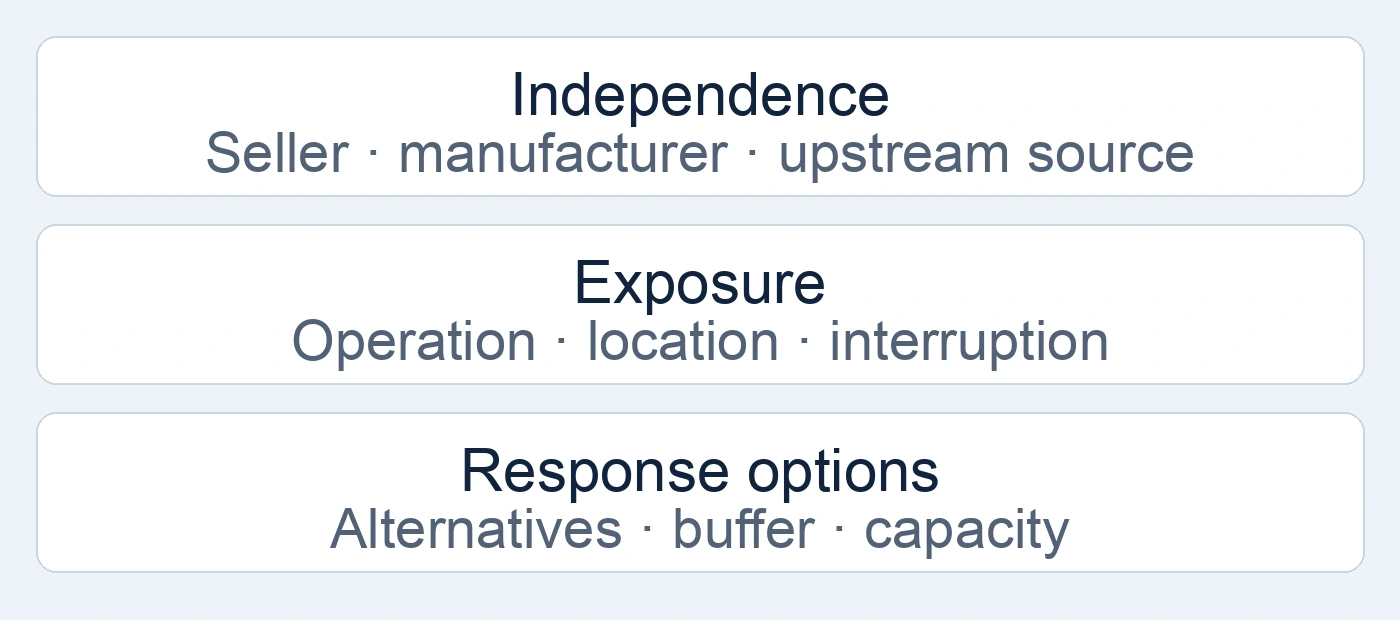
Do several suppliers provide independent backup routes?
Count the underlying supply routes as well as the companies answering an enquiry. NPSA’s business guidance warns that geographically dispersed intermediaries can rely on manufacturers that are not geographically dispersed. Several sellers can therefore leave the same production location exposed to the same event. To examine backup independence, connect the proposed seller to the actual manufacturing operation and relevant upstream source. Keep unresolved links visible. A second offer becomes useful evidence about another commercial route; it does not establish a separate manufacturing route until the relevant relationship is understood.
Define the disruption against which the backup is meant to help. A different seller may be useful if the problem concerns one commercial intermediary, yet do little if both routes depend on the same affected process or location. A second manufacturing site may address one exposure while leaving a common raw-material dependency. These are hypothetical distinctions, not reports of a current supplier problem. Write the dependency being examined before deciding whether two routes are sufficiently different. ‘We have two suppliers’ is otherwise too broad to explain what the proposed backup would protect.
Look upstream beyond the direct contracting party where the relevant risk requires it. The NPSA guidance recommends working through suppliers and their suppliers toward raw materials to understand the network. This does not mean demanding every confidential commercial record without a purpose. Identify the important input or operation and request the information needed to understand that dependency within the authorized project. A route can have a different final assembler and still share a critical source farther upstream. The depth of the enquiry should follow the exposure being examined and the importance of that exposure to the purchase.
Distinguish manufacturing diversity from location diversity. Two separately operated factories in the same area may provide organizational alternatives while remaining exposed to a common regional event. NPSA identifies geographic clustering as a possible source of vulnerability. The buyer’s task is to examine the relevant locations and plausible exposure rather than infer that one famous production cluster is unsafe or another region is automatically resilient. Regional reputation and dated industry statistics do not answer the independence question. The comparison needs the proposed operations and locations, together with the particular risk the buyer wants to address.
Consider the complexity added by another route. The guidance notes that multiple supply routes bring both benefits and challenges and that longer, more complex chains can reduce visibility and increase monitoring difficulty. An alternative can add a new handoff or operating relationship that must be understood. Compare the reduction in the identified dependency with the coordination the alternative would require. More routes are not automatically better for every purchase. A suitable arrangement is one the buyer can understand and manage for the intended purpose, with material unknowns assigned rather than hidden by the appearance of choice.
Check the product scope of the proposed backup. NPSA treats diversity of received finished and intermediate goods as a distinct dimension from the number and location of suppliers. A route that can supply one component does not automatically replace the finished-product arrangement. Likewise, a supplier offering a related product family is not yet an alternative for the approved configuration. State what would be replaced and what would remain unchanged, then route any changed-product suitability questions to the appropriate product review. The resilience comparison should show the real scope of substitution rather than credit a broad catalogue as complete backup.
Keep backup status current enough for the decision it supports. A named potential source, a route that has been investigated and an alternative that is ready for the defined requirement are different positions. The NPSA approach combines mapping with implementation and review; a purchasing application should therefore revisit the information when an important operating or upstream link changes. Confirm the relevant availability before relying on the alternative in a commitment. Retaining a contact in a spreadsheet is useful discovery information, but it does not establish that the backup can perform the required work when needed.
What can you change when a supply dependency is vulnerable?
Different resilience actions address different parts of a supply problem. The UK Department for Business and Trade identifies diversification, international partnerships, stockpiling and surge capacity, onshoring, and demand management as options to consider. NPSA’s business guidance stresses that the options can be combined and that the appropriate mix depends on resources, capacity, interdependencies and priorities. Start with the vulnerability rather than a preferred solution. An action is relevant when it addresses the dependency the buyer has identified, and the additional work or dependency it creates can also be understood.
Diversification changes the set of sources available for the requirement. It can create flexibility when an alternative route is suitable, but the source count alone does not establish resilience. Connect the proposed action to the specific manufacturing, input or location dependency being reduced. If alternatives share the same critical upstream source, a different intervention may still be needed for that exposure. Do not describe a potential supplier as a usable alternative merely because it has expressed interest. The relevant sourcing work is to establish what the alternative could supply and the conditions required before the buyer could rely on it.
Partnerships address a shared challenge through cooperation. The official framework describes working with international partners, while NPSA also refers to collaboration with complementary organizations. For a purchasing project, identify what cooperation would contribute to the particular problem: relevant information, coordination or another clearly defined capability. A vague claim of having a network is insufficient to establish that contribution. Distinguish an available relationship from a proposed introduction and confirm the role of each participant. Cooperation can support a resilience plan, but it does not automatically transfer the manufacturing or purchasing responsibilities of the underlying supply arrangement.
Stocks and surge capacity address different questions about continuity. Holding a buffer concerns goods or components already available to draw on; surge capacity concerns the ability to increase supply when required. The DBT framework includes considering whether surge capacity can be addressed in contracts. A buyer should therefore ask whether the proposal concerns existing goods, additional operating capability or both, and what makes the proposed response usable. A general statement that a factory can increase output does not specify availability, timing or the conditions of that response. Define the required arrangement for review before treating it as a confirmed contingency.
A stock-based response also needs a product-suitability question. NPSA’s vulnerability guidance notes longevity and batch management when considering stored products. At sourcing level, ask whether the proposed buffer would remain suitable for the requirement during the period it is intended to cover and who can provide the necessary product and storage information. This guide does not set a reserve quantity or storage period. Those decisions depend on the selected product, relevant evidence and the buyer’s operating plan. A buffer can only address the identified interruption if the goods remain usable and accessible under the intended arrangement.
Onshoring considers expanding or procuring manufacturing capacity in the buyer’s domestic market. It is a location and capability option, not a universal instruction to replace international sourcing. Compare which dependency would change, whether the required process is realistically available in that location and what other dependencies would remain. A domestic final operation can still depend on imported materials or components. Likewise, an international route may provide useful alternatives when its relevant links are understood. The framework invites investigation of the option; it does not establish that domestic capacity exists for the buyer’s product or that one location is always safer.
Demand management changes what the buyer needs to obtain or how that need is met. The framework includes substitutes and alternatives, innovation and circularity. Begin by identifying which part of the requirement is flexible and which is essential. An alternative product or process is only relevant if its implications for the intended use and approved requirements are assessed. A demand change should not be hidden as an unauthorized product substitution. Explain the proposed change to the responsible decision owner and route product suitability, safety and market questions to their appropriate review before relying on it in the supply plan.
Compare combinations before choosing a large intervention. NPSA recommends listing possible actions and prioritizing those that achieve the necessary improvement with the least intervention, while considering available resources and interdependencies. A smaller change may address the actual exposure, whereas a broad reorganization may introduce work without improving that point. Conversely, one action may be insufficient if the dependency spans several links. State why the selected combination addresses the identified vulnerability and what remains exposed. This is a sourcing-plan decision supported by evidence, not a guarantee that disruption has become impossible.
FAQ
Do several suppliers provide independent backup routes?
Count the underlying supply routes as well as the companies answering an enquiry. NPSA’s business guidance warns that geographically dispersed intermediaries can rely on manufacturers that are not geographically dispersed. Several sellers can therefore leave the same production location exposed to the same event. To examine backup independence, connect the proposed seller to the actual manufacturing operation and relevant upstream source. Keep unresolved links visible. A second offer becomes useful evidence about another commercial route; it does not establish a separate manufacturing route until the relevant relationship is understood.
What can you change when a supply dependency is vulnerable?
Different resilience actions address different parts of a supply problem. The UK Department for Business and Trade identifies diversification, international partnerships, stockpiling and surge capacity, onshoring, and demand management as options to consider. NPSA’s business guidance stresses that the options can be combined and that the appropriate mix depends on resources, capacity, interdependencies and priorities. Start with the vulnerability rather than a preferred solution. An action is relevant when it addresses the dependency the buyer has identified, and the additional work or dependency it creates can also be understood.