Moxibustion tools, devices and accessory fit
How do tool and moxa consumable interfaces fit together?
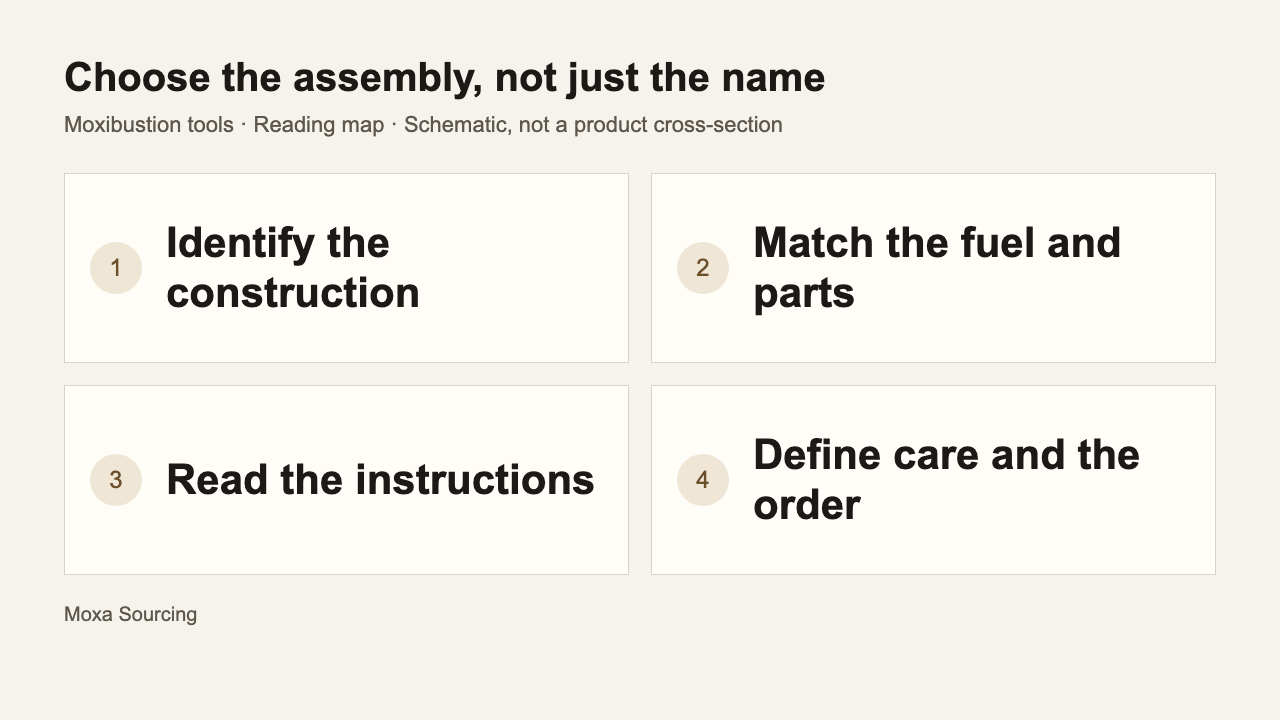
Match the named pair: holder or chamber, fuel dimensions, retention mechanism, orientation and supplied accessories. Outside size, a central opening and a refill size describe different parts. Examples include 11 × 10 mm refills for the green mini jar versus 12 × 15 mm refills for the red jar. The adhesive pad’s 4 cm opening is a holder interface, not a fuel diameter.
Edited by Moxa Sourcing · Updated 14 November 2026. Product examples are edited from complete saved manufacturer-derived catalogue records. Values and instructions retain their model scope; unresolved fields are identified where they arise.
What should be compared first?
| Item | Source-grounded distinction | Scope |
|---|---|---|
| Green mini jar | 11 × 10 mm refill | Named source pairing |
| Red mini jar | 12 × 15 mm refill | Different matching supply |
| Adhesive pad | About 4 cm central opening | Opening, not fuel diameter |
Moxa retainers: forks, roll clips, arms and mounting points
A fork, a roll clip and a furniture clamp are different interfaces
The saved support examples show three mechanically different connections. An oak-handled extender has three tapered prongs pushed into the fuel. A stand has a clip around the roll. The clamp-on stand also has a separate spring clamp connecting its arm to furniture. Calling all three a clip hides which object is being held. A useful assembly drawing starts at the fuel and follows the load path through the retaining part, arm and base or table connection. The source records describe the components, but do not provide a common retention-force test or a universal stability rating for these different mechanisms.
Extender handle length changes without changing the stated fork length
The regular extender has an oak handle about 7 cm long and 1.5 cm across, with a source-listed mass of 20 g. The long version has a handle about 16 cm long and 2 cm across, with a source-listed mass of 45 g. Both have a fork described as about 4 cm long. The longer option therefore does not supply evidence of a longer insertion section. The steel prongs are named as stainless steel, while the handle is oak. The record supplies no steel grade, handle finish, prong spacing or connection drawing between fork and wood. Those are more precise replacement fields than the phrase long moxa holder.
A three-cone illustration is a source claim, not a size envelope
The extender panels say the three-prong fork can hold three regular cones, and name regular cones, thick cones and rolls as uses. The written sequence pushes the fork into the selected fuel before fully lighting it. The record does not specify cone diameter, insertion depth, spacing, mass or a minimum unburned length. It also excludes the illustrated cones and rolls from supplied contents. The claim of using fuel to the end should not be rewritten as an instruction to let combustion reach the handle or prong connection. The buyer needs the selected fuel and its fitting instructions, rather than a capacity inferred from the number of prongs alone.
The clamp-on arm has two connections beyond the roll
The blue clamp-on stand combines a spring furniture clamp, a bendable gooseneck, a metal roll clip and a stainless-steel ash screen. Its parts panel marks a metal rod of about 20 cm, a gooseneck of about 56 cm and a screen about 10 cm across. The spring clamp is described for surfaces up to 5 cm thick, with a non-slip elastic band and silicone pads. That 5 cm figure belongs to furniture attachment, not to the fuel diameter. The padded clamp also does not identify every suitable table material or edge shape. Preserve the arm connection and furniture connection when checking a replacement clamp or a different mounting surface.
The roll range depends on clip orientation
For this clamp-on model, the source distinguishes rolls about 1.8–2.5 cm across with the clip held vertically from rolls about 2.5–4.5 cm across with it held horizontally. The overall phrase up to 4.5 cm loses that orientation condition. A compatibility entry should retain both ranges and the corresponding position of the clip. The record does not give grip force, allowable roll mass, permitted extension from the clip or stability at every gooseneck position. Its 360-degree adjustment claim identifies movement, not a tested load envelope. The assembly must still be described as the particular arm, clamp, roll and screen combination shown.
The clamp-on sequence assembles the screen and clip first
The written sequence screws the ash screen onto its connector and the roll clip onto its connector, secures the furniture clamp to a table edge, then adjusts the gooseneck angle and height. Only after that does it describe fully lighting the roll and fixing it in the clip. The saved 5.8-second muted close-up shows the spring clamp, its 5 cm marking and silicone pad; it is not the full six-step operating sequence. A buyer should retain the complete written steps alongside the short clip. The source’s ash instruction also says to move away from the body before tipping out accumulated ash, a detail that a clamp close-up cannot communicate.
The floor stand carries its own base and joints
The floor model is a black all-metal assembly with a flat base, upright rods, a jointed arm, large and small roll clips and a stainless-steel ash guard. The marked dimensions are about 32.5 cm for the base, 80 cm for the upright pole, 23 and 25 cm for arm sections, and 14 cm across the ash guard. These are part dimensions, not an overall adjustable height range. The source separately asks the buyer to confirm that range. The base has an EVA sponge pad, while the guard has a heat-insulating ring. Neither accessory is interchangeable with the clamp-on model’s furniture pads simply because both are described as protective.
The double clip and guard form a named subassembly
The floor stand’s stated roll range is about 2.5–8 cm across, using its large and small clips for different sizes. The instructions fit the clip’s long screw to the guard’s metal plate and tighten it firmly with the supplied spanner so that it does not turn. The bolt behind the clip then engages the arm’s clip plate, followed by firm hand-tightening of the arm bolt. The source says the arm adjustment screw and roll clip should be on opposite sides, as shown in the tutorial. Those connection details belong to this stand. They are not a thread specification for another clip, and the record supplies no tightening torque or minimum bolt-engagement dimension.
The base-direction warning is part of the configuration
The manufacturer warns that the stand head must face the same side as the flat base, otherwise the stand may tip. For another direction, the source calls for weight on the base and illustrates that arrangement. It also requires the joints to be locked before use and angles adjusted carefully. The record does not state a counterweight mass, reach limit, rated roll load or stability test. A long arm and a broad roll range cannot fill those missing values. This warning makes the base orientation an essential drawing field, alongside joint positions and the selected clip, rather than an optional note added after the stand has been photographed.
Fuel orientation and screen care are expressly stated
The floor-stand instruction places the fully lit roll in the matching clip with the burning end facing the screen. After use, it calls for a soft brush, such as a toothbrush, to remove ash, and specifically excludes a steel brush and steel wool because they may scratch or damage the screen. This is usable model-specific care information. It does not specify a washing solution, sterilisation process, cooling time or screen-replacement interval. The source also warns against burning moxa when nobody is present. Hands-free therefore describes how the roll is supported; it does not describe an unattended operating mode.
Do not resolve stand-weight conflicts by selecting the convenient number
For the floor stand, one parameter panel gives 1.8 kg, another listing field gives 1.95 kg, and the packing fields show 1950 with 45 × 35 × 10 without a settled net-versus-packed assignment. For the clamp-on stand, the panel gives about 435 g, while packing fields show 450 with 76 × 10 × 10 and another field asks the buyer to contact the seller. These values are not interchangeable bases for freight calculation. Keep the source locations and request the net mass, packed mass and carton dimensions for the exact assembly. No current stock, dispatch time or shipping quote follows from these saved figures.
Mini-jar compatibility: match green and red jars to their refills
The reusable jar and its disposable supplies are separate items
The mini-jar range sells six items: a green jar, its individual adhesive patch, a sheet of matching cylinders, a larger red jar, its individual patch and its cylinder sheet. Bare jars contain neither patches nor cylinders. Each cylinder sheet has 30 pieces, but the two sizes differ. The source says the jars are reusable and the patches and cylinders are replaced after use. A replenishment order must therefore identify which of the three item types is needed, not just ask for another pack of mini moxa.
Green and red jars have different source-matched cylinders
The green jar’s option image gives about 33 × 30 mm, while its parameter panel gives about 33 × 33 × 30 mm. Its cylinder is about 11 × 10 mm. The red jar is marked about 39 × 39 mm and its cylinder about 12 × 15 mm. Keep the two-dimensional option marks and three-dimensional green parameter description attributed to their original panels. Neither one is the internal chamber size. The cylinder width differs by only about 1 mm, but its stated height differs by about 5 mm; treating both refills as a generic small cone would lose an actual source distinction.
The green parameter panel does not establish a red-jar temperature
The green-jar panel states 42–46°C and 28–35 minutes, while other source wording describes an average near 45°C and around 30 minutes per cylinder. These are manufacturer values for the green example, without a supplied measurement method or temperature location. They must not become red-jar specifications or safe-use limits for every mini jar. The same source precaution text limits one area to 30 minutes, so the upper 35-minute parameter is not an instruction to extend use beyond that warning. The selected product needs consistent instructions and an identified basis for any claimed thermal value.
Equal jar masses do not identify equal accessories
Both jar options list 15 g. The green patch lists 1 g and its cylinder sheet 12 g; the red patch lists 2 g and its cylinder sheet 15 g. Those are source unit-weight fields for different sale items. They do not give individual cylinder mass or adhesive dimensions. A parts schedule should keep the jar, patch and sheet rows separate and record whether a mass refers to the item, sheet or shipment. The 50:1 fuel label is a manufacturer grade name, not a specification of the jar material or a measured quality comparison between the two sizes.
The cap and filter description remains a combustion design
The record describes a filter-cotton top, hollow base, internal pin and rotary or height adjustment of the top. The instructions lift off the top, light the cylinder through two side grooves, slowly replace the top and remove the adhesive backing before positioning. Raising the top is the source’s response to excessive warmth. This is a source sequence, not a complete engineering drawing or a universally transferable mini-jar procedure. The filter is described as reducing smoke; no smoke-free result, filtration rating, cap-retention measurement or replacement-filter part number is supplied.
Cylinder dimensions, cap travel and the missing chamber drawing
Two jars in one listing use different refills
The white open-flame jar listing separates a standard jar from an upgraded dome jar. The standard gift sets contain 30 or 60 cylinders; their separate refill option contains 30 cylinders about 1.5 × 2.5 cm. The upgraded dome jar is another option, with its own separately listed box of 54 cylinders about 18 × 27 mm. Being adjacent in one catalogue does not make the refills interchangeable. A replenishment order should name the standard or dome version before giving the pack count. Otherwise, a correct count of cylinders can still be an order for the wrong fuel envelope.
Convert the fuel units without creating chamber dimensions
For comparison, 1.5 × 2.5 cm is 15 × 25 mm. The other refill is stated as 18 × 27 mm. This unit conversion makes the two descriptions comparable, but does not identify an internal chamber diameter or chamber depth. The standard jar’s outside dimensions are about 9.5 cm across and 6.7 cm high; no corresponding overall size is supplied for the upgraded jar in this record. Neither outside height tells the buyer how much clearance remains above or below a burning cylinder. Keep the body dimensions, the fuel dimensions and the unprovided internal dimensions in separate fields.
Cap travel is not the same as fuel clearance
The standard white jar uses a rotary cap, an iron cylinder pin, side vents, carbon-fibre filter cotton, a stainless-steel ash screen and an anti-scald base inside an ABS shell. Its source picture marks about 6 mm of adjustment travel when the cap is lifted and turned. That figure describes the pictured adjustment movement, not a complete minimum clearance around the fuel or an approved skin distance. The record does not map the movement to a temperature. A replacement cap, pin or base needs its own interface description; the 6 mm mark cannot serve as the dimensions of all three parts.
A supplied manual is listed but its contents still need review
The standard gift-set contents name the box, jar, short strap, long strap, acupoint chart, manual and the selected 30- or 60-cylinder quantity. The short strap is about 30.5 cm and the long strap about 76 cm, with different body-area illustrations. The standard set therefore has more than one fastening accessory, but that does not establish that both are supplied with the separate upgraded jar. Its option names only the dome jar, strap and box. The listed manual should be requested for the selected assembly and refill, rather than treating the existence of a manual in the standard kit as a complete instruction set for every option.
A four-pin cap does not imply four cylinders
The large red jar has four steel pins in its cap and separately offered cylinders in three sizes. Its manufacturer suggests three of the 18 × 27 mm cylinders, two of the 20 × 27 mm cylinders or one of the 30 × 25 mm cylinders. These are source loading suggestions for the named jar and refill options, not a general rule for other four-pin containers. The four pins do not mean four pieces of any diameter can be loaded together. The source also describes cylinders up to about 3 cm across, which is a width statement; it does not settle every cylinder length, spacing or total fuel quantity.
Keep the refill height apart from a comparison illustration
In the red-jar record, the separately offered large refill is 30 × 25 mm and six pieces per board. A comparison illustration elsewhere shows cylinder diameters around 1.5, 1.8, 2 and 3 cm, and a 4 cm height mark for its largest illustration. That drawing does not change the orderable 30 × 25 mm refill into a 30 × 40 mm product. The saved record explicitly retains the separate refill dimensions. This is a practical reason to map each dimension to its option and source image: a picture comparing general shapes may not be the dimension panel of the item being ordered.
A grade name is not a fitting dimension
The 18 × 27 mm red-jar refill is named 10:1, while the 20 × 27 mm refill is named 1500 yan stone-milled. The saved source does not define either label. They can be retained as manufacturer identifiers in the private source mapping, but should not be converted into a purity percentage, age, thermal output or quality ranking. For the tool interface, the usable stated differences are the dimensions, supplied counts and the manufacturer’s corresponding loading suggestions. Fuel composition and grade interpretation belong to the fuel record; they do not provide missing dimensions of the cap pins or chamber.
The filter position is another part of the fuel envelope
The red jar names top, middle and bottom filter cotton, with a movable piece placed at the top or base according to the supplied design. It also names a foil-lined inner wall, stainless-steel ash screen and hook-and-loop strap about 71 cm long. The outside is about 7.5 cm across the top, 9 cm across the base and 9.5 cm high. These details show that the available interior is not an empty cylinder equal to the exterior. An interface drawing needs the selected filter arrangement, pin projection and screen position around the chosen refill. The source does not provide those internal measurements or a filtration-efficiency result.
Similar steps do not make the assemblies identical
Both records describe opening a cap or lid, fitting a cylinder, lighting it fully and adjusting the jar before fastening it on the body. The white standard jar’s sequence puts its cap back on before adjusting and attaching the strap. The red jar’s written steps identify fitting the filter cotton after the temperature adjustment. Keep those source sequences with the matching drawings. A cylinder that fits on a pin is not evidence that the cap closes, that the filter remains in its intended position or that the screen can be reached for ash removal. Those are separate assembly observations for the selected sample.
The missing chamber drawing remains an honest gap
Neither record supplies a complete chamber drawing with tolerances, pin dimensions, screen clearances, fuel mass, burn duration and approved extinguishing or cooling checks. The gift sets and refill lists are useful evidence of the offered configurations, but not substitutes for that missing interface description. A replenishment brief can still be prepared by naming the jar version, fuel option, stated dimensions and pack count, while carrying the unprovided fields as questions. Keep any later sample measurements separate from the saved catalogue values. No sample fit, temperature setting or safe operating distance has been measured in this editorial comparison.
Adhesive pad and holder interfaces: opening, backing and supplied parts
One adhesive pad is the complete sale unit
The nonwoven adhesive-pad record offers one pad, without the holder, canister or moxa sticks shown in its photographs. Its source packing weight is 1 g, and the packing dimensions are 12 × 10 × 0.1 cm. That is different from a complete burner kit. If a buyer orders this accessory to replenish an existing tool, the tool must still be identified separately. A holder shown passing through the pad is evidence of the illustrated fitting arrangement, not an included component or a published compatibility list for every holder called suspended or magnetic.
The centre opening and pad outline are separate dimensions
The pad itself is about 11.8 × 10 cm, with four rounded tabs and an approximately 4 cm central opening. The 4 cm figure belongs to the opening around the canister, not to a moxa roll diameter or the adhesive contact width. The outer packing dimensions do not replace this opening dimension. To assess a named holder, identify the portion that passes through the opening and the adjacent shape that keeps the pad in its intended position. The saved source gives no opening tolerance, allowed canister mass or validated range of holder neck shapes.
Fabric, adhesive and release paper have different roles
The listed materials are nonwoven fabric, white hot-melt adhesive and release paper. The source describes micro-perforation for breathability and a central opening in the release paper to assist peeling after fitting the pad around the canister. These details do not identify adhesive chemistry, skin-contact test results, a wear duration or a removal method. The pad is described as disposable, so a reorder quantity should not be interpreted as a cleaning or reuse schedule. If skin-contact documentation is needed, request it for the actual adhesive and fabric combination, rather than treating a breathable description as a material-safety result.
Fitting the pad is only part of the holder sequence
The manufacturer’s illustrated sequence opens a separate holder, fits the pad over the canister, inserts and lights a stick, closes the canister and adjusts its top before peeling the backing and fixing the assembly. This is the sequence depicted for a separate holder, not a self-contained operating manual supplied by the pad alone. The pad source gives only a temperature-sensitivity note and no complete fire, burn, removal or extinguishing precautions. Those remain with the selected holder and fuel instructions. The source’s sale unit also remains one pad even though the instructions necessarily show the assembled burner.
This accessory does not offer the same customisation as every tool
The pad listing says logo printing and custom processing are not available for this listing, while it gives 25,200 pads per carton. Neither statement establishes a current commercial quote or a retail pack count: the record separately asks how many pads are packed together. Keep carton quantity, inner packing and branding availability apart. A supplier’s ability to customise a nearby canister does not automatically apply to the adhesive pad. Before completing a kit brief, identify the exact holder fit, the required pad quantity and the permitted packaging arrangement without inventing a private-label option.
Separate tube size, refill pack and complete-jar count
Two reusable paper-tube records offer bare tools and replenishment supplies as separate choices. The four-choice white-tube listing offers one tube with one insulating pad, a 60-cylinder pack, five square patches, or one strap. The bare tube contains neither cylinders nor patches; the strap option contains no tube. Its outside dimensions are about 4.0 × 6.2 cm with a base about 5.2 cm across. These outside dimensions do not establish an internal fuel envelope.
The nine-choice large/small listing provides a more specific refill mapping. Large white and gold tubes are separate bare-tool choices; the small white tube is another choice. The large tube is about 5.5 cm across the top, 8.5 cm high and 6.5 cm across the base. The small tube is about 4 cm across the top, 6.2 cm high and 5.2 cm across the base. The source matches the large tube with 54 cylinders about 18 × 27 mm and the small tube with 60 cylinders about 15 × 25 mm. Large patches are supplied in a 60-piece choice, small patches in a five-piece choice, and each size has its own separate strap choice. Similar outside dimensions in another listing are not a substitute for this named mapping.
| Another mini-jar listing | What the sale unit actually states | Order field to retain |
|---|---|---|
| Single-use mini jar, about 30 × 28 mm | One jar with one fitted cylinder and an adhesive patch | Single use; fully extinguish before disposal |
| 30-piece presentation box | 30 prefitted jars, each about 3 × 2.8 cm | No refill or reuse directions supplied; confirm intended disposal |
| 30-cylinder box with patches | 30 cylinders and 30 patches; tube count is not stated | Request the number of tubes and whether they may be reused |
A photograph showing two tubes does not establish the shipped tube count. Likewise, one pack of cylinders is not one pack of complete burners. Write the tool, cylinder, patch and strap quantities as separate lines before comparing unit prices. Keep unresolved mass fields separate: the single-use jar lists 10 g as a unit field and about 7 g on its jar panel; the two boxed mini products also have conflicting packing weights. These are questions for the selected pack, not values to silently label net or gross.
A practical interface drawing and paired-sample record
Combine the useful drawing and sample fields into one record: tool reference and revision; fuel reference and dimensions; drawing revision; chamber and opening measurements; retainer and screen positions; tolerances agreed for the selected pair; instruction revision; observations; and approval owner. Show where each dimension starts and ends. Record a missing chamber dimension as missing rather than substituting the outside tube diameter.
Both paper-tube sources say old and new versions may be supplied. Ask which version the sample represents and identify it in the order; do not assume the same cap, patch or refill fit without checking. Reopen the affected parts of the paired record after a changed opening, fuel size, retainer, screen, base or strap attachment. Record sample observations separately from catalogue claims and keep the superseded drawing. This is a proposed purchasing workflow, not a report that a sample has already passed fit or thermal testing.
Sources and scope
The product-record and standard links used in this chapter are listed below. Product statements remain attributed to their sources; they do not establish a manufacturing relationship, approval or Moxa Sourcing test result.
- Oak Moxa Stick Extenders — Regular or Long
- Clamp-On Gooseneck Moxibustion Stand
- Floor-Standing Moxibustion Stand
- Mini Moxibustion Jars & Supplies — 6 Options
- Moxibustion Jar Sets and Cylinder Refills
- Large Moxibustion Jar and Cylinder Refills
- Adhesive Pad for Moxibustion Holders — Single Piece
- Portable Moxibustion Tube & Supplies — 4 Options
- Moxibustion Tubes & Supplies — 9 Options
- Single-Use Mini Moxibustion Jar — 1 Piece
- Mini Moxa Jars — 30 per Box
- Mini Moxa Tubes — 30 Cylinders
Frequently asked questions (FAQ)
How do tool and moxa consumable interfaces fit together?
Match the named pair: holder or chamber, fuel dimensions, retention mechanism, orientation and supplied accessories. Outside size, a central opening and a refill size describe different parts. Examples include 11 × 10 mm refills for the green mini jar versus 12 × 15 mm refills for the red jar. The adhesive pad’s 4 cm opening is a holder interface, not a fuel diameter.
Does a similar name prove compatibility?
No. Keep the exact model, selected option, dimensions and instructions together; similar names do not settle the interface.
Which details belong with a sample request?
Identify the tool version, selected parts, matching fuel, quantity and destination, with the instruction and packing fields that still need confirmation.
Next step
Identify the Moxa product reference, configuration, fuel, quantity and destination, with the instruction, packing and unresolved-field requirements for the selected order.
Request a quote