Moxibustion tools, devices and accessory fit
How should cleaning and replacement parts be organised?
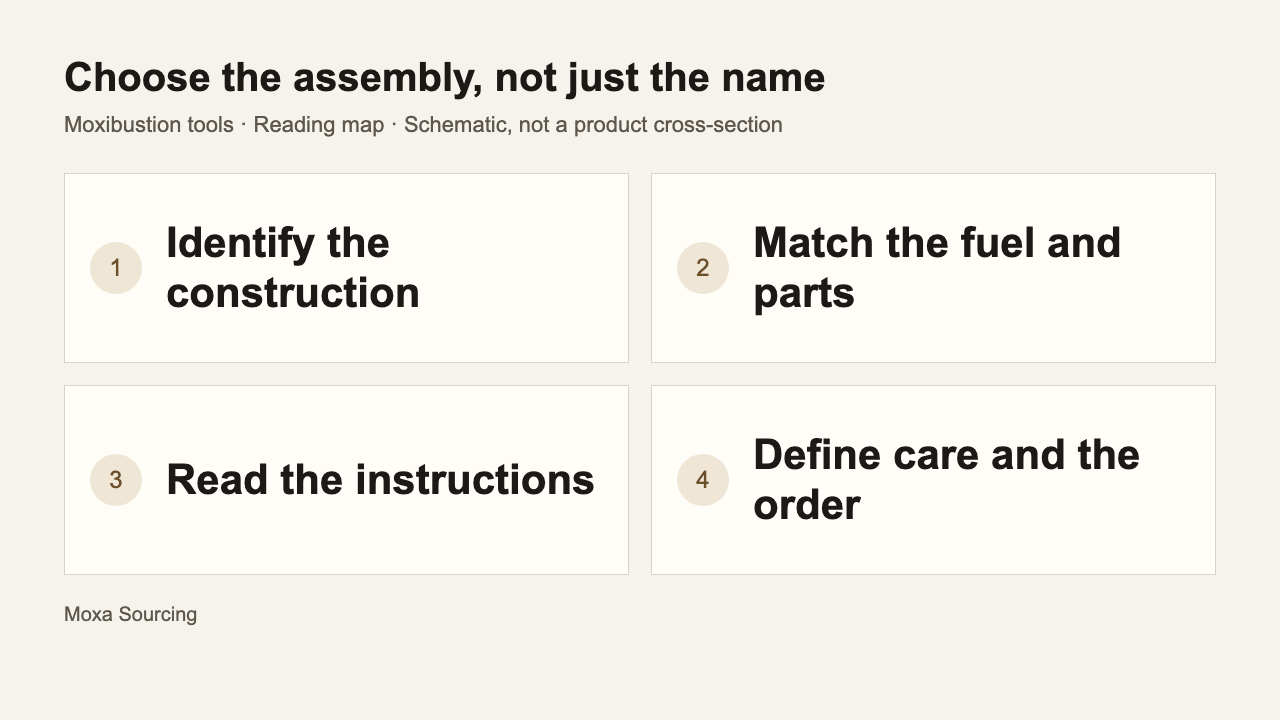
Separate cleaning access from a cleaning method. Covers, filling, powered parts, screens and sleeves have different care requirements; replacement parts must match the actual size and construction version. A washable fabric cover does not make a heating pad washable. Fire-dragon jar spares also need the selected size and the old or new inner-cap version identified.
Edited by Moxa Sourcing · Updated 14 November 2026. Product examples are edited from complete saved manufacturer-derived catalogue records. Values and instructions retain their model scope; unresolved fields are identified where they arise.
What should be compared first?
| Item | Source-grounded distinction | Scope |
|---|---|---|
| Outer cover | Model-specific washing directions | Remove inner components |
| Heating pad and controller | No water washing in the named records | Keep parts separate |
| Spare screen or sleeve | Size and cap version | Confirm actual replacement |
Cleaning and service: separate electrical covers, filling and powered parts
Removable means identify which part can be cleaned
In an electrical botanical warmer, a removable outer cover, herb liner, salt bag, heating pad and controller are different care objects. The blue belt separates its double-layer salt liner from its mugwort pad and cloth cover. The purple cushion separates its herb liner from its electric heating sheet and zipped velvet cover. A listing described as removable and washable does not mean every component is washable. Start the care schedule with the actual component list and attach each care instruction to the named part, rather than putting one washing symbol against the entire product.
The cover instructions exclude machine washing
For both the blue belt cover and purple cushion cover, the saved care symbols specify hand washing, no bleach, flat drying and no dry cleaning. The text also excludes machine washing and tumble drying. Those directions apply to the removed cloth cover. The source does not give a water temperature, detergent, soak duration or validated disinfection method. A buyer can carry the supplied care symbols into the artwork brief while retaining those missing values as questions. A removable cover is not evidence of a reusable clinical barrier or of an agreed cleaning process between different users.
The nonwashable inner components are named explicitly
The blue belt record says not to wash the mugwort pad, heating pad, temperature controller or sea-salt pack in water. The purple cushion likewise excludes water washing of the heating pad, controller and cushion liner. Both records mention sun drying of the relevant filling liner. That is not an instruction to wash the liner first or to expose an assembled powered product to water. It also provides no drying temperature, duration or microbiological result. Keep the original prohibition visible when translating the more general phrase easy to clean.
The round pad has a different level of care detail
The round mugwort belt record describes a removable washable cotton cover and says to remove all inner components before cleaning it, following the supplied care instructions. It does not provide the same detailed care-symbol list found for the blue belt and purple cushion. Those symbols should not be transferred to it as manufacturer instructions. The source separately advises replacing the mugwort inner pad about every two months. That is a manufacturer recommendation for the botanical insert, not the service life of the heater, controller, cover or every mugwort product. A replacement insert still needs its dimensions, filling and selected-product compatibility.
Cooling and storage are part of the care instruction
The records call for cooling before storage and keeping the unused product dry in its bag or packaging. They warn against placing objects on it that create creases, and against folding, covering or rolling it while powered. The blue belt and purple cushion also call for regular checks for wear or damage. These are explicit care conditions, but the saved wording does not supply a detailed fault-diagnosis or return-to-service procedure. A care card should preserve the warnings and provide the selected product’s support route rather than inventing a repair sequence or declaring a damaged product fit after visual inspection alone.
A care label needs the actual cover material
The blue belt’s product panel identifies polyester fibre, while other panels and the video call the cover linen. The purple cushion panel identifies polyester fibre and describes a crystal-velvet surface. Retain the blue belt’s material conflict for confirmation; do not resolve it by translating linen-look appearance into a verified linen-fibre content. A replacement cover or revised label should follow the confirmed material and construction of the actual sample. Colour, embroidery, velvet appearance and fibre composition are different specification fields, even when one photograph shows them together.
Spare parts for three fire-dragon jars: size and inner-cap versions
Spare parts must follow the selected jar size
The fire-dragon range offers a small single-pin jar, a medium three-pin jar and a large four-pin jar. Their top diameters are about 5, 6 and 8.2 cm; heights about 9.5, 11.5 and 10.5 cm; and base diameters about 7, 8.5 and 11.5 cm respectively. The medium is taller than the large, so the names alone do not identify a replacement screen or sleeve. Keep top, base and height measurements assigned to the corresponding body. The record names size-specific upgraded screens but supplies no screen diameter or retention tolerance.
Old and new inner-cap versions need separate identification
The manufacturer says old-style and new-style jars ship at random. The old style has no inner metal cap and the new style has one. The body description also discusses a metal inner wall. These details must remain distinct: an inner-cap change should not be silently treated as an unchanged liner specification. For a buyer approving a sample and spare parts, identify which version will be supplied and preserve the matching photograph. The saved record does not provide a part interchangeability statement, version number or assurance that a replacement intended for one cap arrangement fits the other.
Included accessories are not automatically separately orderable spares
Each jar option includes an ash screen, smoke-filter cover, anti-scald sleeve and acupoint chart, but the seven-option order list sells three jars and four fuel packs. It does not list an independently orderable spare screen, sleeve or cover. The accessory names are useful for a parts request, while price, availability, part codes and compatible version remain unresolved. Calling a filter cover washable and reusable does not establish its replacement interval. The listed material is bian stone plus clay; a composition document shown for that material must still be tied to the supplied configuration and batch.
The refill sizes are mapped to three named jars
The small jar is paired with 18 × 27 mm cylinders, offered as 54 per board or 54 per box. The medium jar is paired with 30 × 25 mm cylinders, six per board. The large jar is paired with 50 × 25 mm cylinders, six per board. All are described as wrapped in mugwort-leaf paper. These are source pairings for this range; the same count of pins in another jar is not enough to transfer the refill. Cylinder mass and burn duration remain requested fields. The jar options themselves exclude cylinders.
The screen instruction includes a refitting condition
The source sequence removes the screen, fits and fully lights cylinders, clips the screen back tightly, then fits the sleeve and optional filter cover. Its 12.8-second muted video demonstrates the sequence with the medium jar. The requirement to refit the screen tightly belongs in the assembly instruction, not only in a cleaning note. A pull-ring makes a particular screen accessible, but the record provides no repeated-removal test or criterion for a worn clip. Refer to the cleaning-access answer for the shared pull-ring feature; this section retains the size and version questions needed for spares.
Cleaning access and removing the screen
The small single-pin ceramic jar record describes an ash screen with a pull-ring for removal. Its comparison panel discusses the difficulty of removing and cleaning a screen without that ring. The feature to identify is the ring and its connection to this screen, not an assumed removal path for all ceramic jars.
A spare-parts schedule starts with the reuse boundary
The reusable paper-tube records distinguish reusable tubes and straps from replaceable cylinders and adhesive patches. The single-use mini jar expressly says to discard the complete unit after extinguishing. The two other mini-product records leave reuse or tube count unresolved. A spare-cylinder order therefore needs the approved tool version and the source-matched cylinder size; it must not silently turn a disposable assembly into a serviceable one.
| Reorder field | What to record |
|---|---|
| Part and compatible tool | Own product reference, option name, size and tool revision; separate cylinder, patch, strap, cap and screen rows. |
| Supply unit | Pieces per pack and packs ordered; distinguish a single patch from a sheet or a complete kit. |
| Replacement instructions | Which parts the manufacturer allows to be removed or replaced, with the matching instruction revision. |
| Commercial fields | Current minimum order, spare-part packing and stated lead time, confirmed for that part. |
At receipt, compare the actual parts with the agreed reference, counts, dimensions, attachment and instruction version. Record missing parts, deformation, damaged screens, loose fasteners or mismatched patches before putting the assembly into service. Ask for a part-specific cleaning and replacement method where absent; a filter’s presence alone supplies no cleaning method or replacement interval. Keep incoming observations and any repeated functional checks as dated records, rather than describing them as tests already performed by Moxa Sourcing.
Sources and scope
The product-record and standard links used in this chapter are listed below. Product statements remain attributed to their sources; they do not establish a manufacturing relationship, approval or Moxa Sourcing test result.
- Electric Mugwort Heating Belt
- Electric Sea-Salt Heat Belt — Blue
- Electric Mugwort Cushion — Purple
- Bian Stone Fire Dragon Jars and Moxa — 7 Options
- Handheld Moxa Massage Cup — Four Rim Shapes
- Bamboo Moxibustion Jars, Refills and Oil
- Gourd and Bamboo Moxibustion Holders
- Pine-Wood Dragon-Bone Moxa Board — 2 Sizes
- Floor-Standing Moxibustion Stand
- Portable Moxibustion Tube & Supplies — 4 Options
- Moxibustion Tubes & Supplies — 9 Options
- Single-Use Mini Moxibustion Jar — 1 Piece
- Mini Moxa Jars — 30 per Box
- Mini Moxa Tubes — 30 Cylinders
Frequently asked questions (FAQ)
How should cleaning and replacement parts be organised?
Separate cleaning access from a cleaning method. Covers, filling, powered parts, screens and sleeves have different care requirements; replacement parts must match the actual size and construction version. A washable fabric cover does not make a heating pad washable. Fire-dragon jar spares also need the selected size and the old or new inner-cap version identified.
Does a similar name prove compatibility?
No. Keep the exact model, selected option, dimensions and instructions together; similar names do not settle the interface.
Which details belong with a sample request?
Identify the tool version, selected parts, matching fuel, quantity and destination, with the instruction and packing fields that still need confirmation.
Next step
Identify the Moxa product reference, configuration, fuel, quantity and destination, with the instruction, packing and unresolved-field requirements for the selected order.
Request a quote