Moxibustion tools, devices and accessory fit
How should operating and stop-use instructions be read?
Keep the instruction sequence, named parts, model version, supervision and stop conditions together. Source-panel conflicts remain explicit questions; a picture or a timer is not a substitute for a complete instruction.
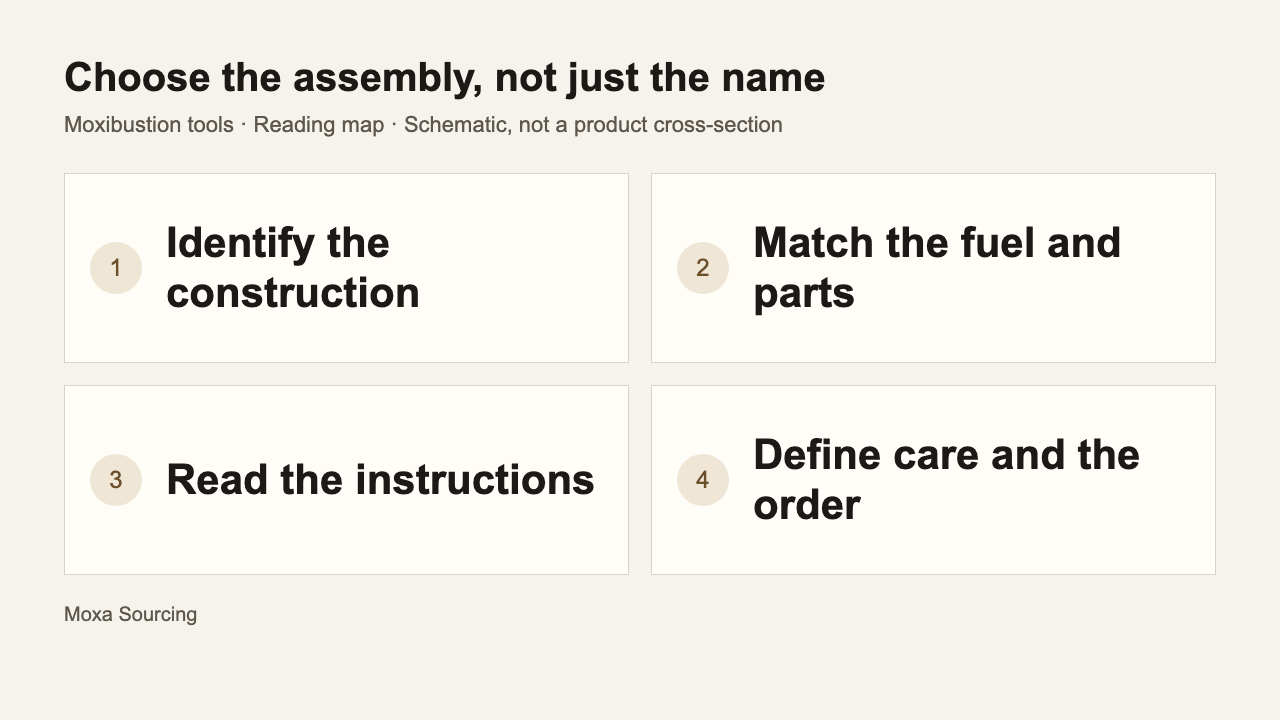
Edited by Moxa Sourcing · Updated 14 November 2026. Product examples are edited from complete saved manufacturer-derived catalogue records. Values and instructions retain their model scope; unresolved fields are identified where they arise.
What should be compared first?
| Item | Source-grounded distinction | Scope |
|---|---|---|
| During use | Observe the stated conditions | Retain model scope |
| After use | Complete extinguishing | Follow selected instructions |
| Before opening | Cooling where specified | No universal elapsed time |
Reading an instruction set: the flexible pine-board example
The flexible board is not an enclosed box
The pine board consists of linked rounded slats, double-layer 201 stainless-steel mesh, stainless-steel handles and a cloth cover attached with hook-and-loop strips. The short option is about 25 × 30 cm and the long option about 70 × 30 cm, illustrated for the abdomen and back respectively. The flexible linked structure can bend and roll for storage. It is not the hinged, latched chamber described in the adjustable wood-box example. A shared material name does not make the board’s loading layers or handling instructions suitable for that box, nor does the long shape establish a clinical outcome along the spine.
The saved record preserves two different sequences
One written description places mulberry-bark paper on the person lying face down, positions the board, adds an even ginger layer and moxa floss, then lights it while watching the skin. A second six-step list starts with a warming towel or mulberry-bark paper in the tray, spreads finely chopped ginger, positions the tray along the back, adds two rows of floss and lights them. The sequences differ in where the initial layer is placed and when the tray is positioned. They should be reconciled with the manufacturer’s actual instruction, rather than merged into a newly invented operating order.
The ginger-layer warning has no supplied numerical thickness
The manufacturer says the ginger layer must be thick enough to prevent moxa from leaking through and touching the skin. Another step calls the ginger layer thin and even. The saved material provides no numerical thickness or verified loading mass that resolves those descriptions. This is an instruction gap, not permission to recommend a thickness by analogy with another tray. The board’s double mesh and the illustrated heat arrows do not replace the explicit layer warning. A usable instruction set needs the correct layer arrangement and its applicable constraints identified before the source panel is treated as a complete procedure.
The source couples burning with continuous monitoring
The board record requires monitoring the person and heat while the floss burns, keeping flammable materials clear and completely extinguishing the moxa afterward. It also says to stop if the heat is excessive or redness or itching develops. The illustrated 30-minute session and the manufacturer’s time restrictions are source statements, not an independently approved patient schedule. A buyer reading the instruction should preserve the monitoring and stop conditions alongside any time statement. The record does not give a complete measured cooling confirmation or extinguishing method, and this comparison does not supply one.
A handle description is not a measured temperature result
The source describes the stainless-steel handles as staying cool enough to lift. That is a manufacturer handling claim, without a measured handle temperature, test duration or grip condition in the saved record. The single 410 g weight field also fails to identify which board size it describes. Keep these limits when preparing lifting and packing information. The actual short or long sample needs its own mass and handling instruction. The removable washable cloth cover is a separate component; the cloth statement does not authorise washing the linked wooden board or mesh assembly by the same method.
Finding the stop-use conditions in a document
Read the timing of each instruction: skin observation during use, complete extinguishing after use and cooling before opening. The examples below retain those distinct actions and their source limits.
The large jar and cylinder-refill listing combines two different instructions: watch the skin during use to avoid scalds, and check complete extinguishing after use. Their timing matters. Skin observation belongs to use; the extinguishing check belongs after use. Neither clause supplies a numerical skin-temperature limit, a treatment duration or a cooling time. Those absent values should remain absent in the comparison instead of being borrowed from another product.
The cones-and-extenders listing says to let the moxa box cool before opening it after use, to avoid scalding. The stated sequence is cooling before opening. This sentence does not identify the box model, a cooling duration or a way to confirm its cooled state. It can support a question about the matching box instructions, but cannot establish that every extender, lid or screen may be opened after the same elapsed time.
These records support an instruction comparison, not a completed stop-use procedure. Keep the literal warning, the action it modifies, its place in the sequence and its model scope together. Where the selected document has no explicit discontinue condition, record that omission and request the appropriate document. A construction photograph, supplier invoice or certificate-holder name cannot answer the missing instruction question.
Keep lighting, closure, removal and disposal in the same instruction set
The saved handling sequences differ in practical details. The reusable white paper tube places the cylinder on its pin, lights it, closes the tube, fits the patch and then sets the vent before application. The single-use mini jar instead describes side-lighting the fitted cylinder and gently replacing its cover. The 30-jar presentation-box model names lighting through notches on both sides. These are model-specific document contents, not one procedure to apply to every jar.
Preserve the later steps as carefully as the lighting photographs. The single-use model expressly requires complete extinguishing before disposal and prohibits unattended open-flame use. The 30-cylinder listing warns that its cap becomes hot during burning and calls for complete extinguishing afterwards. The copper-box instructions require removal from the body before emptying accumulated ash. Do not let the reusable-tube description supply reuse permission for the 30-jar box, whose source gives no refill or reuse instructions.
A usable handover follows the whole sequence: preparation and supplied parts; the selected model’s lighting method; closure and control operation; supervision and stop-use warnings; removal; extinguishing; cooling confirmation before residue handling or packing; and disposal or service instructions. Where the record does not state an extinguishing method, cooling criterion or disposal route, request that part of the manufacturer’s instructions. Do not invent a fixed cooling time or advise sealing a lit unit in its retail box. Keep the complete original warnings with the translated instructions; this comparison is not a clinical use schedule.
Sources and scope
The product-record and standard links used in this chapter are listed below. Product statements remain attributed to their sources; they do not establish a manufacturing relationship, approval or Moxa Sourcing test result.
Frequently asked questions (FAQ)
How should operating and stop-use instructions be read?
Keep the instruction sequence, named parts, model version, supervision and stop conditions together. Source-panel conflicts remain explicit questions; a picture or a timer is not a substitute for a complete instruction.
Does a similar name prove compatibility?
No. Keep the exact model, selected option, dimensions and instructions together; similar names do not settle the interface.
Which details belong with a sample request?
Identify the tool version, selected parts, matching fuel, quantity and destination, with the instruction and packing fields that still need confirmation.
Next step
Identify the Moxa product reference, configuration, fuel, quantity and destination, with the instruction, packing and unresolved-field requirements for the selected order.
Request a quote