Moxibustion tools, devices and accessory fit
Which moxibustion tool construction fits the task?
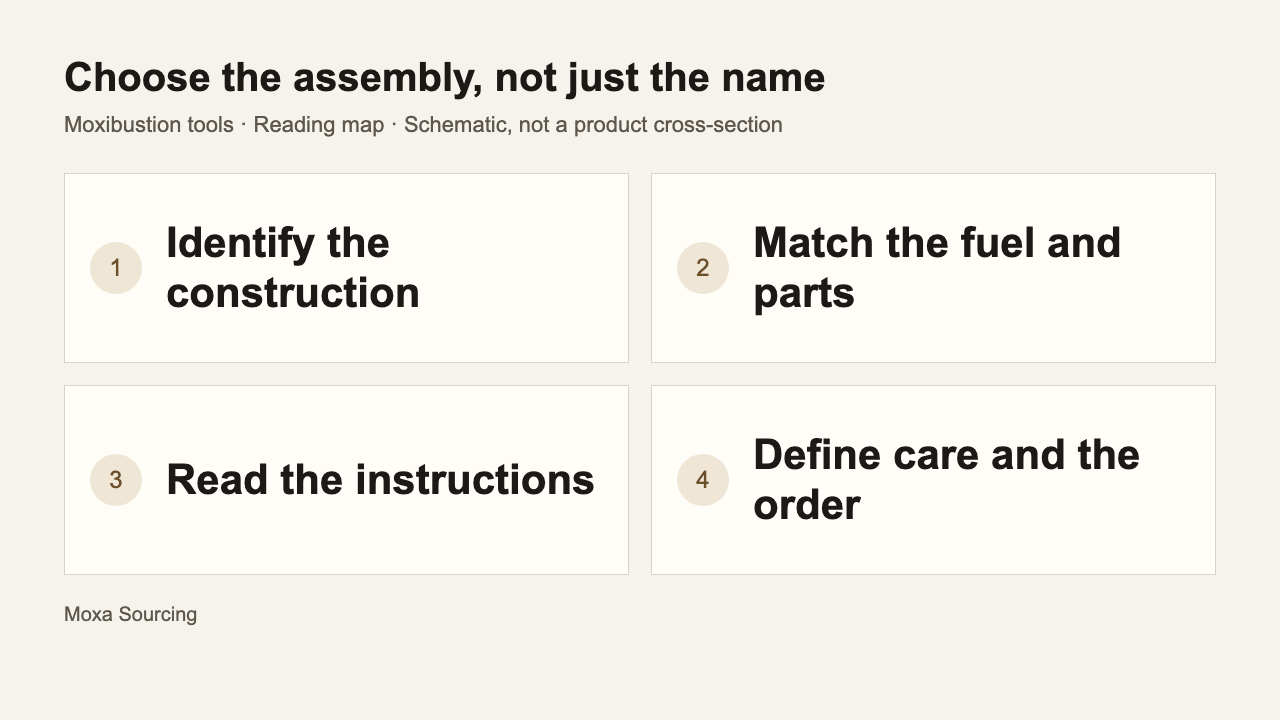
Compare bamboo roll-through boxes, pin-mounted containers, handheld cups and adjustable wood boxes by their actual fuel route, controls, body-facing parts and supplied accessories. For example, the six-option adjustable wood-box listing sells boxes, covers and fuel separately. A three-pin bamboo container also differs from a three-hole roll-through box.
Edited by Moxa Sourcing · Updated 14 November 2026. Product examples are edited from complete saved manufacturer-derived catalogue records. Values and instructions retain their model scope; unresolved fields are identified where they arise.
What should be compared first?
| Item | Source-grounded distinction | Scope |
|---|---|---|
| Bamboo box | Roll-through holes or cylinder pins | Different source families |
| Handheld cup | Roll or internal cylinder | Rim and retention differ |
| Adjustable wood box | Pins, grooves and lower drawer | Six separate options |
Bamboo moxa boxes: hole, pin, screen and strap construction
A hole-count box and a pin-count container are different families
The word bamboo describes a material, not a single fuel interface. In the first saved example, rectangular boxes have metal-lined holes through the lid, spring clips holding rolls and side discs that adjust vents. In the second, round containers hold cylinders on three or five pins beneath a bamboo lid. The round container also has a cloth sleeve, filter cover and heat-shield pad. These differences matter before comparing the number in the product name. A three-hole box is not the same assembly as a three-pin container, and the fuel-loading route in one example cannot be copied into the other example’s instruction.
Five hole counts, with two supply configurations each
The rectangular box record offers one, two, three, four and six holes. Each hole count has a latch configuration and a configuration supplied with one automatic pusher per hole, giving ten choices in total. The record excludes the moxa sticks from the supplied contents. A pusher in a demonstration photograph therefore does not establish that the latch-only option includes it. Conversely, the pusher option includes as many pushers as there are holes, rather than one pusher shared by a multi-hole box. Keep those contents on the same order line as the chosen hole count so that the packing list does not silently reduce the selected configuration to a generic bamboo box.
The five box shapes do not follow one linear size sequence
The one-hole box is about 9.1 × 8.2 × 8.2 cm; the two-hole box about 13.2 × 8.2 × 8.2 cm; and the three-hole box about 17.3 × 8.2 × 8.2 cm. The four-hole box changes the footprint to about 13.2 × 12.5 cm and the height to about 8.5 cm. The six-hole box is about 17.3 × 12.5 cm, with no height supplied in the saved specification. Thus the four-hole version is not simply the next longer version of the three-hole box. Comparing footprints helps a buyer distinguish the offered layouts, but the dimensions do not provide a chamber-depth or treatment-area measurement.
Box mass and packed mass have different evidence
The source panel gives approximate box masses of 146, 187, 243, 270 and 330 g for the one-, two-, three-, four- and six-hole versions respectively. Its general weight field still says to ask the supplier, and packed weight is not identified for each choice. The panel values can describe the pictured boxes without resolving shipping mass for the latch and pusher variants. The pusher count also differs by option, so an order brief should preserve the selected supplied contents when requesting packed weight. A carton quantity of 120 pieces appears in the listing; it does not establish that all ten choices use one mixed-carton arrangement or the same carton dimensions.
The hole liner, spring clip and pusher have separate jobs
In the rectangular construction, the metal-lined hole guides the roll through the lid, the spring clip holds it and the optional pusher advances it as it burns. These are three components in one route through the assembly. The word automatic describes the source’s feed mechanism; it does not establish automatic temperature control, automatic shut-off or permission to leave the device unattended. The saved record supplies no hole diameter, clip force, pusher travel or compatible roll gauge. Those are interface fields for the chosen sample. A drawing should therefore show the roll passing through the liner and clip, and identify the optional feed component separately rather than calling every metal part a holder.
The side discs regulate vents rather than measure temperature
Rotating wooden discs open or close vents on the rectangular box. The instruction describes turning them to set a comfortable temperature after the roll has been fitted, lit and positioned and the box secured with its strap. The discs are mechanical openings; the record identifies no sensor, display, thermostat or calibrated scale. Nor does it supply an opening angle associated with a particular temperature. When describing this construction, retain the vent location and its method of movement. A label such as temperature control should not make the buyer expect electronic feedback or an agreed temperature setting that the source never supplies.
The larger round container is wider and slightly shorter
The round three-pin container is stated as about 12.5 cm in diameter and 12 cm high, with a source-listed mass of 350 g. The five-pin container is about 18.5 cm in diameter and 11 cm high, with a source-listed mass of 600 g. Both are one-container packs with a cloth sleeve, smoke-filter cover and one heat-shield pad. The larger pin count is paired with a larger diameter, but a slightly lower stated height. This example shows why pin count cannot replace a size drawing. The gallery also shows styles that are outside the two offered options; those images do not expand the purchasable range.
Name the layers without treating them as interchangeable
The round container’s cutaway names a thickened smoke-filter cover, high-density ash-catching mesh, a heat-shield pad and a thickened inner wall. The cloth sleeve and elastic strap are also named. These parts occupy different positions and perform different described functions. A replacement cover is not automatically a replacement ash mesh, and the included heat-shield pad should not disappear from the bill of contents because a photograph looks padded. The source uses smoke-filtering and scald-protection claims for these layers. It gives no filtration efficiency, maximum contact temperature, mesh aperture or material composition for the cloth. The layer map identifies the parts; separate specifications are needed to define any claimed performance.
The round container has two described adjustments
For the round model, the source describes turning the lid to enlarge or reduce the vent opening, and raising or lowering the pins to alter the position of the burning cones. It associates a smaller opening and raised pins with lower temperature, and a larger opening and lowered pins with higher temperature. Keep the two movements separate in an illustration: rotating a vent does not physically raise the cone, while moving a pin does not specify an airflow opening. The text does not give a calibrated cone-to-skin distance or a numbered setting for either control. These descriptions belong to this model and cannot settle the controls of the rectangular clip-and-pusher box.
The six-step sequence distinguishes fitting from fastening
The round-container sequence starts with fitting the heat-shield mesh over the base, then fitting and fully lighting cones on the pins. The lid is placed with its arrow aligned, the clasps are fastened, the vent is adjusted and the strap is secured. The alignment arrow and clasps are therefore part of the assembly explanation, not decoration. The demonstration ends with ginger slices placed in the container, but the saved record excludes both cones and ginger from the supplied contents. A manual or packing illustration should not convert that final demonstration into an included-fuel claim. Nor should a cloth sleeve be used as a reason to omit the explicit lid-fastening step.
An adjustable strap still needs a usable fit description
The rectangular box has an extended elastic strap, while the round container is described with an elastic strap and padded cloth sleeve. The source promotes a broad fit for the round model, but gives no strap length or adjustment range. That wording is not a numerical fit specification. For either family, identify where the strap attaches, which surfaces it crosses and whether the fastening can be reached in the intended position. The source illustrations show several body areas, but they do not supply measurements for every body size or prove that a different strap material behaves the same. Strap, sleeve and box should remain separate lines when a replacement or custom print is requested.
Suspended combustion does not mean an empty path
Both examples are described as open-flame suspended moxibustion, yet their internal descriptions are not identical. The rectangular box places a dust screen below the held rolls. The round model identifies several intervening layers. A marketing illustration showing heat arrows or the phrase direct heat does not erase the listed screen, mesh or shield. For a buyer’s construction drawing, trace the actual route from fuel through the chamber and named layers to the body-facing surface. Keep descriptive heat arrows as illustrations. Neither saved record supplies measured heat distribution or a clinical result that would justify converting the drawing into a performance map.
Read each model’s warnings with its own construction
Both saved records warn about burns, nearby flammable materials, accumulated ash and complete extinguishing after use. Both also contain source-specific user and session restrictions. The rectangular-box record expressly says to move the device away from the body when clearing accumulated ash; the round-container record adds continuous skin observation. These details should stay attached to the corresponding instructions. This anatomy answer does not replace a supplied manual or prescribe a treatment schedule. The presence of an ash screen or the name smoke-filter cover cannot be treated as an exemption from fire precautions. Complete cooling, cleaning and replacement instructions remain missing fields where the saved records do not provide them.
Handheld moxa cups: rims, fuel routes, screens and covers
A cup may hold a roll or a cylinder
Two handheld cup examples use different internal fuel routes. The four-rim massage cup accepts a roll described as about 4 cm in diameter, while the ceramic cup has a pin for a moxa cylinder. The first opens by unscrewing its split construction; the second is illustrated as a double-wall body with vents, a cylinder pin and a fitted ash screen. The shared words cup, massage and moxibustion do not make the fuels interchangeable. Before comparing the outer shape, identify whether the sample requires a long roll passing through a holder or a short cylinder fixed inside the cup.
The four rims are selectable physical configurations
The massage-cup record offers a comb-tooth rim, a raised-dot rim, a wide single-groove rim and a double-ring rim with a red sleeve. The source associates them with head massage, abdominal kneading, scraping and pushing or kneading respectively. These are the source’s named uses, not comparative clinical results. All are about 8.5 cm across. The comb-tooth cup is about 14.3 cm tall; the other three are about 13.5 cm tall. A purchase description should therefore name the rim and sleeve combination, rather than requesting a colour and assuming that every base has the same contact shape.
The bian-stone name does not resolve the bill of materials
The massage-cup product panel identifies an aluminium-alloy body wall, stainless-steel ash mesh, iron screws and a silicone outer sleeve. Other fields call the product bian stone, and the manufacturer describes a bian-stone base, but the saved record does not locate the stone component precisely or supply its specification. Preserve that unresolved distinction. It would be inaccurate to describe the whole wall as stone when the panel identifies aluminium alloy, or to infer a stone composition from the dark rim alone. The material request should locate the base, liner, mesh, screw and sleeve on a drawing and attach the appropriate specification to each.
Roll movement is described separately from the grip
The split massage cup has a ribbed silicone sleeve screwed to the yellow base. The instructions describe inserting and fully lighting the roll, closing the cup and moving the roll up or down to a suitable temperature. The source associates raising the roll with less heat and lowering it with more heat. This is a movement of the fuel relative to the cup; it is not a calibrated dial or an electronic temperature setting. The silicone sleeve is described as heat resistant, but no temperature rating or verified grip-surface temperature is supplied. The stated roll diameter does not provide the internal opening tolerance or the amount of travel available.
An extinguishing cap is a separate supplied part
Each massage-cup option lists one cup, one extinguishing cap and one gift box. The cap is described as high-temperature-resistant silicone and is placed over the remaining roll after use to exclude oxygen. The source says the roll goes out quickly, but supplies no time, temperature or verification method for complete extinguishing. A purchaser can identify the cap as included without inventing a shut-off performance value. Moxa rolls are absent from the option contents, and the gift box is not shown on the saved product page. These are different evidence states: the cap is named in the contents, the fuel is not included in that list, and the box artwork remains unseen.
Four packing weights should not become four cup masses
The option packing weights are 510 g for the comb-tooth cup, 530 g for the raised-dot cup, 500 g for the single-groove cup and 520 g for the double-ring cup. All four share a stated packing size of 18 × 15.5 × 11 cm, while another field gives about 0.53 kg per box. The record asks separately for cup weight without packing. Keep those labels: the small differences do not establish how much metal, stone or silicone each cup contains. The common carton dimensions also do not prove that one rim can be substituted for another without a packing or contents check.
The ceramic options separate artwork, fuel and oil
The ceramic record offers a brown cup and a white lotus cup, each with a filter cover, heat sleeve and acupoint chart. Two further options add 54 cylinders to the corresponding cup set. A fifth option is a separate 10 mL mugwort-and-ginger oil. The parameter panel also names a dragonfly design, but that design is not selectable in the saved listing. An image or parameter-panel name cannot silently become an offered option. Neither the oil nor the cylinders belong to every cup order. This configuration map prevents a comparison based on artwork from losing the more consequential question of which accessories and fuel are supplied.
The ceramic section identifies more than a hollow shell
The manufacturer illustration names a top vent, middle air inlets, cylinder pin, ash screen and bottom vent within a double-layer ceramic body. The lotus cup is about 10 cm high and 6.5 cm across; the brown cup about 10.5 cm high and 7.5 cm across. Those are overall dimensions, not pin spacing, internal chamber diameter or screen opening size. The rounded lower rim is described for scraping, while the sleeve and cover are described for heat insulation and smoke filtering. Keep the rim, body wall, fuel pin, air openings and removable accessories visible as different elements in a diagram. The source provides no measured airflow or surface-temperature map.
The ceramic sequence fits the sleeve before lighting
The four written steps are to fit the heat sleeve, fit and fully light a cylinder, fit the ash screen and then fit the smoke-filter cover. The 3.8-second muted video is documented as showing that sequence. It is a short handling demonstration, not evidence of burn duration, cooling time or repeated-use life. The sequence also differs from the screw-open roll cup, whose roll position is adjusted after closing. Mixing the illustrations from the two products would lose the order of fitting the ceramic cup’s screen and cover. A handover package should pair each set of pictures with its own named parts and sequence.
A chart and report image do not complete the instructions
The ceramic-cup source includes an acupoint chart and shows a quality-report image. Neither substitutes for the missing complete precaution panel. The saved description does not resolve the cup’s burn precautions, distance, session time, user restrictions, flammable surroundings or extinguishing procedure. It also leaves several weight fields unassigned: about 260 g in one panel, about 0.6 kg in a listing field and 350, 550 and 50 in unitless packing fields. These gaps need applicable documents and option mapping; they cannot be filled with the massage cup’s warnings or weights. The separately sold oil has its own ingredients and directions gap and should not be used to infer a cup instruction.
How a strapped portable burner is put together
A portable burner is not defined by its colour or by a photograph of a strap. The saved ten-option suspended-moxa-container record separates empty cans, cans supplied with fuel and patches, disposable low-smoke versions, and fixing accessories sold without a can. This is one useful construction example, not a claim that every portable burner has the same parts. The procurement task is to select an option first and then identify which parts and instructions belong to that option.
The manufacturer’s exploded view in this record describes the yellow can from top to bottom: a rotating temperature-adjusting cap, fixing pins for the moxa stick, a sleeve that moves up and down, the main tube described as heat-gathering and anti-scald, an ash-separating mesh, and a hollowed-out base. These names identify separate components. The view is specifically of the yellow can; it does not establish that the smaller low-smoke cans use the same construction. The protective descriptions are source claims, with no numerical surface-temperature result supplied here.
Options 1, 2 and 3 are white, beige and yellow empty cans. The option descriptions exclude both the moxa stick and the adhesive patch. The white-can photo also names one heat-insulating pad, while its option description does not settle that inclusion. Keep the pad as an unresolved contents question. A stick shown being inserted into an empty can is an illustration, not evidence that the stick is included in the order. This distinction affects the bill of contents before it affects the choice of strap.
The beige and yellow empty-can photos mark an approximate top diameter of 4 cm, height of 6.2 cm and base diameter of 5.2 cm. The white option has no marked dimensions in the saved record. Option 6, a small can supplied with a stick and patch, is marked approximately 4 cm across its cap, 4.8 cm high and 3 cm across the base. A cap diameter and a base diameter describe different surfaces; neither is the internal combustion-chamber diameter or the fixing-pin spacing. The listing does not supply those internal dimensions.
Option 4 is a five-piece pack of fixing tape. Although the source calls it square tape, its illustration is cross-shaped with a central hole and approximate overall dimensions of 10 × 11.8 cm. Option 5 is one elastic strap with a plastic ring holder, with no can included. Neither the strap’s length nor its adjustment range is stated. The tape outline and the ring are different fixing interfaces, so an order for one accessory cannot be treated as an order for the other. The source does not document a universal fit across all ten options.
Option 7 is a separate pack of thirty adhesive patches for the small can, marked approximately 5 × 5 cm and shown with a central hole. That is the patch’s outer size, not the hole diameter. The record supplies no adhesive specification, hole measurement or validated connection to each of the other can sizes. Options supplied with a patch do not state their patch count. Preserve the difference between the thirty-piece refill pack and an unspecified number supplied in a can option.
Options 8 and 9 are the standard and upgraded low-smoke small cans, each described as supplied with a stick and patch. The standard version is marked about 3.1 cm across and 2.7 cm high; the upgraded version about 3 cm across and 2.8 cm high. The panels describe these low-smoke small cans as used once and discarded. Their names and dimensions distinguish them from the larger empty cans; “upgraded” alone does not document a change in mesh, fuel composition, smoke output or heat control. No composition, stick dimensions or burn time is supplied for their fuel.
Option 10 is named as a disposable low-smoke large can, but its source-photo label describes a white suspended-moxa can with a patch and stick. The saved catalogue record identifies that mismatch and withholds the supplier-branded photograph. The option’s identity, dimensions, contents and design remain unresolved. It must remain a separate unresolved entry in a comparison; the white empty-can measurements, the small-can dimensions and the low-smoke version descriptions do not resolve its identity.
The material field in this listing is “other”; the tube, cap, pins, mesh and base materials are not identified. The source offers changes to the cap material and shape, fixing-pin shape and method, tube material and number of holes, and base material and openings, alongside colour and packing changes. These are separate proposed changes. Selecting a colour does not settle a metal grade, while selecting a different pin arrangement changes the interface that must be described for the intended stick. No offered customisation establishes the properties of a finished buyer-approved sample.
The panels show a stick fixed on pins below the cap, adjustment by rotation or by raising and lowering the sleeve, and fixing with tape, patches or the elastic strap. They do not provide a complete operating sequence. The saved source has no step-by-step lighting, fitting, extinguishing or disposal instructions and no container-specific precautions. The exploded drawing therefore supports an anatomy comparison, not a ready-to-use manual. Obtain the selected option’s complete instructions and fire, burn, ventilation and user-group precautions before treating the illustrated assembly as an operating procedure.
Choosing an adjustable wood moxa box for a stated setting
Choose the box, cover and fuel separately
The adjustable wood-box example contains six order options, but only two of them are boxes. The first is the large adjustable box; the second is the extra-large box. The next two options are the corresponding smoke-filter cloth covers, each sold without a box. The last two are boxed cylinders and boxed rolls. A request for a “complete large box” therefore needs a contents decision: does it mean the box alone, the box with its matching cover, or a kit that also includes one of the fuels? The saved record does not turn all six options into one supplied set. Its option photographs show an ash brush supplied with each box.
Separate body fit from a structural load rating
The large option carries the source label “up to 150 jin”, approximately 75 kg; the extra-large option carries “up to 260 jin”, approximately 130 kg. These are manufacturer fit labels attached to the two options. They are not a documented test showing how much weight the box can support, and they do not instruct a person to sit or stand on it. The illustrated arrangement places the box over a person lying down. For selection, keep the label beside the box geometry and the intended position. A body-mass label alone cannot describe the space available beneath the raised box, the width of the person at that position or the space needed for placing and removing it.
Read three dimensions and the adjustment range
The saved dimensions are approximately 45 × 25 cm for the large box and 59 × 29 cm for the extra-large box. Both have a stated height adjustment of about 17–39.5 cm. The length and width distinguish the box sizes, while the height range describes adjustment of the side boards. Do not relabel that range as the distance between burning fuel and skin: the record does not give a drawing locating the fuel, screen, lower drawer and body within that measurement. It also does not identify these length and width values as internal clear openings. The source notes hand-measurement variation, so a project drawing should identify the surfaces and endpoints used for each dimension.
The lid pins are one fuel interface
This box provides hanging pins on the lid for moxa cylinders. The separate cylinder option is stated as 18 × 27 mm, with 54 cylinders in its box. That describes the offered fuel, not a pin diameter, pin spacing or maximum cylinder mass. The record does not specify those three interface values. A cylinder selected for the pins is a different loading arrangement from a roll lying in a groove. A replacement cylinder therefore needs to be identified with the intended pin arrangement; matching the outer cylinder dimensions is only one part of that description. No cylinder retention force, approved inclination or universal substitute-fuel list is supplied in the saved material.
The grooves hold rolls or loose floss
The source gives the grooves a specific job: holding moxa rolls or loose floss. It expressly says that these fuels are to be lit only inside the grooves and are not to be placed on the screen. This is the important compatibility boundary in this example. The lower screen may look like a broad support surface in a photograph, but the written instruction does not permit it to become the fuel bed. The offered rolls are 18 × 200 mm, ten per box. Their length is not the stated length of the groove, and their pack count is not a simultaneous loading capacity. The record supplies no groove dimensions or allowed quantity of loose floss.
The screen and lower drawer have different functions
The construction description separates a double-layer dense ash screen from a drawer-style bottom layer for ginger or garlic slices. The screen belongs to ash separation; the lower drawer provides the layer shown for the slices. A drawing that merges them into one “bottom tray” loses this distinction and can also hide the instruction against placing rolls or floss on the screen. The source describes ash protection, but gives no mesh aperture, wire diameter, test procedure or measured escape rate. It also gives no slice thickness or drawer loading limit. The useful specification is a component map with the two parts named separately, followed by the missing dimensions for the selected version.
A material label does not locate every material
The two main material names are solid wood and stainless steel. The source further locates thick stainless-steel lining on five sides in the upper part and inner trays, and describes unpainted wood and thick boards. These details are more informative than calling the whole assembly simply “wood”. They still do not identify the wood species, stainless-steel grade, board thickness or lining thickness. The source uses insulation and scald-protection descriptions for the construction; those descriptions are not numerical contact-temperature results. For a parts schedule, keep the body, lining, trays, pins, screen, hinges and latch as separate entries rather than assigning one material or one protective property to every component.
Vent position is a model-specific control description
The rotary vents are described as closed for lower temperature and open for higher temperature. That is the direction of adjustment stated for this box. The record does not give temperature settings, an airflow rate, a calibrated scale or a response time after moving the vent. Do not turn the description into a universal rule for all moxibustion tools: another design may have a different air path, fuel position or control. Within this model, record the vent position together with the selected fuel and the presence or absence of the cloth cover. The source video shows both covered and uncovered use, but supplies no measured comparison between those arrangements.
Size matching comes before a claim about filtering
The cover for the large box and the cover for the extra-large box are distinct accessories. The record says each fits its corresponding size and excludes the box from that cover option. It calls them smoke-filter covers, but supplies no filtration efficiency, particle-size range, gas-removal result, fabric composition or replacement interval. Their name therefore identifies the offered accessory and its intended function; it does not prove that a covered box makes an enclosed space suitable for combustion. The first purchasing checks are the exact box size, the corresponding cover, its attachment and access to the controls. Performance and care instructions need their own applicable evidence.
Keep the assembly sequence attached to the pictured model
The written sequence begins by checking the parts, placing round washers on the screws, aligning the lifting boards, tightening the screws and adjusting the boards. It then describes fitting and lighting cylinders on the pins, with rolls or floss placed in the grooves as the alternative arrangement described in the record. Ginger or garlic slices go on the lower layer, followed by closing and latching the lid and positioning the box. These are source instructions for this construction, not instructions for a bamboo box with a strap or for a handheld pot. In a supplied manual, the illustrations must make the washer, screw, lifting board, fuel holder, lower layer and latch identifiable at the corresponding step.
Use the demonstration for handling details, not hidden measurements
The saved demonstration is a 66.4-second muted video. Its documented scenes include unboxing, fitting and adjusting the side boards, showing the pins and grooves, loading fuels and ginger slices, lighting, closing the lid, using the latch, opening the vents and placing the box over the abdomen. That sequence can help locate parts in an illustrated instruction. It does not supply spoken warnings, a calibrated heat observation, a verified burn duration or proof of what an unseen user feels. A photograph of a closed box also cannot settle whether the fuel was loaded on pins or in grooves. Preserve the written instruction alongside the visual sequence rather than filling those gaps from the appearance of the scene.
Compare a large stationary arrangement with a wearable form
For the setting decision, the important feature is an adjustable box placed over a person lying down, with fuel holders inside and controls on the box. It is not described as a tool to carry while walking, a strap-mounted mini burner or a seat. Its footprint and adjustable boards create different placement and handling questions from those smaller forms. The source mentions home and wellness-centre settings, but that statement does not establish a clinic throughput, a staffing ratio or an unattended-use mode. A buyer deciding between forms should describe the intended position and handling arrangement first. Room layout, access to the latch and vents, and the path for removing the cooled box can then be discussed for the chosen version.
The warnings remain specific to the source instructions
The manufacturer-derived instructions say use should feel warm and should stop immediately if it feels too hot or a rash, itching or other discomfort appears. They also warn about falling ash and nearby flammable items, require accumulated ash to be cleared before continuing, and require the moxa to be completely extinguished afterwards. The same record contains restrictions concerning user condition, pregnancy, mugwort allergy, serious illness, supervision and sensitive areas. These are part of the source instruction set and must travel with the selected product; this construction comparison does not replace that set or provide personal treatment advice. The source gives no complete numerical extinguishing or cooling procedure, so those steps remain document requests for the actual supplied box.
Packing values need units and option ownership
The box packing is described as one unit in a corrugated carton, with thick foam board on all six inner sides. The record also contains six packing-field numbers: 4000, 5100, 260, 300, 200 and 270, without units. They cannot become shipping weights merely because their order resembles the option list. The saved text explicitly leaves item weights unstated. A freight brief therefore needs the packed weight and carton dimensions for the selected box and any separately packed cover or fuel. The foam arrangement is useful packaging information, but it does not establish an impact-test result, stack limit or carton performance rating. Those values require their own records.
A useful sample record follows the actual assembly
For this example, a sample description can follow the physical route through the product: selected box size, side-board adjustment, washers and screws, lid pins, grooved fuel support, ash screen, lower drawer, lining, vents, latch and hinges. Add the corresponding cover only when it is part of the chosen order, and identify the cylinder or roll option separately. Record source-stated values as source-stated and leave unprovided interface measurements blank until they are supplied or measured on the sample. This is an editorial way to organise the actual source, not an assertion that a sample has passed inspection. It keeps a future change to one part from being silently treated as approval of the entire box-and-fuel arrangement.
Three constructions that need separate component lists
The pinewood strapped container, horizontal copper box and dome jar illustrate why an outside shape is only a starting point. Their controls, fuel supports and body-facing layers differ. The following are catalogue examples, with dimensions attached to the named version.
| Example | Construction and control | Supplied configuration |
|---|---|---|
| Pinewood container | About 7 cm across and 6.5 cm high; pinewood body and lid, galvanized-sheet lining, iron pin, stainless-steel ash screen, filter cotton and insulating cloth sleeve. A rotating knob moves the cone. | Container and about 71 cm strap; demonstration cones are not listed as included. |
| Horizontal-insert copper box | About 8 × 3.8 cm; horizontal fuel support, rotary vent and bottom clip. The two offered choices are about 100 g thickened and 90 g standard. | Confirm the fabric cover and other included parts for the selected box. |
| Upgraded dome jar | Cap about 6 cm across, body about 10 cm across, height about 8.5 cm; ABS shell, steel pin, carbon-fibre filter cotton and stainless-steel ash screen. | The dome-jar option supplies a strap and box. A separate white-jar gift set supplies 30 cylinders and has a different parts list. |
The copper listing also illustrates vertical-insert designs, but its two selectable box options are horizontal-insert. Do not turn a comparison picture into an additional orderable configuration. Its general material field says mugwort, while the box panels identify copper; no alloy grade is given. The dome jar’s 168 g panel value belongs to that jar, not to its separate gift-set option. Use each product record’s own reference and option name when taking these examples into an order.
Sources and scope
The product-record and standard links used in this chapter are listed below. Product statements remain attributed to their sources; they do not establish a manufacturing relationship, approval or Moxa Sourcing test result.
- Bamboo Moxibustion Boxes | 1–6 Holes
- Bamboo Moxa Container Set — 3-Pin / 5-Pin
- Handheld Moxa Massage Cup — Four Rim Shapes
- Ceramic Moxibustion Cups and Oil — 5 Options
- Suspended-Moxa Containers — Ten Options
- Adjustable Wood Moxibustion Boxes — 6 Options
- Pinewood Moxa Container with Strap
- Copper Moxibustion Box, 100 g or 90 g
- Dome Moxibustion Jar, Cylinders and Oil
Frequently asked questions (FAQ)
Which moxibustion tool construction fits the task?
Compare bamboo roll-through boxes, pin-mounted containers, handheld cups and adjustable wood boxes by their actual fuel route, controls, body-facing parts and supplied accessories. For example, the six-option adjustable wood-box listing sells boxes, covers and fuel separately. A three-pin bamboo container also differs from a three-hole roll-through box.
Does a similar name prove compatibility?
No. Keep the exact model, selected option, dimensions and instructions together; similar names do not settle the interface.
Which details belong with a sample request?
Identify the tool version, selected parts, matching fuel, quantity and destination, with the instruction and packing fields that still need confirmation.
Next step
Identify the Moxa product reference, configuration, fuel, quantity and destination, with the instruction, packing and unresolved-field requirements for the selected order.
Request a quote