Mugwort Balms, Patches and Sprays
Is It Really a Mugwort Patch? Checking Formula and Product Identity
A public discussion thread asks where to buy “authentic organic/naturally sourced mugwort patches”, and a commenter in the same thread asks the sharper question: does the patch actually contain mugwort? [D05] That second question is the whole of this chapter. Before authenticity, organic status or supplier reliability, there is a prior question — what is in the product, and how would you know?
Editorial review: Moxa Sourcing ·
1. Why identity comes before everything else
Buyers in this category tend to ask three questions in the wrong order. They ask whether a supplier is reliable, whether a product is organic, and whether it works. Each of those questions presupposes an answer to a fourth: what is the product? A supplier cannot be assessed against a specification that has not been written. An organic claim cannot be checked against an ingredient whose identity is unknown. An outcome cannot be attributed to a product whose composition is uncertain.
The discussion record makes the point concretely. The original question asks for a source of “authentic organic/naturally sourced mugwort patches” [D05]. The word “authentic” is doing a lot of work: it could mean genuine as opposed to counterfeit, actually containing mugwort, made from a named species, made in a particular region, or simply trustworthy. None of those meanings can be tested until the product’s composition and origin are stated. A commenter in the same thread asks whether the patches contain mugwort at all [D05], which is the right instinct — and, notably, a question the original listing could not answer from its title.
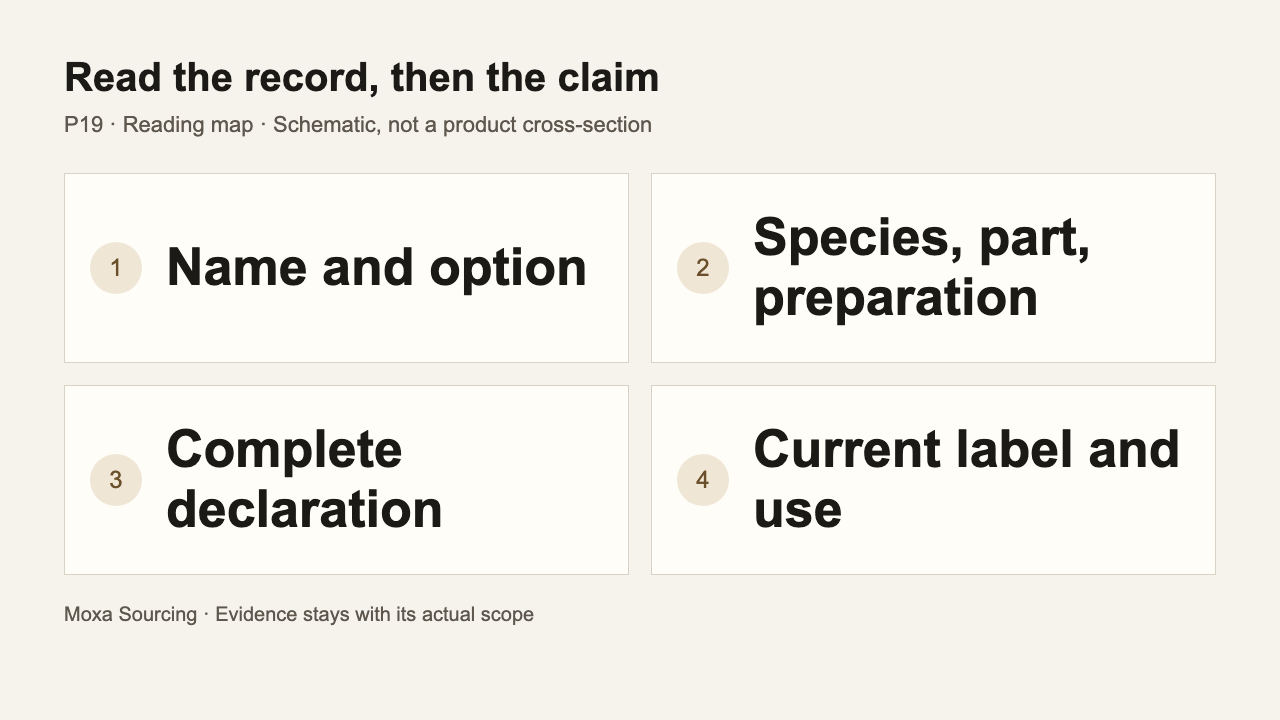
Identity is therefore not a formality to be completed after commercial selection. It is the frame within which every later comparison becomes meaningful. The rest of this chapter builds that frame in four layers, applies it to six real listings, and ends with a document request a buyer can send without further editing.
2. The four layers of product identity
“Product identity” sounds like one fact. In practice it is four facts that are established by different documents and can fail independently.
Layer one: the name and the code
A trade name and a product code identify the commercial offer. They are how you order, how you complain, and how you trace a batch. They do not describe composition. Two products with the same name from different suppliers may share nothing but the name.
Layer two: botanical identity
This is the plant question: which species, which plant part, which preparation, and at what strength. It is answered by a specification, a certificate of analysis, or a technical data sheet — not by a front panel.
Layer three: the full formula
This is the product question: everything in the article, including carriers, solvents, emulsifiers, thickeners, adhesives, preservatives, antioxidants, colours and fragrance. A formula that lists only the botanicals is a marketing summary, not a declaration.
Layer four: intended use and the current label
This is the regulatory and practical question: what the product says it is for, how it says to use it, who it says should not use it, and how it says to store it. Intended use is what connects a composition to an obligation.
| Layer | Established by | Typical failure if skipped |
|---|---|---|
| Name and code | Purchase order, listing, pack artwork | You reorder the wrong variant, or cannot trace a batch |
| Botanical identity | Specification, CoA, TDS, supplier declaration | You attribute a study or a claim to the wrong species or plant part |
| Full formula | Ingredient declaration, full INCI or equivalent, allergen statement | You miss an adhesive, solvent or fragrance that explains a reaction |
| Intended use and label | Current label, IFU, artwork proof | You market or use the product outside its stated purpose |
The layers are ordered because each one constrains the next. You cannot write a meaningful specification at layer two without knowing which variant you are specifying at layer one, and you cannot assess a label at layer four without the formula from layer three.
3. Layer one: the name and the code
The six reference listings show how much and how little a name carries.
- MS-CAT-29D5D09B3B is titled “Mugwort Soothing Balm, 20 g Tin” and carries the code MS-CAT-29D5D09B3B [1].
- MS-CAT-75A3663FE7 is titled “Herbal Massage Balm 50 g and Roll-On Liquid 50 ml”, code MS-CAT-75A3663FE7, and covers two distinct options [2].
- MS-CAT-04321578D7 is titled “Herbal Roll-On Liquid, 50 ml”, code MS-CAT-04321578D7 [3].
- MS-CAT-ADBE39E4F2 is titled “Sanqi Botanical Red-Paste Patches — 12 per Box”, code MS-CAT-ADBE39E4F2 [4].
- MS-CAT-49819BAC9D is titled “Safflower & Mugwort Patches — 7 per Box”, code MS-CAT-49819BAC9D [5].
- MS-CAT-0C0A4A2DC9 is titled “Mugwort Bone-Penetrating Patch — 12 per Box”, code MS-CAT-0C0A4A2DC9 [6].
Three observations follow. Three of the six titles name mugwort, while five reference composition accounts name it. The red-paste patch and standalone roll-on therefore show why title search alone can miss a declared ingredient. One offer combines a balm and a roll-on, which need their own option identifiers. The phrase “bone-penetrating” is a source product name, not a demonstrated mechanism [1] [2] [3] [4] [5] [6].
The practical consequence is that a product code is not bureaucracy. It is the only identifier that survives translation, re-listing and artwork changes. When the MS-CAT-75A3663FE7 offer is quoted, “the 50 g balm” and “the 50 ml roll-on” are two different codes in practice even if the listing gives one parent code, and the buyer should require the supplier to state which option a quotation covers.
Names that travel badly
“Bone-penetrating” is a translation of a traditional Chinese product category term. In English it reads as a therapeutic mechanism. The listing itself uses the phrase as part of the product name and separately quotes classical material as “reference material” and “educational only” [6]. A buyer who repeats “penetrating” as a mechanism has converted a name into a claim, and a claim into an obligation. The same caution applies to “moxibustion patch” (Chapter 5) and to “detox”, “meridian” and “dredging” language where it appears in translated listings.
4. Layer two: botanical identity
Botanical identity has four sub-questions, and a listing usually answers at most two of them.
Species
The common name mugwort is insufficient to establish the botanical species in a technical specification. The reference listings do not establish a complete Latin botanical identity. Keep that field open and request the identity of the selected material; do not substitute the species used in a research paper.
The species question has a direct documentary consequence. A controlled trial discussed in Chapter 4 used a 3% Artemisia absinthium ointment and a 3% liniment in knee osteoarthritis [K03]. If a buyer’s product is an Artemisia argyi patch, that trial is a methodological example, not product evidence. If the product’s species is unstated, the trial cannot even be connected to it hypothetically.
Plant part
Leaf, stem, root, flower and whole herb are different raw materials with different compositions. The listings are inconsistent in a way that is easy to miss: MS-CAT-29D5D09B3B says “mugwort oil”; MS-CAT-49819BAC9D, MS-CAT-0C0A4A2DC9 and MS-CAT-04321578D7 say “mugwort leaf” or “Ai Ye”; MS-CAT-ADBE39E4F2 and MS-CAT-75A3663FE7 say only “mugwort” [1][5][6][3][4][2]. “Leaf” is more specific than “mugwort”, and “oil” is a preparation, not a plant part. A specification should state both: the part and the preparation.
Preparation form
The reference listings give product-specific wording rather than an extraction specification: MS-CAT-29D5D09B3B names “mugwort oil”, while MS-CAT-49819BAC9D, MS-CAT-0C0A4A2DC9 and MS-CAT-04321578D7 name mugwort leaf [1][5][6][3]. These entries do not identify the preparation as an essential oil, a macerate or a solvent extract. Preserve the wording in the identity card and request the preparation description for the selected product; do not convert the word “oil” into an extraction method.
Strength or ratio
The reviewed listings do not provide a verified mugwort concentration or extraction ratio. Some identify the plant part as leaf, which is useful information and should not be recorded as missing. The position of mugwort in an ingredient sequence does not supply a percentage. Record the declared part separately from the still-unknown concentration and preparation [1][5][6][3][4][2].
The presence of the word mugwort does not identify the rest of the formulation. A named botanical can occur alongside other declared ingredients or within a more complex supplied preparation. Compare the actual declarations; sensory differences and clinical consequences need their own evidence.
This collection uses mugwort as a common trade term, not a botanical identification. Arabic references to الشيح carry that same limited meaning; they do not identify a product as Artemisia absinthium. Retain the Latin binomial when a species is established.
5. Layer three: the full formula declaration
A public ingredient list and a controlled quantitative formulation are different documents. The reference listings declare some composition fields and leave others unresolved. Their presentation order alone does not establish concentration or the supplier’s reason for that order.
| Reference | Declared composition | What is not settled by the declaration |
|---|---|---|
| MS-CAT-29D5D09B3B | Mugwort oil, olive fruit oil, peony seed oil, flaxseed oil, camellia seed oil, lavender leaf oil, peppermint oil | Species, part, extraction method, ratios, any wax or thickener, antioxidant, fragrance |
| MS-CAT-75A3663FE7 balm | Tougu Cao, methyl salicylate, Haifeng Teng, Shenjin Cao, Gushui Bu, safflower, sanqi, centipede, Danggui, purified water | Base, emulsifier, preservative, fragrance; and the material field’s “mugwort” is not in this list |
| MS-CAT-75A3663FE7 roll-on | Not supplied | Everything |
| MS-CAT-04321578D7 | Glucosamine chondroitin, Tougu Cao, mugwort leaf, dried ginger, Danggui, safflower, borneol, camphor, azone | Solvent, base, preservative, fragrance, ratios |
| MS-CAT-ADBE39E4F2 | Sanqi, mugwort, camphor, borneol, wintergreen, mint | Paste base, binder, ratios, adhesive, liner coating |
| MS-CAT-49819BAC9D | Safflower, mugwort leaf, sanqi, chuanxiong, dried ginger, camphor, borneol, azone, menthol, hot-melt adhesive | Adhesive chemistry, ratios, backing composition, liner coating |
| MS-CAT-0C0A4A2DC9 | Mugwort leaf, Tougu Cao, camphor, borneol, menthol | Paste base, binder, ratios, adhesive, liner coating |
Read the declaration as three groups
A declaration of this kind is easier to audit if it is split into three groups.
Featured materials. Record each declared material with the identity and origin actually supported. Plant ingredients belong in botanical fields. The centipede named in the MS-CAT-75A3663FE7 panel is an animal-derived material, so it should not be grouped under plants or silently rewritten as an herb [2].
Other named ingredients and functions. Record camphor, borneol, menthol, methyl salicylate, wintergreen and azone exactly where declared. Their names alone do not establish concentration, function, individual response or market status. Chapter5 separates sensation descriptions from measured heat and safety instructions.
Carriers and construction materials. The declarations name carrier oils in the 20 g balm, water in the 50 g balm and hot-melt adhesive in one patch. Record these separately from botanical materials. An ingredient-focused summary should not omit the formulation and construction that will actually be supplied [1] [2] [5].
The completeness test
Ask which document answers the buyer’s decision: the public declaration, the controlled composition account, the material specification or a private manufacturing formula. A public listing is not expected to disclose every confidential process detail. Obtain sufficient controlled information for identity, safe instructions, the intended market and the approved configuration; retain private details in the proper file.
6. Layer four: intended use and the current label
Intended use is the bridge between a composition and an obligation. The same patch can be a cosmetic, a medical device, a drug or a general consumer product depending on what it is presented to do. That classification then determines which claims are permitted, which warnings are mandatory, which documents are required, and which authority, if any, must be notified.
The listings give intended use in three ways, and each is weaker than a current label.
- By body site. MS-CAT-ADBE39E4F2 says the patch is applied to the neck, shoulders, arms, waist, knees or legs [4]; MS-CAT-49819BAC9D says back, arms, waist and legs [5]; MS-CAT-0C0A4A2DC9 says neck, shoulders, waist and legs [6].
- By occasion. MS-CAT-49819BAC9D pictures shoulder and neck discomfort from looking down for long periods, waist discomfort from sitting, and knee discomfort from overuse [5].
- By warning. Several listings state that the product cannot replace medicines or medical devices [4][5][6][3]. That warning is itself a statement about intended use, and it is one of the most useful lines on the page.
None of these is a substitute for the current label. Labels change; listings are snapshots. The label is also where the mandatory wording lives — the exact stop-use instruction, the age limits, the pregnancy warning, the storage condition. Chapter 7 shows how to use those lines. Chapter 13 lists the label and classification entry points.
Version is part of identity
A product is not identified until the version is identified. The MS-CAT-ADBE39E4F2 reference demonstrates why: the listing fields classify the patch as not self-heating and needing no heating, while a separate promotional panel describes eight hours of warmth [4]. Both cannot be true of the same version in the same sense. One may describe the product’s thermal mechanism and the other a user sensation, or one may be a marketing panel carried over from another product, or the two may refer to different versions. The only safe statement is that the selected version must be confirmed. A buyer who orders “the MS-CAT-ADBE39E4F2 patch” without confirming the version has ordered an ambiguity.
7. Building an identity card
An identity card is a one-page record that a buyer fills in before quotation and updates when a sample arrives. It is deliberately boring. Its value is that it makes gaps visible.
| Field | What to record | Example (MS-CAT-29D5D09B3B) |
|---|---|---|
| Commercial name | Exactly as printed, including subtitle | Mugwort Soothing Balm, 20 g Tin |
| Product code | Supplier code and own code, if any | MS-CAT-29D5D09B3B |
| Variant / option | Size, pack, option letter | 1 tin per box, 20 g net |
| Species | Binomial, or “not stated” | Not stated |
| Plant part | Leaf, root, whole herb, etc. | Not stated |
| Preparation | Oil, extract, powder, essential oil, macerate | “Mugwort oil” (type not stated) |
| Strength | % or ratio, or “not stated” | Not stated |
| Full declaration | Every ingredient, including carriers | Seven oils listed; base/wax/antioxidant not stated |
| Construction | Tin, jar, bottle, patch layer stack | Aluminium screw-top tin, about 48 mm |
| Intended use | As stated on current label | Topical balm; external use only |
| Warnings | Patch test, age, pregnancy, broken skin | Patch test 24 h; avoid eyes; under-3 caution |
| Label version | Date, revision, artwork reference | Not stated in listing |
Two rules make the card useful. First, write “not stated” rather than leaving a field blank or guessing. A blank invites a later assumption; “not stated” records a fact about the document. Second, keep the card with the quotation. When the sample arrives, compare the card against the sample label and the pack, and record every difference. Differences are the most reliable early warning that a version has changed.
8. Reading an external label archive without over-reading it
Public label archives are useful because they show how a regulator or an aggregator records a product: the name, the ingredient panel, the code, the packer, the status. They are dangerous because a record can look like an approval. It is not.
The reference archive for this collection is a submitted label for a “Mugwort Pain Relief Patch” in the DailyMed system [K02]. The page shows an inactive drug code, which is exactly the kind of detail that matters. A drug code directory, such as the FDA National Drug Code Directory, is a listing of products and codes; it is not a statement that a product is approved, effective or lawful to sell in every market [K01]. The label archive is the submitted label, not an endorsement of its claims.
What a label archive can tell you
- How a product’s name, strength and ingredient panel were presented at the time of submission.
- Which code was associated with the product, and whether that code is currently active.
- The structure of a label: identity statement, indications, warnings, directions.
- What a complete label looks like, which helps you read an incomplete one.
What it cannot tell you
- That the product is approved, licensed or clinically proven.
- That the product is safe for a particular person.
- That the product is available, current, or the same as the one you are buying.
- That the label’s claims are supported — a submission is a submission.
The correct use of the archive is comparative and structural: it shows you the shape of a complete label so you can see what is missing from a listing. The incorrect use is citational: “a mugwort patch is in the drug directory, therefore mugwort patches are drugs” is a non sequitur, because the directory contains products in many statuses and the entry may be inactive.
9. The MS-CAT-75A3663FE7 conflict: when two fields disagree
The MS-CAT-75A3663FE7 listing is the clearest identity problem in the reference set, and it deserves a section of its own because the temptation to resolve it by assumption is strong.
The offer presents two options: a 50 g herbal massage balm in a jar, and a 50 ml herbal roll-on liquid [2]. The balm’s ingredient panel is explicit: Tougu Cao, methyl salicylate, Haifeng Teng, Shenjin Cao, Gushui Bu, safflower, sanqi, centipede, Danggui and purified water. Mugwort is not in that list. Yet a separate source field on the same offer reads “material: mugwort”. The roll-on option has no ingredient declaration at all.
Three readings are possible, and the document does not choose between them:
- The material field is a category label, not a composition. “Mugwort” may describe the product family or the source catalogue’s filing category, while the actual balm is a different herbal formula. Under this reading, the balm is not a mugwort balm.
- The declaration is partial. Mugwort may be present in a base, extract or blend that the panel does not itemise. Under this reading, the product contains mugwort but the declaration is incomplete.
- The two options were filed together and the field belongs to the other option. Under this reading, the material field may describe the roll-on rather than the balm, or the listing may have been assembled from two source records.
Each reading implies a different next action. Reading one requires removing the product from a mugwort comparison. Reading two requires a corrected declaration before any claim is made. Reading three requires the supplier to identify which option the field describes. The collection keeps all three open and records the conflict in the self-check. It does not pick the most convenient one, because doing so would manufacture an identity the source does not support.
Rule for conflicting fields. When two fields on the same offer disagree, record both with their exact locations, state the readings the disagreement permits, and make the next action conditional on the supplier’s answer. Never average the fields, never choose the more plausible one, and never let a later summary present one of them as established.
The same rule applies to the MS-CAT-ADBE39E4F2 weight fields (44.5 g on the product panel, 70 g in the packing information) and to the MS-CAT-04321578D7 direction panels (roll-on steps versus film-and-peel steps) [4][3]. In each case the disagreement is data about the document, and the resolution belongs to a later, better source.
10. What to ask a supplier for
The following request is written for a trade buyer and can be sent as-is. It asks for the minimum set that would turn a listing into an identity.
Botanical identity
- The binomial species of the mugwort material, and whether it is a single species or a blend.
- The plant part used (leaf, stem, root, whole herb), and the harvest or production region if claimed.
- The preparation form: dried leaf, powder, macerate, extract, essential oil or distillate.
- For an extract, the extraction solvent and the extract ratio; for an oil, whether it is an infusion, a macerate or a diluted essential oil.
- The quantity or percentage in the finished formula, or the formulation range.
Formula
- The complete ingredient declaration, including carriers, solvents, emulsifiers, thickeners, preservatives, antioxidants, colours and fragrance.
- For a patch: the composition of the adhesive or paste base, the backing, and any liner coating.
- Allergen declarations for fragrance and essential-oil components, in the format required by the destination market.
- The current specification sheet with version number and date.
Conformity and version
- A certificate of analysis for the batch that will be shipped, with the tested parameters and the specification limits.
- Confirmation of which label version and artwork will be applied, with a proof.
- Confirmation of the exact variant quoted, especially where one listing covers two options.
- The safety data sheet, where the destination market requires one for the product or its transport.
None of these requests is unusual, and a supplier who cannot answer them at sample stage is telling you something useful. The point of asking is not to accumulate paper; it is to make the identity card complete enough that a later problem can be traced to a batch, a version and a document.
11. Six common misreadings
“The title says mugwort, so it is a mugwort product.”
“The title says mugwort, so it establishes the formula.” Three reference titles name mugwort and five composition accounts declare it. The two-option offer also contains a conflict between its material field and balm panel. Compare the actual declarations and selected option rather than inferring composition from the title.
“Mugwort is listed first, so it is the main ingredient.”
Ordering conventions differ between markets and between documents, and a marketing list may follow emphasis rather than concentration. Without the applicable rule and the ratios, the position of a name proves little.
“It says herbal, so there are no synthetic ingredients.”
“It says herbal, so every ingredient is botanical.” The reference declarations include named materials such as methyl salicylate and azone alongside botanicals. Record their actual identities and functions from the product file; the word “herbal” does not establish the origin of each ingredient.
“The product is in a drug directory, so it is approved.”
A directory entry records a code and a product record. It does not establish approval, effectiveness or current status, and the reference archive itself shows an inactive code [K01][K02].
“The species does not matter; mugwort is mugwort.”
“The species does not matter; mugwort is mugwort.” The study examined Artemisia absinthium; it did not examine the unstated botanical species of a reference patch. Preserve that identity gap when comparing the research and product [K03].
“The supplier’s listing is the label.”
A listing is a web page. The label is a controlled document attached to the product. They can diverge, and when they do, the label governs the product and the listing governs the offer. Chapter 13 explains how to reconcile them.
12. Identity checklist
Use this list before comparing products, and again when a sample arrives.
- Commercial name and product code recorded exactly.
- Variant or option identified, with its own code where the listing covers several options.
- Species stated, or “not stated” recorded as a gap.
- Plant part stated.
- Preparation form stated.
- Strength or ratio stated, or recorded as a gap.
- Full declaration obtained, including carriers and construction materials.
- Conflict fields listed with their exact locations.
- Intended use taken from the current label, not from the listing.
- Label version and artwork proof requested.
- Batch certificate and specification version requested.
- Identity card compared against the physical sample and every difference recorded.
The next chapter takes the identity card as given and asks a different question: once you know what the product is, which format — a balm you rub in or a patch you leave on — actually fits the use you have in mind?
Technical evidence records
13. Read the botanical preparation before comparing percentages
A statement such as “contains mugwort extract” leaves several quantities unresolved. It may name the purchased ingredient, the extract within that ingredient, or a botanical input used during production. Those quantities should not be collapsed into one percentage. For a balm or coated patch, the buyer needs to connect the botanical material to the preparation actually incorporated and then to the finished product.
Two European Medicines Agency sources explain this distinction in the context of herbal medicines: the declaration guideline, Revision 1, and the quality guideline, Revision 3. At the time of this source check, EMA listed the 2010 declaration guideline as the current effective version and a 2026 Revision 2 as a draft with consultation closed. The 2022 quality guideline was listed as current effective. These documents are medicinal frameworks. They help explain technical vocabulary here; they do not determine the category, authorization or label compliance of any reference balm or patch. EMA declaration guideline status; EMA herbal-quality guideline status.
Material, preparation and final formula are successive descriptions
The declaration guideline distinguishes a herbal substance from a herbal preparation. The substance is the identified plant material; the preparation results from processing such as extraction, distillation, expression or other specified treatments. Its botanical identity still matters, but the process adds information that the plant name cannot convey. A powder, a tincture and an essential oil are not three interchangeable ways to write the same ingredient.
The final balm or patch adds another level. It can contain that preparation alongside its own carrier, adhesive, water, oils or other components. A percentage of a preparation in the finished formula therefore describes a different relationship from the ratio used to make that preparation. A supplier’s statement about one relationship does not fill the field for another.
Start a comparison with the full chain: identified plant material and part; named preparation and physical state; relevant processing description; excipients included in the supplied preparation; quantity incorporated into the finished formulation; and the basis of that quantity. If the file stops at “mugwort”, retain the shorter declaration faithfully and leave the remaining fields open. Do not reconstruct an extract specification from a familiar product name.
What “genuine” or “native” means in an extract file
In this technical terminology, the genuine or native preparation is considered without added excipients. It is not an authenticity award, an organic claim or a statement that one supplier is more trustworthy. The definition also notes that soft and liquid genuine preparations may contain variable amounts of extraction solvent. Thus “native” should not be silently translated as dry, solvent-free or chemically pure. Declaration guideline, definitions.
A commercial extract ingredient can contain the genuine preparation and added technological ingredients. The mass of the purchased ingredient may consequently be larger than the mass of its genuine extract fraction. To interpret a stated percentage, ask whether it includes those excipients. This is a question about the calculation basis, not a suggestion that the presence of a carrier makes the ingredient misleading or unsuitable.
Do not confuse this carrier with the final balm’s base. A technological carrier supplied within a botanical extract and an oil or adhesive used to make the finished product occupy different positions in the record. They may both be relevant to a complete composition account, but one cannot be deducted from the other without an actual formulation and quantities.
The extraction ratio is an input-to-preparation relationship
The drug-extract ratio, usually abbreviated DER, relates the quantity of herbal substance used to the quantity of preparation obtained. DER genuine refers specifically to the genuine preparation. The quantities on the two sides of the colon need their stated basis. A number describing the botanical input relative to extract is not a percentage of mugwort in a finished balm, nor a measurement of how much crosses skin.
The declaration guideline includes ranges because a preparation can be described by a range of input-to-output relationships rather than a single unexplained marketing number. For comparison, retain the range, identify the material and preparation to which it belongs, and keep the extraction solvent alongside it. Removing the range to make the display shorter changes the information the source provides.
Nor does a larger numerical ratio alone establish greater clinical strength. It does not identify the entire chemical composition or the final application amount. Two preparations with different plants, plant parts or processes do not become comparable simply because both are described as “10:1”. The reference mugwort listings do not provide verified DER values; this explanation does not supply them.
A published calculation shows why the denominator matters
EMA’s declaration guideline gives an illustrative valerian-root dry-extract example. It describes 200 mg of an extract ingredient containing 80% genuine extract and 20% other excipients. The genuine extract quantity is therefore 160 mg. With the stated genuine ratio of 3–6:1, the example expresses the corresponding botanical input as 480–960 mg of valerian root. These values belong to that illustrative declaration, not to a mugwort product. Declaration guideline, section 6.2.3, example a.
The calculation separates three masses: supplied ingredient, genuine extract and equivalent starting material. None is the amount absorbed by a patient. Applying the ratio to the full 200 mg, without first accounting for the genuine fraction, would answer a different and incorrect question for that example. The lesson for a balm or patch specification is to name the calculation basis before multiplying anything.
It would also be incorrect to transfer the example’s root, solvent, ratio or excipient fraction to mugwort. The example is useful because its relationships are explicit. A real mugwort preparation needs its own declaration and supporting specification, not a set of numbers borrowed from a worked example about another plant.
A marker result is not automatically a therapeutic claim
The herbal-quality guideline distinguishes constituents with known therapeutic activity, active markers and analytical markers. It describes standardised preparations adjusted to a defined content of constituents with known therapeutic activity, quantified preparations adjusted to a specified range of active markers, and other preparations using analytical markers for control. The categories have defined meanings in that medicinal framework; they are not synonyms for “premium extract”. Quality guideline, section 3.1.
An analytical marker can be chosen for analytical control independently of therapeutic activity. A report showing that marker’s content may therefore answer an identity or consistency question without establishing pain relief. Ask what the marker is, why it was selected, which specification it belongs to and what conclusion the method supports. Do not turn a chromatographic peak or a content result into an efficacy statement by changing its heading.
The distinction also matters when comparing batches. If a supplier calls an extract standardised, ask for the actual defined constituent and adjustment basis. If it calls the result quantified, ask what range and marker it means. Preserve the supplier’s exact technical category when supported, or record that the word has not yet been explained. Neither an undefined “standardized” label nor an isolated assay number establishes equivalence to a preparation used in a clinical trial.
Extraction solvent and finished-product composition need separate fields
The declaration framework identifies the extraction solvent or solvent mixture and the preparation’s physical state. This tells the reader about manufacture of the preparation. It does not, by itself, tell the reader the complete solvent composition in the finished topical product or a measured residual-solvent concentration.
In a multi-stage file, preserve the role of each entry: solvent used to make the preparation; any solvent remaining as part of the supplied preparation; additional liquid used to formulate the balm, liniment or adhesive; and any result specifically measuring a residual substance. Where one of these is relevant but unknown, leave that field unresolved rather than translating an extraction description directly into a finished-product percentage.
| Statement | What it describes | What still needs to be named |
|---|---|---|
| Percentage of purchased ingredient | Amount of the supplied ingredient within a formula | Ingredient composition and any included excipients |
| Genuine fraction of an extract ingredient | Preparation considered without added excipients | Physical state and the actual declaration basis |
| DER genuine | Starting herbal substance relative to genuine preparation | Plant, part, range, process and extraction solvent |
| Marker content | Quantity of a specified constituent or group | Marker’s role, method and specification |
| Amount per patch or application | Quantity associated with an identified article or application | Whether it means loading, applied product, release or another measured quantity |
Use the declaration to compare the right objects
A usable identity comparison should now distinguish a plant-name match from a preparation match and a finished-product match. The same species and part do not establish the same extract. The same extract name does not establish the same excipient fraction. The same incorporated percentage does not establish the same applied amount, delivery or clinical result.
For the reference listings, the remaining request is narrow: obtain the selected preparation’s identity and composition basis, then reconcile that information with the actual formula and current label. This does not require publishing a supplier’s confidential manufacturing recipe. It requires sufficient controlled information for the relevant buyer decision and product obligations, with private technical details kept in the appropriate file.
14. Identity continues after the plant has been named
A Latin name on a balm label answers only one part of the identity question. It does not show how the harvested plant was identified, whether a supplied extract came from that material, or whether the declared extract belongs to the formula now being offered. The practical task is to connect those objects without treating one document as a description of all of them.
The EMA’s final 2025 GACP guideline, sections 4, 7 and 8, explains the upstream part of this problem. Its scope is herbal substances used to prepare herbal medicinal products. It is used here to explain identity records; this collection has not established the classification or GACP compliance of the reference finished products.
Identification at collection and identification on a label are different records
The guideline expects collectors to know the plant’s identifying characteristics and habitat, distinguish it from botanically related or visually similar species, recognise diseased plants or plant parts, and understand relevant collection and processing practices. Where adequate knowledge is lacking, local supervision and verification of training and documentation are described. That is a description of the identification process, rather than a recommendation to identify a raw herb from a retail product photograph.
For a mugwort-related patch, an upstream record might therefore concern the harvested botanical material while the retail label concerns a coated article containing a preparation. Neither record should be made to answer the other’s question. The label can declare a botanical name without showing the collection record. A collection record can establish which material was collected without establishing the full composition of a later adhesive layer.
When the preparation is an extract, ask which input record is linked to the supplied extract lot. When the extract is incorporated into a balm or coating, ask which formula version identifies it. These are proposed evidence links, not a claim that a particular reference product has already supplied such records. If a link is missing, identify the missing link precisely; do not replace it with the claim that the product contains no mugwort.
Propagation information can be more specific than the common name
For seeds and vegetative propagation material, the guideline includes genus, species, variety, cultivar or chemotype, and origin among the identification considerations. It also addresses evaluation of propagation-material suppliers and documentation of changes that can affect quality. This explains why two records that both use a common plant name need not contain the same level of identity information.
It does not mean every public topical-product listing must print every possible botanical subdivision. The question is which detail is relevant to the material actually specified, and whether that detail remains consistent in the private supply record. A public listing that names the species but says nothing about a cultivar leaves that field unknown; it does not prove that the wrong cultivar was used or that cultivar selection was relevant.
Keep the declared plant part alongside the botanical name. The guideline addresses control of different species, varieties and plant parts throughout production, rather than identification at only one point. A leaf declaration should not silently turn into an unspecified whole-plant declaration when information is copied from a source record into an extract description or a finished-product brief.
Environmental examples are reasons to check, not findings in these products
The collector-training section discusses contamination from the immediate environment and from co-collected poisonous weeds. Examples include pyrrolizidine alkaloids, tropane alkaloids, polycyclic aromatic hydrocarbons and heavy metals. They are examples in a general guideline. This collection has not detected them in the reference mugwort products, and the list is not a report that those products contain them.
A useful reading separates the hazard considered, the material to which it relates, the evidence actually obtained and any applicable acceptance criterion. A field-risk assessment is not the same as a finished-balm analytical result. A test on one constituent is not a complete botanical identity assessment. Where a supplier provides a report, retain the actual specimen and method scope rather than changing “tested for” into “proved free of”.
The result of this identity-chain review is a clearer description of what is known about the supplied material. It does not supply a harvest optimum, a universal contaminant limit, a therapeutic effect or a safe application instruction. Those conclusions require their own relevant product evidence.
15. A microscope image answers a different identity question from an ingredient list
A finished-product image, a botanical declaration and a laboratory micrograph can all be labelled “product information”, but they do not establish the same facts. Keeping their roles separate prevents a visible particle from becoming an invented ingredient identity or a smooth-looking balm from becoming proof that every constituent is dissolved.
The FDA’s final 2026 Q3 guidance, section III, items 2–4, describes phase and structural characterisation in the context of topical drugs submitted in ANDAs. The following explains how to read those kinds of records. No microscopy, particle analysis or polymorph analysis of the reference botanical products has been performed by this collection.
Look for the specimen and preparation, not just the picture
The guidance discusses representative high-resolution micrographs at multiple magnifications, with detailed sample-preparation information. In that context, suitable images can help differentiate a single-phase product, a multiphase product such as an emulsion, or a formulation with suspended active ingredient. The magnification and preparation are part of the evidence, rather than decoration beneath the image.
The absence of visible undissolved particles in appropriate images may support an interpretation that the active ingredient is dissolved. It does not identify every molecule in an unknown herbal preparation, establish the botanical species or prove an unlimited absence of particles. A commercial photograph is not such a micrograph, and a photograph of an ingredient is not an analysis of the finished formula.
If white or dark particles appear in a sample, do not name them as herb, active ingredient, filler or contaminant from appearance alone. Preserve the observation and identify what analytical work, if any, actually determined their nature. The distinction remains important even when the seller has provided a complete ingredient declaration.
A size distribution is more than an average
For relevant multiphase products, the guidance discusses particle-size distribution and crystal habit, and emulsion globule-size distribution where applicable. It asks for full distribution profiles for relevant samples. A single average cannot show the same information as the distribution from which it was calculated.
For emulsions, the type of emulsion is another separate determination. The source gives examples of appropriate techniques involving a water-soluble dye and microscopic assessment, or dilution and an electrical assessment. They are examples of laboratory characterisation, not instructions for a buyer to diagnose the formulation at home.
When comparing reports, keep the actual material and method attached to each result. A globule-size result for one formula is not automatically a particle-size specification for a different balm. Nor can an extract’s declared particle size be substituted for a measurement of the finished semisolid without evidence that the measurement concerns the same object.
Do not turn missing evidence into a physical conclusion
The source also discusses characterising the polymorphic forms of suspended active ingredient within a drug product. It warns that an absence of evidence of polymorphs does not establish that they do not exist. Whether this kind of assessment is relevant to a particular constituent and formulation must be established; the presence of a herbal mixture does not provide that answer.
Botanical identity, a chemical marker assay and physical-structure characterisation therefore remain distinct. One asks which plant material is declared or identified, another asks about a measured chemical constituent, and another describes the arrangement of matter in the tested formulation. A well-labelled picture cannot perform all three tasks.
16. Read a botanical fingerprint as an identity record
When a buyer asks whether a balm or patch really contains the named botanical material, a chromatogram can look like a decisive answer. Its value depends on what was tested and what the method can distinguish. A peak on a page is not automatically a species identification or a measurement of the whole herbal preparation.
The EMA specifications guideline, Revision 3, sections 3.1.1, 5.1, 5.2 and 5.4, describes botanical and phytochemical identification in herbal medicinal products. Its medicinal scope matters: the methods explain evidence types here without establishing the regulatory category or analytical compliance of a reference product.
The whole plant and the finished preparation offer different features
Macroscopic and microscopic botanical characters can help identify plant material and distinguish potential substitutes or adulterants. After processing into an extract and incorporation into a balm or adhesive layer, the available identification features are different. A photograph of a leaf and an analysis of the finished preparation should therefore retain their respective specimen identities.
The guideline describes phytochemical characterisation using analytical information such as chromatographic fingerprints. It treats the herbal substance or preparation as a complex, multicomponent active substance in the medicinal framework. Selected characteristic constituents can support a fingerprint for identity and consistency; the fingerprint is not a claim that one peak represents every component.
Ask what makes the identification specific
For herbal preparations and finished herbal medicines, the guideline says identification based solely on chromatographic retention time is not regarded as specific. It gives examples of combinations of chromatographic tests or combined techniques that may be acceptable, including HPLC with diode-array detection, HPLC/MS and GC/MS. These names describe analytical approaches, not tests performed by this collection.
A report should therefore explain the identification basis rather than simply display a familiar instrument abbreviation. Which material and preparation were examined? What comparison or reference was used? Which method and result support the stated conclusion? Does the work concern the raw botanical input, an extract or the actual finished formula? An answer for one object should not be relabelled as an answer for another.
A fingerprint and an assay remain complementary
A characteristic fingerprint can help assess identity and a pattern of constituents. An assay quantifies a defined constituent or another justified quantity. A marker concentration does not replace the whole identity comparison, and a visually similar fingerprint does not itself state how much extract was incorporated into the balm.
For a combination product, the finished fingerprint must also be interpreted with the contributions of its components in mind. The six reference products contain different declarations and combinations; they should not be assigned one common “mugwort fingerprint” merely because the commercial category shares that word.
The practical outcome is a narrower, checkable claim: the stated specimen was examined by the stated method and the report supports the stated identification conclusion. That can improve an authenticity review without becoming a clinical-effect claim, a certification of every batch or an unqualified statement that all possible substitutes have been excluded.
17. Identify the reference material behind the result
The word “reference” can mean a product chosen for discussion, a plant specimen, an extract used for comparison or a defined chemical standard. Those objects have different roles. The six commercial reference products in this collection are examples for reading public information; they are not analytical reference standards.
Section 3.7 of the EMA herbal specifications guideline explains reference materials for identity, purity testing and assignment of content. It includes a botanical sample, a preparation such as an extract or tincture, or a chemically defined substance such as a marker or known impurity. The selected reference needs to be suitable for its intended analytical purpose.
A material can be suitable for one purpose without settling another
The guideline notes that pharmacopoeial reference standards are described for a dedicated purpose and demonstrated suitable for the indicated use. A reference selected for identifying a constituent should not automatically be presented as establishing the quantitative content of the entire botanical preparation. A reference for a known impurity is not a complete authenticity standard for the plant.
When reviewing a mugwort-related report, identify the reference by its actual documented role. Was it used to compare botanical characters, a chromatographic pattern or a measured constituent? Is that role the one needed for the conclusion on the report? Keeping these questions explicit prevents the word “standard” from supplying more authority than the analysis contains.
Plant specimens and chemical references preserve different information
The guideline discusses availability of a herbarium specimen where the herbal substance is not described in a relevant pharmacopoeia, with a whole plant or an appropriate part where a whole specimen is impractical. That concerns an authenticated botanical record. It is distinct from a small vial of a chemical reference or a retained finished balm.
This does not establish a herbarium requirement for every reference topical product. Its value here is explanatory: an upstream plant record, a preparation reference and a finished-product sample preserve different information. A buyer asking about the botanical source should not be told that an unrelated finished-product photograph is the same evidence.
Read the result at the reference’s actual scope
A useful analytical record links the test specimen, reference material, procedure, result and conclusion. If one element is unknown, preserve the uncertainty instead of replacing it with a broad “laboratory verified” statement. A laboratory’s name alone does not identify the reference used or the question answered.
Nor does a chemical reference supply evidence about pain relief, an organic scheme, a wear period or an individual’s tolerance. Those are separate questions. Within an identity dossier, its contribution is the specific analytical comparison or assigned content that the method and reference support.
18. A marker calculation needs the actual preparation batch
The earlier declaration section separates an extract ingredient, its genuine fraction and its botanical input. A marker assay adds another relationship. It measures the selected constituent or group under an analytical method; calculating an amount of preparation from that result requires the appropriate content basis.
Section 3.1.3 of the EMA herbal specifications guideline discusses using batch-specific marker content to quantify the herbal preparation as active substance in a finished herbal medicine. It also requires justification of the marker’s purpose and suitable analytical control. This is an explanation of that evidence relationship, not an assay result for a reference balm.
Keep the numerator and denominator on the same basis
Consider an arithmetic illustration only. Suppose a preparation is measured to contain 2% of a selected marker by mass, and the finished composition contains 0.1% of that marker by mass. If the marker comes only from that preparation, the relevant content bases match and the analytical relationship is valid, dividing 0.1 by 2 gives a preparation mass fraction of 0.05, or 5%.
The assumptions are part of the example. It is not a verified method, formula or mugwort result. If another component contributes the marker, if one percentage concerns a dry basis and the other an as-supplied basis, or if the finished-product measurement does not validly represent the marker content, the simple division cannot supply the claimed preparation amount.
The preparation in the calculation must also be the preparation whose marker content is used. Substituting a generic literature concentration for an actual batch-specific value changes the evidence. A result for another plant, extract method or supplied ingredient is not automatically a suitable denominator.
Do not confuse adjustment categories with a potency ranking
The declaration section explains the guideline’s standardised, quantified and other preparation categories. For an actual report, retain the relevant declared category and marker role rather than translate every controlled percentage into “standardised mugwort”. An analytical marker can serve control purposes without being the constituent responsible for a therapeutic effect.
The specifications guideline also distinguishes ranges or declared-content criteria from variation relative to an initial batch-specific result. These are different reference values. A result can be close to an initial measurement while answering a different question from conformity to a declared-content range. Preserve the actual criterion, basis and stage instead of recording only “within tolerance”.
Report the supported quantity
A clear evidence note names the preparation and lot, the marker and its role, the measured content in the preparation, the finished-product result, the calculation basis and the supported conclusion. If the source gives only a marker result, retain it as a marker result. Do not manufacture a full extract percentage from missing information.
Even a valid preparation-content calculation is not the amount released from a patch, absorbed through skin or responsible for pain relief. Those quantities concern different evidence. Keeping them separate allows the assay to be useful without asking it to prove more than it measured.
19. Read an extract’s physical test on its own measurement basis
A preparation file may report water, loss on drying, particle size or an organoleptic description. These entries add information to the botanical name, but each describes a particular property. They should not be combined into a general assertion that an extract is pure, stronger or clinically effective.
The EMA specifications guideline, sections 5.1 and 5.2, separates characteristics of herbal substances from characteristics of preparations. This distinction helps a buyer recognise whether a result concerns leaves or powder, the supplied extract or the finished topical formula.
Water and loss on drying are not automatically the same result
The guideline discusses moisture-related acceptance criteria and notes that a loss-on-drying procedure may be adequate in some circumstances. For preparations containing essential oil, a method specific for water can be needed. A record labelled “loss on drying” should therefore retain that label and method rather than be automatically renamed “water content”.
For a mugwort-related ingredient, first identify the actual preparation and the test performed. A numerical result without that context does not establish which material was lost during the measurement. Nor can a result for dried botanical material simply replace a result for an extract that contains solvents or added excipients.
Particle-size evidence belongs to its specimen
The preparation section discusses particle size for relevant cut or powdered materials and extracts, with appropriate procedures and acceptance criteria when particle size significantly affects relevant properties. It does not assign one universal particle-size limit to every herbal ingredient.
Keep the measured material in the report. A result for a powder before formulation is not automatically a measurement of particles remaining in a balm. A result for an extract does not by itself describe globules in an emulsion. The earlier physical-structure section explains why those objects need separate interpretation.
Sensory characters are part of a description
The source includes organoleptic characters where characteristic. A stated colour, odour or appearance can help describe the preparation under review. It should remain attributed to that material, rather than be transferred into a promise about the smell or skin feel of a finished product containing other ingredients.
A usable comparison therefore keeps the botanical definition, preparation composition, physical tests and finished-product observations in their own fields. The purpose is to compare like measurements and identify real gaps, not to reward the offer with the longest list of unexplained numbers.
20. A complete ingredient declaration and complete chemical characterisation are different tasks
A formula declaration identifies the materials intentionally used to make a product. A botanical preparation can itself contain a complex mixture of chemical constituents. Asking for the complete ingredient declaration therefore does not mean that every molecule in a plant preparation has already been isolated and named.
The FDA’s 2016 Botanical Drug Development guidance, section VII.B, discusses this analytical difficulty. It describes complementary methods, constituent profiles and mass-balance information in the context of botanical drug development. The discussion does not remove the need to declare the actual materials used in a reference balm or coating.
Read which chemical information a method supplies
The guidance recommends evaluating suitable current and emerging analytical technologies and using complementary approaches to identify and quantify active or other chemical constituents. Where the active constituents are unknown and the mixture cannot be fully characterised, it discusses a characteristic profile sensitive to relevant raw-material or manufacturing changes.
A profile is therefore selected for a defined analytical purpose. It is not a substitute for naming an intentionally added oil, adhesive, carrier or other formulation ingredient. Conversely, a recipe naming those ingredients does not provide the analytical profile of every botanical preparation within them.
Weight and chromatographic area have different reporting bases
The source lists several forms of chemical information for consideration, including amounts by weight of known constituents, total amounts within chemical classes, area percentages and relative retention times of unknown quantifiable peaks. These are separate reporting quantities.
When reading a dossier, retain those bases. A chromatographic area percentage should not simply be rewritten as the same percentage by mass in the finished balm. An amount assigned to a class of constituents is not necessarily an identification of every individual molecule within that class. The report’s method and supported relationship determine what can be concluded.
The guidance’s examples of class-level information include lipids and fatty acids, amino acids, carbohydrates and other composition measures where appropriate. Their inclusion in a botanical-drug discussion does not prescribe an identical panel for every topical product. The actual material and purpose remain relevant.
Mass balance concerns the material accounted for
The FDA discusses using data from multiple analytical procedures to demonstrate mass balance among chemical classes and, where appropriate, constituents within a class. This is a broader compositional account than one selected marker result. It does not allow an unidentified remainder to be labelled automatically as mugwort or as a clinically active fraction.
For an actual report, ask what material the balance concerns, which quantities were measured and how the methods fit together. If the source reports only a selected constituent, preserve that limited result. If it provides a broader account, do not reduce it to the largest convenient percentage while omitting the basis.
Keep the two levels together in the identity file
The formulation record and analytical record can support each other while remaining distinct. One identifies what was intentionally combined; the other characterises the relevant material using defined methods. Neither should be used to conceal a missing field in the other.
For the reference products, the appropriate request is the actual declared formula and preparation information, followed by analytical evidence relevant to the question being resolved. This makes the identity review specific without demanding an invented all-molecule certificate or treating an undefined “herbal complex” as a complete declaration.
Continue: Chapter 2 — Balm or patch?
Frequently asked questions (FAQ)
Does a mugwort trade name establish the botanical species?
No. The reference listings do not establish a complete Latin species identity. Keep species, plant part and preparation as separate fields.
Does an ingredient sequence establish percentages?
The reviewed declarations do not provide verified mugwort percentages or extraction ratios. The order alone does not supply those missing values.
How should conflicting fields be recorded?
Keep both statements with their locations, identify the selected option and request the current applicable declaration or instruction. Do not choose one by assumption.