Mugwort Balms, Patches and Sprays
The Four Layers of a Mugwort Patch
A patch is not a single material. It is a stack: a backing, a functional layer, a release liner, and a pack that keeps the stack dry until use. Each layer answers a different question, and a failure in any one of them can look like a failure of the product as a whole.
Editorial review: Moxa Sourcing ·
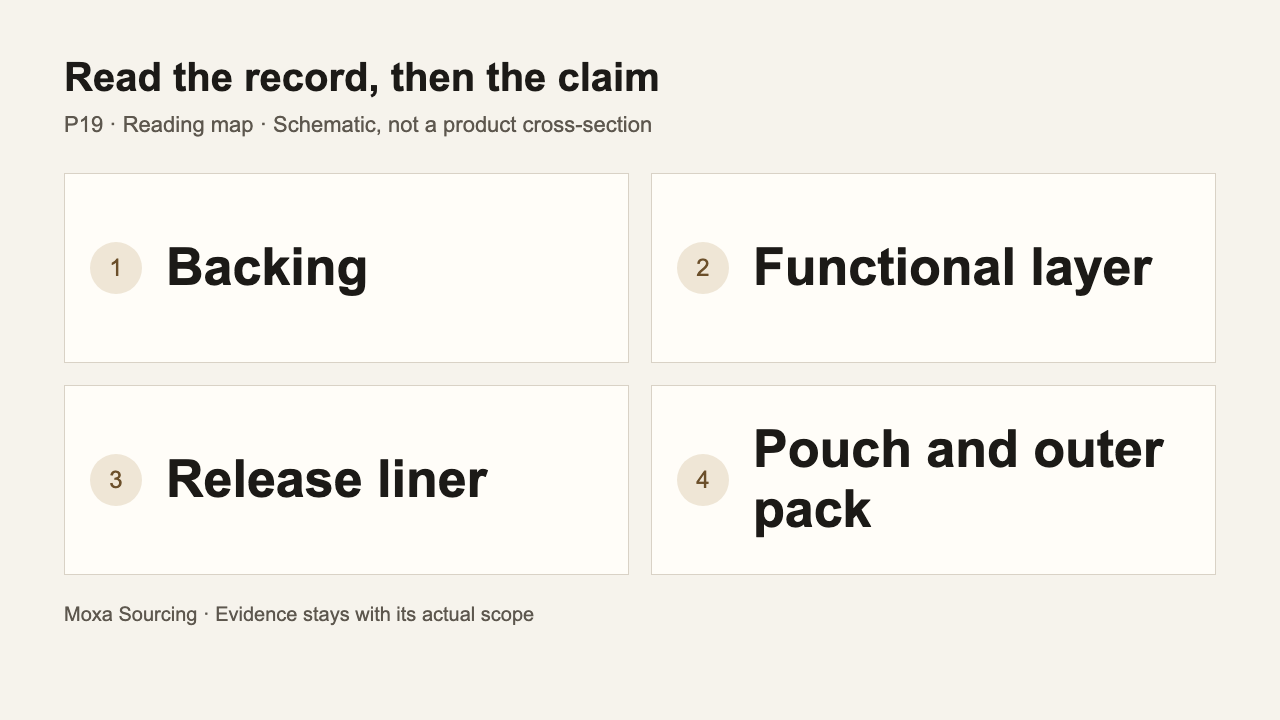
1. The stack and what each layer does
An adhesive patch has four functional parts and a packaging chain. The backing carries the structure and controls breathability and stretch. The functional layer holds the herbal material and contacts the skin. The release liner protects the functional layer until application and controls how the patch is opened. The pouch, box and carton protect the stack from moisture, light and handling.
| Layer | Function | Question it answers |
|---|---|---|
| Backing | Carries the article; controls breathability and elasticity | Will it stay on and feel acceptable for the wear time? |
| Functional layer | Holds and releases the herbal material | What is in contact with the skin, and how is it held? |
| Release liner | Protects the functional layer; controls opening | Can the user apply it without touching the paste? |
| Pouch | Moisture and odour barrier | Will the stack be usable after storage? |
| Box and carton | Protection, labelling and freight unit | What does the buyer receive, and in what quantity? |
2. Layer one: the backing
Three backing descriptions appear in the reference set. The MS-CAT-ADBE39E4F2 patch uses a breathable tan nonwoven carrier [4]. The MS-CAT-49819BAC9D patch uses a skin-tone elastic fabric, with a material field that reads “nonwoven fabric” [5]. The MS-CAT-0C0A4A2DC9 patch uses breathable non-woven fabric [6].
What the backing controls
- Breathability. The listings describe the backing as breathable; no transmission rate is stated. Whether it feels less occlusive on a given site is a sample question.
- Elasticity. The MS-CAT-49819BAC9D listing describes elastic fabric; the other two do not. How much a patch stretches is not stated.
- Conformability. How well the flat patch follows a curved surface. This is partly backing, partly patch shape.
- Strength. Whether the patch tears on removal or leaves fibres behind.
- Appearance. A skin-tone backing is less visible; a tan or white backing is more visible.
The listings say “nonwoven” or “non-woven fabric” [4][6]. The fibre, weight and finish are not stated. The word therefore identifies a material family in the listing, not a specification; the specification is a supplier question.
Shape as part of the backing decision
The MS-CAT-ADBE39E4F2 patch has a curved three-lobed shape of about 13 by 10.5 cm [4]. The MS-CAT-49819BAC9D patch is a rectangle of about 10 by 13 cm [5]. The MS-CAT-0C0A4A2DC9 patch is a rectangle of about 8 by 12 cm [6]. Shape affects conformability and the area treated; it also affects how the patch is cut and lined.
3. Layer two: paste or adhesive
The three listings describe two constructions. The MS-CAT-ADBE39E4F2 patch uses a “concentrated, slow-cooked paste layer” between the nonwoven and the release paper [4]. The MS-CAT-0C0A4A2DC9 patch uses a “thick herbal paste” [6]. The MS-CAT-49819BAC9D patch uses a “herbal hot-melt adhesive” [5].
The listings do not give coating weight, thickness, flexibility or release rate. The collection therefore does not rank the constructions on those properties. What can be compared is what the listing states.
| What is stated | MS-CAT-ADBE39E4F2 | MS-CAT-49819BAC9D | MS-CAT-0C0A4A2DC9 |
|---|---|---|---|
| Functional layer named | Concentrated, slow-cooked paste | Herbal hot-melt adhesive | Thick herbal paste |
| Backing named | Breathable tan nonwoven | Skin-tone elastic fabric | Breathable non-woven fabric |
| Liner named | White release paper | Double S-cut liner | S-shaped release cut |
| Coating weight | Not stated | Not stated | Not stated |
| Thickness / flexibility | Not stated | Not stated | Not stated |
| Release rate | Not stated | Not stated | Not stated |
A buyer who needs thickness, flexibility, adhesion or release data must request them from the supplier. The public listing cannot supply them, and a comparison table that fills them in would be inventing data.
4. Layer three: the release liner
The release liner is the sheet the user peels away. It is usually coated paper or film with a release surface. The reference set shows three approaches.
- MS-CAT-ADBE39E4F2: white release paper, peeled off before application [4].
- MS-CAT-49819BAC9D: a double S-cut release liner, designed so the user can peel the middle strip, stick one side, peel the other side, and smooth the patch down [5].
- MS-CAT-0C0A4A2DC9: an S-shaped release cut for easy tearing [6].
The cut pattern is an application aid. It lets the user position the patch without the whole liner coming away at once. It is not a cutting instruction for the patch itself, and it does not change the wear time.
Why the liner matters commercially
The liner affects the cost, the converting process and the user experience. A poorly chosen liner can tear, delaminate or fail to release, which turns a good patch into a frustrating one. It also affects how the patch behaves in a hot or humid environment, which is why the pouch specification matters.
5. Layer four: the pouch, box and carton
The packaging chain protects the stack and defines the purchase unit.
Pouch
The MS-CAT-ADBE39E4F2 patch is packed in an aluminium-foil inner pouch, shown in the source video as keeping out moisture and odours [4]. The MS-CAT-49819BAC9D patches are sealed together in one plastic inner pouch inside the box, described in the video as “sealed packing, 7 patches per bag” [5]. The MS-CAT-0C0A4A2DC9 listing does not describe a pouch [6].
The descriptions identify different pack configurations, but do not provide comparable barrier, seal-integrity or cost data. No performance or price ranking follows from foil versus plastic alone. The shared pouch contains seven patches [5]; the listing does not establish the storage conditions or protection of the remaining articles after opening.
Box and carton
The MS-CAT-ADBE39E4F2 box contains 12 patches, with 320 boxes per carton and a stated box size of 12 × 16 × 1.3 cm [4]. The MS-CAT-49819BAC9D box contains 7 patches, with 320 boxes per carton and a 60 g per-box weight [5]. The MS-CAT-0C0A4A2DC9 box contains 12 patches with no carton count stated [6]. These are freight and storage numbers, and they should be confirmed against a current packing list before they are used in a quotation.
6. Three reference patches, layer by layer
| Layer | MS-CAT-ADBE39E4F2 | MS-CAT-49819BAC9D | MS-CAT-0C0A4A2DC9 |
|---|---|---|---|
| Backing | Breathable tan nonwoven | Skin-tone elastic fabric (material field: nonwoven) | Breathable non-woven fabric |
| Functional layer | Concentrated slow-cooked paste | Herbal hot-melt adhesive | Thick herbal paste |
| Release liner | White release paper | Double S-cut release liner | S-shaped release cut |
| Pouch | Aluminium-foil inner pouch | One sealed plastic pouch for 7 patches | Not described |
| Box | 12 patches; 12 × 16 × 1.3 cm | 7 patches; 60 g per box | 12 patches |
| Carton | 320 boxes | 320 boxes | Not stated |
| Shape | Curved, three-lobed, ~13 × 10.5 cm | Rectangle, ~10 × 13 cm | Rectangle, ~8 × 12 cm |
The table is a reading aid, not a ranking. It shows that “a mugwort patch” covers at least three different constructions, and that a question about adhesion, residue or comfort has to be asked of a specific stack.
7. Adhesion is a group of measurements
Panel peel, liner peel, tack and shear describe different test events. Their methods and specimens need to be kept with the values. The reference listings do not report a comparable set of these measurements. Section11 explains the differences and the limits of using laboratory results to predict wear on skin.
8. Which document answers which layer
| Layer | Document or evidence | What to look for |
|---|---|---|
| Backing | Material specification | Fibre type, weight, breathability, stretch |
| Functional layer | Formula and process description | Composition, loading, paste or adhesive type |
| Release liner | Liner specification | Paper or film, release coating, cut pattern |
| Pouch | Packaging specification | Material, barrier, seal strength |
| Box and carton | Packing list and artwork proof | Counts, dimensions, weights, labelling |
| Whole article | Relevant authorized-use evaluation and stability evidence | Adhesion over time, residue, storage |
A supplier who can answer the layer questions but not the whole-article questions has a material file, not a product file. Both are useful; they are not the same.
9. Frequently asked questions (FAQ)
Is a paste patch stronger than an adhesive patch?
It may carry more material mass, but “stronger” is not established. The delivered dose depends on the matrix and the wear time, and no reference listing gives a delivered dose.
What does “breathable” mean on a patch?
It usually means the backing allows some water vapour to pass. It is a qualitative claim unless a transmission rate is stated, and none of the reference listings states one [4][5][6].
Why do patches have S-cuts?
To make the liner easier to peel in stages, so the user can position the patch before fully exposing the adhesive [5][6]. It is an application aid, not a dose or wear feature.
Can I cut a patch to a smaller size?
No reference listing gives a cutting instruction, and cutting exposes a new edge of paste or adhesive. If a smaller area is needed, that is a specification request to the supplier.
Does the pouch matter if I use the patches quickly?
Yes. The pouch is the moisture barrier during storage and transport, and a shared pouch exposes all patches once opened [5]. Storage conditions after opening should be stated by the supplier.
Technical evidence records
10. Loading, release and delivery are different specifications
A request for the “amount in a patch” can mean several different quantities. It can mean the mass of the finished article, the mass of the coating, the amount of a named ingredient loaded into that coating, or the amount released during a defined experiment. The amount that passes through skin is another question again. A useful specification names the quantity and its unit before any two numbers are compared.
The FDA’s 2019 draft on transdermal and topical delivery systems describes matrix constructions in which drug substances can be dissolved or partly suspended among other components, and reservoir constructions with a contained liquid or gel. Its scope is medicinal delivery systems with a carrier device. The draft is not for implementation and is not evidence that the herbal patches in this collection have either a particular internal design or an established drug-delivery performance. Its terminology is useful because it prevents the mass of a coated sheet from being presented as the dose reaching a person. FDA draft, background and product-development sections.
Read every mass with its numerator and denominator
A result expressed per patch differs from a result expressed per unit area. The first describes the specified article; the second describes an area-based quantity. Neither tells the reader what portion is adhesive, botanical preparation, water, another solvent or backing unless the composition and method also specify that information. Net content on a retail pack may count articles rather than declare the mass of any individual ingredient.
For the products described earlier, several loading fields are absent. The correct technical response is to request the missing fields, not to estimate them from a photograph of a thick paste. A visually thicker layer does not reveal its density or concentration. A larger patch does not establish a higher amount per square centimetre. A box weight can include liners, pouches and the box itself, so it cannot be divided by the patch count and called the active dose.
Keep the sample code, product configuration and measurement state beside each result. A coating mass described before drying may have a different meaning from a mass measured after drying. If that distinction matters to the supplier’s process, ask which state its stated value represents. The answer should be traceable to the same formulation and coated area as the sample under review.
Construction drawings prevent a false comparison
In a matrix design, ingredients may be held within the layer or layers described by the manufacturer. In a reservoir design, a contained liquid or gel and its enclosing structure introduce a different arrangement. These are technical examples from medicinal delivery-system development. A seller’s use of words such as gel, paste, plaster or patch is insufficient to assign one of those designs to an undocumented product.
Ask for a simple cross-section identifying what each layer is, which layer contacts the skin, which holds the declared botanical preparation, and which parts are removed before use. Distinguish a liner slit from a cut through the coated article. The reference S-shaped cuts help explain staged liner removal; they do not establish that a user may cut the functional patch. A smaller article should be specified and assessed as its own configuration when the current directions do not authorize cutting.
A drawing is also useful for interpreting sample defects. Material seen on a removed liner could come from a coating-transfer problem; a backing defect and an opening defect are different observations. Record what is visible and where it is located before assigning a cause. Appearance can document an event without identifying the chemical composition of the residue or the mechanism responsible for it.
A release experiment measures its own system
A release result needs the method that produced it. The receiving medium, apparatus, temperature, exposed area, sampling schedule and analytical measurement are part of the result. The EMA guideline treats in vitro release and skin-permeation work as distinct forms of investigation. It also explains that an appropriate quality-control strategy depends on the product and the property being controlled. Such tests are not interchangeable merely because each generates a curve over time.
The EMA document’s chemical-medicine scope and exclusion of herbal medicines from its therapeutic-equivalence section remain important here. The distinction between release and permeation can inform a buyer’s questions, but it does not provide a shortcut for declaring a mugwort patch equivalent to an authorized medicine. A laboratory result for one identified substance also does not characterize every constituent in a multi-ingredient botanical preparation. The analyte and the question it answers must be stated. EMA guideline, sections 2, 4.2.5 and 4.3, and annexes I–II.
When a supplier says that a patch “releases slowly”, first ask whether this is a product description or the conclusion of a test. If it is tested, ask for the actual sample, method, substance measured, time points and result. The phrase should not be expanded into a promise that the whole botanical mixture enters skin continuously, that a therapeutic concentration is maintained, or that the label permits a longer wear time.
Attachment is necessary information, but it is not delivery data
A patch that lifts at an edge no longer has the same apparent contact pattern as a flat attached article. That makes attachment a relevant performance observation. It does not make adhesion force a substitute for release or exposure measurements. A force measured on a test surface answers a different question from the percentage of a patch remaining attached during use, and both differ from the amount of a substance released.
For a technical report, identify the surface or substrate, the test procedure and the product state. For an authorized usability evaluation, record the actual site, duration and conditions allowed by the current instructions, along with the observed attachment and removal. Do not introduce an unapproved wear trial on a person merely to fill a supplier-data gap. Where safety or use instructions are unresolved, resolve those first or restrict the comparison to suitable non-human and documentary observations.
| Field | What it describes | Information needed to interpret it |
|---|---|---|
| Article dimensions | Nominal size and shape | Whether the stated area includes an uncoated margin |
| Coating quantity | Amount of the functional layer | Measurement state, area, method and tolerance |
| Ingredient loading | Amount of a named constituent in the article | Ingredient identity, basis of calculation and assay where applicable |
| Release result | Measured movement into the test system’s receiving medium | Analyte, apparatus, conditions and sampling times |
| Permeation result | Measured passage in the specified skin-permeation model | Model, analytical method, conditions and limitations |
| Attachment observation | How the article remains attached under stated conditions | Procedure, site or substrate, time and scoring method |
| Clinical outcome | A health outcome in a defined study population | Study product, protocol, comparator, outcomes and uncertainty |
Keep the pouch in the same product file
The carrier and coating are evaluated in the condition in which they are supplied and used. The package that protects them therefore belongs in the same file. A description such as foil pouch or plastic pouch identifies only part of that package. It does not state the full laminate, its thickness, the seal configuration, integrity or measured barrier performance. Without comparable specifications and results, the material name alone does not establish which finished pouch provides better protection.
When several patches share one pouch, ask how the remaining articles are protected after opening and whether the current instructions address that condition. A closed-pack shelf-life result does not by itself answer an opened-pack question. Likewise, placing a new pouch around an unchanged patch creates a packaging change that needs its own relevance assessment; “the formula is unchanged” does not answer the package-protection question.
A complete comparison can now connect the record from beginning to end: named formulation, layer drawing, specified coating, final pouch, sample identifier and relevant test conditions. If any link is missing, retain that gap explicitly. This is more informative than assigning an overall “strong” or “weak” score to a patch whose article mass, ingredient loading and delivery results have been mixed together.
11. Read the test object before reading the result
A supplier can provide a valid test result that answers a different question from the one a buyer is asking. A result for an adhesive raw material, a laminate without the botanical preparation, and the finished patch are not the same evidence object. Start with the specimen description before comparing force, time, composition or appearance.
The FDA’s 2019 delivery-system draft distinguishes adhesive polymer as a raw material, adhesive in a laminate without the drug and other excipients, and adhesive in the finished product. It also discusses separate laboratory adhesion methods and finished-system properties. We use these distinctions to read documents for a coated herbal patch. The draft’s medicinal carrier-device scope and “not for implementation” status remain as described above; its examples are not specifications or a certification requirement assigned to the reference products. FDA draft, printed pages 6 and 20–22.
A material certificate does not describe every later layer
An adhesive supplier’s certificate may identify a batch and report properties of that adhesive as supplied. It can be useful evidence about the input material. It does not automatically include the effects of adding botanical preparations or other ingredients, coating, drying or laminating, converting the article, and storing it in the final pouch.
The draft notes that adhesive raw-material variation can matter to finished delivery-system performance, even when different batches fall within the material supplier’s specification. For a buyer, this does not mean a material certificate should be rejected. It means the certificate needs to be connected to the finished-product file: which adhesive batch was used, which finished configuration it belongs to, and which relevant finished properties were assessed.
If a reference listing says “herbal hot-melt adhesive”, retain that construction description. It does not provide the polymer identity, grade, test method or finished-product result. Request the missing information at the level needed for the actual decision. Do not fill it by assuming that all hot-melt adhesives share the same test values.
Peel adhesion depends on what was peeled from what
The draft describes peel adhesion as a force measured when a delivery system is removed from a standard test panel. It identifies test variables including the substrate, contact time before testing, peel angle and peel speed. A value without those conditions is incomplete for comparison.
For example, a result from a metal panel and one from a plastic panel need not be interchangeable. Nor should a change in the testing angle be treated as a change in product quality without considering the method. To compare samples, first determine whether the reports use a compatible procedure, specimen size, reporting unit and product state.
A panel result should remain a panel result. The draft explicitly distinguishes the usefulness of laboratory adhesion testing for quality control from prediction of adhesion during use on people. A laboratory force also does not quantify pain on removal. Those are different observations, requiring their own suitable evidence rather than a more impressive-looking force value.
Release-liner peel is a different separation
A liner-peel test concerns separation of the patch from its protective liner. It does not measure the force for removing a worn patch from skin. The draft identifies peel angle and speed as relevant parameters here too, but the two tests have different interfaces.
This distinction helps interpret a complaint that a patch is “hard to peel”. Was it difficult to open the pouch, start the liner, detach the liner from the coating, or remove the used article? The phrase alone cannot identify the event. The S-shaped or split liners in the reference set describe an opening and placement arrangement; a test report must identify which actual liner and coated article it evaluated.
Tack and shear also require their methods
The draft’s probe-tack discussion describes separation of a test probe from an adhesive. Contact area, pressure, contact duration and separation rate influence that measurement. A casual fingertip impression can describe an experience, but it is not the same measured property or a substitute for the report.
For shear, the draft distinguishes dynamic and static procedures. A dynamic procedure measures a specified separation process, while a static procedure can measure time to detachment under a specified load and arrangement. The reported unit and failure mode help show which event was measured. A long holding time and a large force are not alternative units for one universal “stickiness” score.
Consequently, keep tack, panel peel, liner peel and shear in separate fields. None of the reviewed reference listings supplies a comparable set of these results. The explanation here identifies the missing technical information; it does not create values for the products.
Cold flow can show up before a patch is worn
The draft uses cold flow for adhesive matrix creeping or oozing beyond a backing edge or through a liner slit. It notes that material can be found on the article, liner, pouch or protective films. This is a different observation from material left on skin after use.
A quantitative cold-flow measure may not fully describe the user’s difficulty removing a patch from a pouch or a protective film. The draft therefore discusses combining appropriate quantitative and qualitative assessments. A buyer reading such a report should retain both the measured feature and the described handling event, rather than replacing them with a single “no residue” verdict.
If material is visible at an edge in a sample, record where it is, the condition of the pack and the relevant storage history if known. That observation does not by itself identify the chemical composition of the material or prove why it moved. It can be a starting point for a documented investigation without becoming an unsupported diagnosis of manufacturing failure.
Material migration needs its own analytical question
The draft separately discusses substances drawn from packaging or delivery-system materials under laboratory extraction conditions and substances present in the packaged product after migration during storage or use conditions. These are the extractables and leachables questions. The backing, liner, pouch, printing and other components can therefore be relevant parts of the material file, rather than disappearing from consideration because only the coated face touches skin.
A deliberately strong laboratory extraction condition and an observation in a stored finished product answer different questions. Finding a substance in an extract does not by itself establish how much a person encounters during labelled use.
The same draft treats certain impurities already present in adhesive raw materials separately from extractables and leachables. A report should therefore identify the analyte, its possible source and the purpose of the method. We do not prescribe a toxicological limit or a laboratory solvent for an undocumented herbal patch; the actual product, use and appropriate professional assessment determine the relevant work.
| Evidence object | Question it can help answer | Important boundary |
|---|---|---|
| Adhesive raw-material batch | What input material was supplied and which specified properties were measured? | Not a complete test of the final botanical patch |
| Laminate specimen | How did the specified layers behave under the recorded method? | Composition and construction must match the stated specimen |
| Liner and coated article | How did the two separate during the liner-peel procedure? | Different from removing a worn patch from skin |
| Packaged finished patch | What condition and performance were assessed after stated storage? | Retain pouch, batch, age and test conditions |
| Laboratory extraction or migration sample | Which substances were investigated under which conditions? | Do not convert a finding directly into clinical exposure or harm |
| Observed use | What happened under the documented authorized use conditions? | Not a replacement for material identity or a controlled clinical study |
A change request should identify the affected evidence
A new liner, adhesive grade or pouch may leave the trade name unchanged. It nevertheless changes a defined part of the product configuration. The useful question is which existing evidence still describes the proposed version and what additional assessment is needed. “Same herbal formula” cannot alone answer a changed liner-separation question.
Record the old and proposed configurations, the reason for the change and the observations or tests relevant to that change. These are document fields for a buyer’s review, not a claim that a change has occurred in the reference products. No replacement component is approved by this explanation, and no supplier performance result is invented.
12. A skin-contact score is different from peel force
A patch report can describe peel force on a panel, the area remaining attached to skin, or whether a patch detached during wear. These are different measurements. The earlier test-record section explains laboratory specimen and force tests; this section addresses a published example of area-based clinical assessment.
The FDA’s final July 2026 adhesion guidance for TDS submitted in ANDAs uses an ordinal scale for comparative assessment. It concerns generic medicinal delivery systems, not a qualification test performed on the reference herbal patches. The table below explains the scale’s meaning.
| Score | Adhered surface area | Reading |
|---|---|---|
| 0 | At least 90% | Essentially no lifting |
| 1 | At least 75% and less than 90% | Some edge lifting |
| 2 | At least 50% and less than 75% | At least half remains adhered |
| 3 | More than 0% and less than 50% | More than half lifted, without complete detachment |
| 4 | 0% | Completely detached |
The direction and intervals matter
A lower score means less detachment on this scale. A score of 4 is not a better adhesion rating than a score of 1. Nor are the categories equal increments of percentage area: the range represented by each category differs. The score should not be renamed a percentage or converted to a peel-force unit.
A score of 0 also does not mean exactly 100% attachment. It represents the stated area category. If a report supplies an additional percentage estimate, retain that estimate with the score and time point. The guidance gives the example of a score of 2 together with an estimated 60% adhered area; those two entries provide different levels of detail.
Read how the observation was supported
The guidance discusses trained visual assessment and other appropriate approaches such as dot-matrix templates. Where an alternative scale is used, it calls for reporting both that score and the corresponding five-point score, with justification and qualification information for the alternative approach. A report’s scoring system therefore needs its definition.
Photographs can support the visual observation at each assessment time. The final guidance specifically says that the photographic evidence is not intended for automated or photometric analysis at that time. A phone photograph and an unexplained software percentage should not be presented as an already accepted implementation of this method.
Keep actual observations separate from analysis values
For successive observations, the source calls for the actual score at each time point, independently assessed without carrying forward a previous score. It separately describes an analysis convention that carries forward the highest detachment score. The evidence chapter explains the difference and its arithmetic.
For the actual mugwort-patch comparison, retain the report’s product configuration, assessment method, area definition, time points and results. A bench peel measurement cannot fill an absent skin-contact record, while an area score cannot identify the adhesive’s chemical composition. Neither measurement alone establishes pain relief, a suitable wear period or individual skin tolerance.
13. Follow the material through mixing, coating, drying and lamination
A finished patch combines materials, but the manufacturing record also describes transformations between material states. A bulk mixture, wet coating, dried layer and laminate are not interchangeable test specimens. Reading the process sequence helps explain which record can answer a question about the final construction.
The manufacturing section of the FDA’s November 2019 TDS development and quality draft, printed pages 17–19, describes these operations for medicinal delivery systems. It remains a draft, not for implementation, with a current notice about the revised quality-system regulation. The technical distinctions are used here to read a dossier, without assigning a pharmaceutical manufacturing programme to the reference herbal patches.
Mixing establishes the material presented to the coater
The draft describes mixing as producing a bulk mixture for the coating step. Relevant effects can include content, uniformity, microscopic appearance, stability of components and physical properties of the adhesive. It identifies equipment design, order of addition and mixing conditions among variables that can matter.
This means a supplied ingredient’s certificate and a mixed-bulk result answer different questions. A certificate concerns the input as supplied. The bulk record concerns the mixture after ingredients have been combined in the stated process. A later finished-patch report concerns still another object.
The source also identifies material characteristics such as particle size, rheology and solids content in solvent-based mixtures. A common commercial ingredient name therefore does not describe every property presented to the mixer. The particular significance needs the actual formulation and process evidence; this guide does not infer it from the word mugwort.
Coating creates a spatial distribution on a substrate
Coating applies the mixture to a substrate. In the draft, relevant considerations include content uniformity and microscopic appearance across the full coating operation. The bulk mixture’s rheology and the substrate’s within-roll uniformity can be part of that assessment.
For a buyer reading a report, identify whether the measurement concerns the mixture in a vessel or material distributed across a coated sheet. A uniform bulk result alone does not describe every location on the sheet. A photograph of one finished patch also does not document the entire coating run.
The record needs the product version, relevant substrate and process stage, the observation or measurement and its basis. It need not expose an upstream supplier’s identity publicly. The useful information is the relationship between the controlled construction and the offered product, with confidential technical detail retained in the appropriate private file.
Drying is more than a change in visible wetness
The draft describes drying as solvent removal after coating, with potential effects on component content, microscopic appearance, release, residual substances and physical properties of the matrix. It lists process variables such as line speed, zone conditions, air flow and drying-air conditions for product-specific development.
A result measured before drying should therefore retain that state. It cannot automatically be used as the dry-layer result. Likewise, a dry coating weight and a wet coating weight have different bases. The actual composition and solvent removal determine the relationship; a generic percentage should not be supplied to close the gap.
The source also calls for justification where extra material is used to compensate for evaporation during drying. That does not establish that any particular herbal patch uses an overage or loses a particular botanical constituent. It explains why an initial batch formula and a finished-content result can require a process account rather than a simple assumption that every input quantity remains unchanged.
Lamination creates a combined structure
Lamination combines layers into a common laminate. The source discusses supporting information for treatments used to bond particular layers. An adhesive specimen before lamination is therefore different from the combined structure subsequently tested.
For the reference configurations, keep the backing, coating, liner and pouch identified as separate objects while following the stages that bring them together. Where a report concerns a laminate without the botanical preparation, retain that limitation. Where it concerns a complete finished construction, identify which version was tested.
Connect the process record to the result being compared
A useful process-linked comparison asks where a relevant property was established, what later operations could affect it and which evidence represents the final offered configuration. It does not treat the number of process steps as a quality ranking. A simpler construction is not automatically worse, and a longer process description is not proof of better performance.
The practical outcome is a traceable sequence of material states and evidence. It supports a more precise discussion of appearance, construction and consistency without inventing coating speeds, drying temperatures, acceptance limits or results for a reference product.
14. A sheet average and an individual patch result answer different questions
A specification can describe a coated laminate, while an order supplies individual patches cut from it. The relationship between those objects needs evidence. A single average for the bulk material does not automatically describe variation along a run, across a sheet or between the finished units.
The FDA’s 2019 TDS draft, printed pages 18–21, distinguishes in-process controls from finished-unit testing in its medicinal development framework. The following explains that distinction for reading a patch dossier, rather than prescribing a universal sampling plan for herbal products.
Location and time can both matter
The draft discusses controls for uniformity across a laminate and throughout a coating run. For coat weight and uniformity, it calls for representative information across the full length and width, or suitable continuous monitoring. The spatial and production-time basis therefore belongs to the result.
A small piece from one location is an observation of that piece. It is not automatically a representative description of every part of a roll. Conversely, a suitable process-monitoring record can provide information beyond a few isolated photographs. The report needs to explain what was sampled or monitored and which production object it represents.
The source also discusses visible film defects, such as streaks affecting continuity. A visual observation can be relevant to construction while remaining different from an assay of chemical content. A clean-looking sheet is not a substitute for the latter, and an average content result does not erase a documented local defect.
Keep the mean and spread together
For dispersed mixtures, the draft discusses reporting the mean, individual range and relative standard deviation when multiple samples are taken. These fields describe different aspects of the data. A mean without its spread can conceal variation among the observations used to calculate it.
For illustration, the three values 9, 10 and 11 have the same mean, 10, as three values of 10, 10 and 10. Their ranges differ. This arithmetic example is not a measured coat weight, acceptance range or validated sample plan. It explains why a report containing only “average 10” leaves information unresolved.
Where a relative standard deviation is reported, retain the method and underlying measurement context. Do not confuse it with a percentage of herb in the formula or a percentage of skin area attached. The word percentage does not make these quantities interchangeable.
Finished units add a further level
The draft separately discusses content uniformity of dosage units. Where a medicinal system is designed for user cutting, it also discusses uniformity among pieces from an individual unit. This conditional pharmaceutical recommendation is not permission to cut any of the reference herbal patches.
For an actual construction, identify the complete unit supplied, how it relates to the tested laminate and which finished-unit characteristic the report measures. The stated number of patches per box is a packing quantity, not a demonstration of uniformity of their coating or content.
Read a change against the evidence it affects
A different unit size, coating width or converting arrangement can change which production object a report represents. The relevant question is whether the supporting evidence still describes the offered configuration. It is not enough to retain the old report title while changing the product version.
For the buyer’s material comparison, preserve the report’s specimen, locations or monitoring basis, relevant statistics and finished configuration. Where those links are not available, record the gap. The explanation does not establish that a reference patch is nonuniform; it establishes what has and has not been demonstrated.
15. Cutting, printing and pouching belong to the finished configuration
After a laminate has been made, converting it into individual patches and packing them creates further evidence objects. A report on the unconverted sheet does not automatically describe the liner opening, cut geometry, printed article or sealed pouch supplied to the buyer.
The FDA’s 2019 delivery-system draft, printed pages 7 and 17–19, discusses these operations in medicinal product development. Its examples help organise a construction review; they do not establish a manufacturing process or acceptance specification for the reference herbal products.
The cut determines which interfaces the user handles
The draft describes converting and pouching as cutting a continuous laminate into individual units and sealing units in a pouch. It links those operations to usability, including removal of a release liner, and to pouch integrity. Its in-process discussion includes product placement, die-cuts and kiss-cuts as relevant appearance checks.
For the reference products with S-shaped or split liners, keep the actual opening arrangement in the configuration record. A liner slit and a cut defining the outer unit are different features. A picture showing one does not establish the dimensions, depth or performance of the other.
The buyer’s question is what was observed or checked on the offered unit. Was the result from a complete patch after converting, a sample cut from a development sheet or an unconverted laminate? Those specimens can answer useful questions, but the report should not silently substitute one for another.
A sealed pouch is an assembled system
The source identifies sealing temperature and dwell time among process parameters that can matter to pouching. It does not supply a universal setting suitable for every laminate and seal design. A list of machine settings is therefore different from evidence that the actual pouch met its relevant integrity criterion.
Retain the pouch material and configuration, sealing process version and result with the finished-product record. If the pouch construction or sealing arrangement changes, ask which evidence represents the changed configuration. Keeping the same box artwork does not establish that the inner pack is unchanged.
The distinction also applies to what was tested inside the pack. A result on a sealed finished unit, a bulk laminate or material removed from its pouch describes a different state. For a reference product containing several patches in one inner pouch, an unopened-pack result should not be expanded into an invented storage period for the remainder after opening.
Printing is more than decoration in the material file
The draft recommends considering representative labelling early in development because the printing process and inks can interact with the system. It also notes that aspects such as heat input or penetration during printing may matter to product quality. The relevant file can therefore include the printed construction, not only an unprinted material sample.
Within its medicinal scope, the draft discusses visibility of identifying marks on clear or translucent delivery systems, including the risk of overlooking a system that remains on a person or has detached. This is an explanation of a design concern, not a finding that the opaque herbal reference patches share that particular problem.
A technical report on an unprinted backing should retain that scope. A proposed printed configuration needs its own link to the relevant development evidence. The purpose is to identify a material or process change, rather than treat every artwork alteration as proof of changed performance.
Some operations continue after the layer looks finished
The draft describes curing steps for some systems after drying or pouching, with completion before release testing where curing can affect results. It also addresses defined, justified hold periods for in-process materials between operations. These are conditional considerations; they do not supply a curing time or maximum hold period for a mugwort patch.
For a sample report, record the state in which the sample was tested. If a process includes a relevant curing step, a result before that step and a result after it should not lose their identities. If the actual process has no such step, do not add one merely because it appears in a pharmaceutical example.
The finished configuration is therefore a linked description: materials and layers, converted unit, liner arrangement, printing, pouch and relevant process state. That description makes comparison more precise without disclosing supplier-sensitive recipes or claiming that a reference product has passed tests not provided.
16. Read a storage study as a sequence of defined conditions
A shelf-life field gives a period, but a storage study describes what happened to a specified product under defined conditions. When a buyer asks whether a patch can travel through a hot delivery route, be stored after a cold journey or remain usable in light, a period printed on a listing does not answer the entire question.
The FDA’s November 2019 TDS development draft, sections IV.D and V.B, printed pages 24–25, discusses additional stability investigations and the relationship between data and storage labelling for medicinal delivery systems. The following reading method keeps those distinct evidence questions visible.
A challenge condition has a purpose
In addition to formal stability and photostability studies, the draft discusses challenge conditions including temperature excursions, freeze/thaw and crystal seeding. It connects these investigations to product-quality concerns such as crystal formation and growth. These are different challenges; “stability tested” should not erase which was actually investigated.
A temperature excursion concerns a defined departure from the storage condition. Freeze/thaw concerns the sequence of freezing and thawing used in the study. Crystal seeding is a development investigation into crystallisation behaviour. Their names do not establish that a retail patch experienced those conditions or that a supplier has performed all three studies.
In the report, retain the particular configuration, exposure sequence and quality attributes assessed. A statement that appearance remained acceptable does not supply an unreported adhesion or release result. Likewise, an adhesion result after one challenge does not describe every other challenge named in the draft. The outcome belongs to the tested conditions and endpoints.
Light during wear is a different exposure from light in storage
The source discusses in-use photostability investigations for certain medicinal TDS formulations. It identifies backing-membrane opacity, wear duration and expected exposure to light during use as considerations. Those factors explain why a light-protective pouch and the backing of the article have different roles in the evidence file.
For a report, identify whether exposure occurred with the product in its pouch or with the article outside it, and which backing configuration was evaluated. Do not transfer a result from an opaque backing to a different construction merely because the botanical declaration is unchanged. The actual study must establish the relevance of the configuration compared.
This does not establish light sensitivity in a reference mugwort patch. It identifies a question that a technical file may need to answer. No exposure duration, light intensity or acceptance criterion for these reference products is supplied by the discussion.
Permitted storage departures need their own support
The draft relates labelled storage conditions to stability evidence and says permitted excursions should be indicated in the label. A report investigating a particular departure and a current label allowing that departure are therefore separate records to reconcile. A buyer should not invent an allowance by treating a study’s challenge as an instruction for shipment or use.
Keep the approved storage wording with the exact offered pack and product version. If a transport proposal departs from it, ask for the applicable supporting assessment and instruction. Do not create a general temperature limit from another medicinal product or assume that an unopened-pack period defines how long several remaining patches may be held after a shared pouch is opened.
This source remains draft guidance for medicinal systems, not an implemented universal rule for the reference herbal patches. It supplies neither a shelf life nor permission to heat, freeze, expose, reuse or otherwise test a consumer product at home. Preserve each reference product’s actual directions and unresolved storage fields.
17. Used medicinal systems can retain material after their labelled use
A patch’s initial loading, material remaining after use and amount delivered are different quantities. A report about material remaining in an article needs the actual system, labelled use period, analytical result and interpretation. It does not become an instruction to use the article again.
The FDA’s August 2011 final guidance on residual drug in transdermal and related delivery systems, sections I–IV, addresses medicinal transdermal systems, transmucosal systems and topical patches in its stated drug-development context. It explains why a medicinal system may initially contain more drug than the intended amount delivered: surplus can support delivery over the intended period, leaving residual drug in the used system.
A residual quantity is an explicit design question
The guidance recommends a scientific, risk-based development approach to minimise residual drug consistent with the state of technology. It describes design and formulation choices rather than a rule that every system should begin with exactly the amount eventually delivered. Optimising delivery and reducing unused material are connected design tasks.
Its examples of relevant variables include formulation, system components, excipient type and concentration, drug loading, adhesive thickness, and backing composition and thickness. These variables belong to the characterised medicinal system. A botanical name or photograph of a thick paste does not provide their values for a reference patch.
The document also treats product understanding as relevant throughout development and the product lifecycle, including reformulation. A statement that the botanical list remains unchanged does not, by itself, establish the residual-material result for a changed construction. The relevant evidence must describe the configuration it actually investigated.
The safety assessment and the analytical amount are separate records
FDA asks for scientific justification supporting the residual amount, including evaluation of safety risks associated with the formulation and system design. An analytical value and the assessment of what it means should therefore remain identifiable. A smaller measured residue alone does not establish better delivery, a safer formula or a greater clinical benefit.
The source discusses unintended exposure involving used medicinal systems and people other than the intended patient. Those concerns explain why post-use handling belongs in the product file. They do not quantify the risk of any reference mugwort patch, establish that it contains a particular medicinal active or supply a disposal instruction for an undocumented product.
For the reference herbal patches, retain the actual single-use, removal and disposal instructions; request missing instructions rather than borrowing a medicinal system’s method. No residual-drug study, delivered-dose result or reuse permission has been established for these references. The contribution of this source is the distinction among initial loading, residual material, design justification and post-use instructions.