How Moxa Is Made: All 9 Production Stages & Quality Factors
Before you evaluate price, you need to understand the physical journey from field to finished burn. Built directly from our interactive Moxa Quality Journey tool, this guide traces all nine production stages—showing what happens at each step, which variables change real user experience, and what evidence buyers should confirm.
Finished moxa is never defined by one headline label. Origin, harvest, leaf sorting, aging records, refining equipment, screening yield, wrapping paper, and forming density compound across nine stages.
Moxa Sourcing · China Mugwort Category Sourcing Partner
Ready to turn these standards and cost checks into a verified order?
Even if you know exactly what you want to buy, we help you find the right supplier in China, compare samples and quotes on the same basis, and follow through on the specifications you approve—across both ready-made wholesale and private-label/custom OEM.
Moxa Quality Journey explains how moxa is made and what affects quality; Moxa Product Builder explains how each choice changes cost. Use both together.
Turn marketing words (“wild,” “3-year,” “30:1,” “stone-milled”) into recordable checkpoints—harvest dates, warehouse logs, input basis, and physical burn tests.
1. Two complementary lenses: Process Flow vs. Cost Architecture
Most sourcing mistakes happen when buyers try to judge a quote before understanding how the product was physically created—or learn production terms without seeing how they drive landed cost. That is why we built two distinct interactive tools with intentionally different focal points:
- Lens 1 — Process Flow & Quality Factors (Moxa Quality Journey): Explains what steps mugwort goes through, which physical factors influence smoke, fiber length, aroma, and heat feel, and how Chinese standards define measurable indicators.
- Lens 2 — Open-Book Cost Structure (Moxa Product Builder): Explains what each choice costs—separating raw-leaf purchase, aging carrying cost, refining fee denominator, packaging, freight, and visible supplier profit (see our companion Moxa Product Cost Breakdown Guide).
2. The complete 9-stage moxa production flow (from field to finished burn)
| Stage | What happens physically | Key quality factors | Evidence to confirm |
|---|---|---|---|
| 1. Origin (产地) | Mugwort (Artemisia argyi) grows under local soil, climate, and cultivar conditions (Qichun, Nanyang, Shandong, etc.) | Regional climate, cultivar, and supply-chain maturity—not an automatic quality grade | Source record & GI scope (DB42/T 926-2013 / DB4113/T 106-2025 (historical reference; withdrawn 2026-10-15)) |
| 2. Growing (种植方式) | Managed cultivated fields vs. wild-collected mountain sites | Batch consistency, agronomic control, and collection labor | Cultivation method & batch history (wild ≠ automatic higher grade) |
| 3. Harvest (收割茬次) | First, second, or third seasonal cut followed immediately by drying | Leaf maturity, moisture removal, and weather at harvest | Exact harvest date, cut sequence, and drying state |
| 4. Input Sorting (纯叶 vs. 全草) | Separating dry leaves from coarse woody stems before milling | Stem content directly alters smoke harshness, sparks, and ratio math | Explicit dry input basis: leaf-only vs. whole plant |
| 5. Storage Aging (陈放年限) | Storing dried raw leaves under ventilated, moisture-controlled warehousing | Moisture stabilization, mellowing of sharp volatile notes, mold/pest prevention | Warehouse intake/exit dates & conditions (GB/T 40976-2021 ≥1 yr; DB4113/T 048-2023 (historical reference; withdrawn 2026-10-30)) |
| 6. Refining (加工工艺) | Crushing, milling, pounding, and screening dried leaves into fibrous wool | Equipment heat, fiber length preservation, dust creation, and pass counts | Equipment type (stone mill / roller / mortar / machine) & separate grind/sieve counts |
| 7. Yield & Mass Balance (出绒率) | Separating usable wool from processing fines (艾粉), coarse residue (艾渣), and losses | Input-to-output ratio (3:1 to 30:1+) on a consistent dry basis | Actual input mass, wool output mass, and calculated yield % |
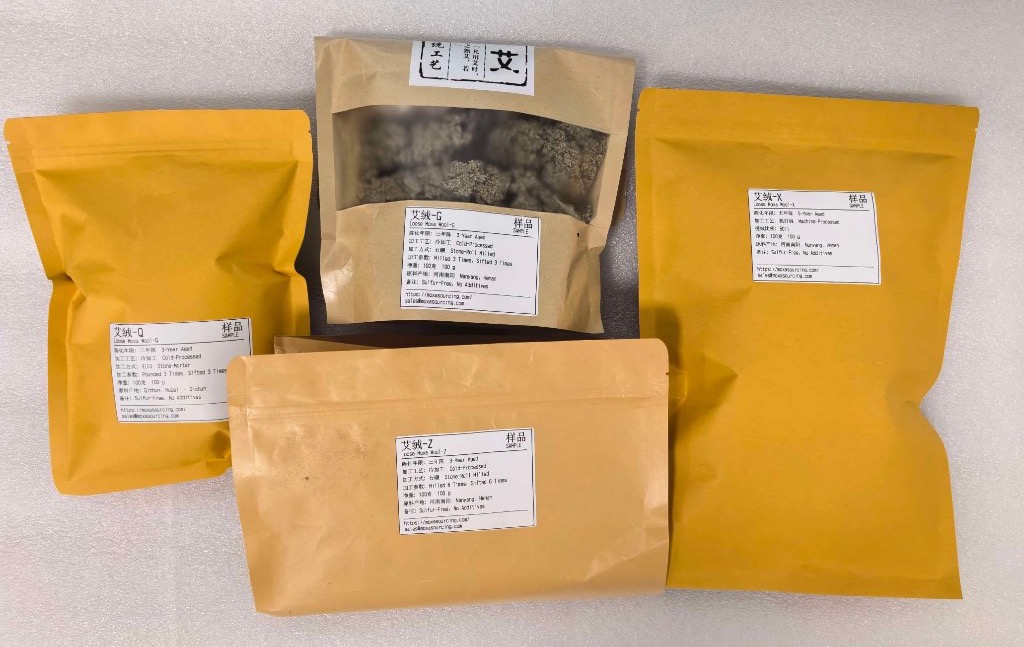
| 8. Moxa Wool (艾绒成品) | Resulting loose wool evaluated before shaping or direct sale | Fine-powder content, fluffiness, microscopy, moisture, total ash, smoke & tar | Matching physical reference sample & agreed GB/T 40976-2021 checks |
| 9. Finished Product (成型包装) | Rolling into sticks, cutting into cylinders, shaping cones, or carbonizing | Diameter, length, packing density, wrapping paper, glue, and post-treatment | Written product spec, density check, and burn evaluation (GB/T 40975-2021) |
3. Stages 1–4: Origin, growing, harvest & the critical leaf-vs-stem checkpoint
Every batch begins in the field, yet upstream adjectives are the most frequently misunderstood claims in overseas moxa buying:
- Origin sets starting conditions, not a guaranteed outcome: Two farms inside the same famous production region (Qichun or Nanyang) can produce dramatically different raw material depending on weather, harvest maturity, and drying discipline.
- Cultivated vs. wild is a supply characteristic, not a score: Managed cultivation improves batch consistency and traceability; wild collection from scattered terrain adds labor cost without automatically proving cleaner finished wool.
- Sorting & drying sit right before storage: Fresh wet plant mass is never interchangeable with dry leaf input. More importantly, separating coarse stems before milling defines whether downstream ratios are genuinely comparable (a 10:1 whole-plant ratio includes stems that a 10:1 leaf-only ratio already removed).
4. Stages 5–7: Storage aging, refining equipment & yield mass balance
Once dried leaves enter the warehouse, three manufacturing steps do the heaviest lifting in shaping aroma, fiber texture, and combustion smoothness:
- Storage aging is time plus environment: Under
GB/T 40976-2021, dried mugwort leaves in scope are stored at least one year; under Nanyang standardDB4113/T 048-2023(historical reference; withdrawn 2026-10-30), reliable aging means documented intake dates, humidity/temperature control, and continuous records even if stock changes warehouses. - Refining equipment shapes fiber mechanics: High-speed mechanical mills maximize throughput and often produce brighter golden wool, while traditional stone mills (石磨), stone rollers (石碾), and stone mortars (石臼) operate slower and cooler—often retaining longer fibers and natural oil aroma (see our deep dive: Stone-Milled vs. Machine-Milled Moxa).
- Mass balance keeps ratio claims honest: Every kilogram entering the mill splits into four buckets—
Usable Wool + Processing Fines (艾粉) + Coarse Residue (艾渣) + Unmeasured Losses = 100% Input. At 10:1 (10% wool yield), the remaining 90% is removed plant material before burning, never combustion ash.

5. Stages 8–9: From measurable moxa wool to finished sticks, cylinders & carbonized formats
Stage 8—the finished moxa wool itself—is the buyer’s strongest physical checkpoint because fiber cleanliness, fine-powder content, fluffiness, moisture, and odor can be directly observed and tested before wrapping ever hides the material.
In Stage 9, forming and packaging introduce a final layer of variables that can make the exact same wool perform differently:
- Geometry & packing density: Cylinder diameter, length, and unit weight determine bulk density (
g/cm³), which directly controls burn duration and peak temperature (covered inGB/T 40975-2021). - Wrapping paper & adhesive: Ordinary paper, cotton paper, and mulberry bark paper (桑皮纸) differ sharply in smoke smell and ash-column stability.
- Cylinders vs. cones & carbonization: Pre-cut cylindrical segments (艾柱) are distinct from hand-shaped conical cones (艾锥); carbonization (“smokeless moxa”) is a separate post-refining thermal treatment whose indoor smoke behavior should always be verified on samples rather than assumed from a label.
Next step after mastering the 9 stages: Once you know the process path your customers need, switch to the cost lens in Moxa Product Builder (or read our Complete China Moxa Cost Breakdown Guide) to see how every stage translates into transparent landed cost.
Process FAQ
How many stages does raw mugwort go through before becoming finished moxa?
Nine linked stages: origin, growing/collection, harvest & drying, leaf-vs-stem input sorting, controlled storage aging, refining equipment, yield mass-balance screening, measurable wool evaluation, and finished forming/wrapping (plus optional carbonization).
Does one upstream label like origin or storage age decide final moxa quality?
No. Upstream labels set starting conditions only; leaf sorting, warehouse humidity, refining equipment, screening, forming density, and wrapping paper all materially change real burn performance.
What is the difference between Moxa Quality Journey and Moxa Product Builder?
Moxa Quality Journey focuses on the 9-stage production flow, quality factors, and Chinese standards. Moxa Product Builder focuses on open-book cost structure, spec locking, and supplier quote comparison.
What happens to the non-wool part of the mugwort leaf during refining?
It separates into processing fines (艾粉), coarse residue (艾渣), and unmeasured handling losses—pre-burn plant fractions that are completely distinct from combustion ash formed after burning.