Source a monthly comfort heat patch by locking placement, composition, temperature, duration, discretion, warnings, packaging and market claims.
What exactly is being sourced?
Define a heat-product construction and placement before assigning a monthly-comfort name or requesting private-label packaging.
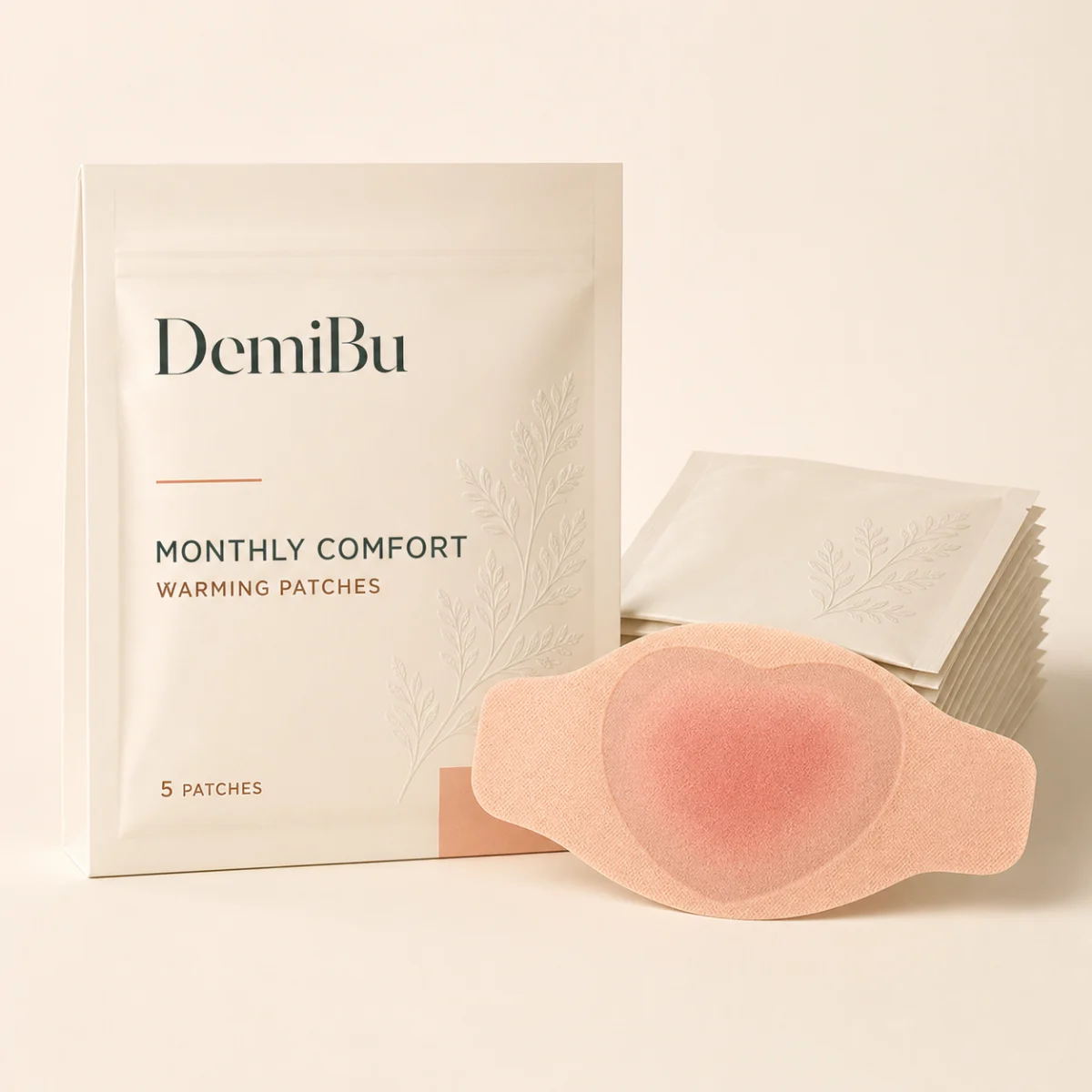
A monthly-comfort patch may be an air-activated heat pad attached to underwear, a direct-skin warming patch or another construction. These formats differ in heat transfer, adhesive, materials, warnings and destination classification. The buyer should not let a supplier choose the placement after packaging is designed. Record placement in the product name, instructions, test plan and specification.
Obtain the complete heat-material or formula statement, layer construction, dimensions, fill or weight, adhesive, liner and pouch. B2B pages show common air-activated ingredients and customizable sizes, but those are reference questions only. MB2B-0008 remains a selected product platform whose exact composition and heat data must be confirmed against the product reference and samples.
Define the intended channel and user experience. Discretion may involve a thin profile, quiet material, low visibility under clothing, individual pouches and easy disposal. These are product attributes that can be sampled. Avoid turning the name into a promise about menstrual conditions, symptoms, circulation or treatment. The buyer-market reviewer decides any claim beyond factual warmth and use.
Separate the buying model. An existing reference may support faster samples. A private-label version adds controlled artwork and packaging. A new shape, formula, adhesive or heat target is development and may require tooling, validation and higher minimums. Quotes must identify which path they represent.
| Definition field | Question | Approval evidence |
|---|---|---|
| Placement | Underwear, clothing or skin? | Representative sample, instructions and market review |
| Construction | Air-activated chamber or another system? | Composition and layer statement |
| Heat | Average, peak and duration under what method? | Representative temperature curves |
| Discretion | Thickness, sound, visibility and movement target? | Wear observation under intended clothing |
| Positioning | Factual warmth or a regulated claim route? | Buyer or importer classification and claims decision |
| Buying model | Existing, private label or new development? | Comparable quotation and sample scope |
How should temperature and duration be evaluated?
Use a defined curve test that reflects the chosen placement and records rise, working range, peak, distribution and end point.
A single maximum or duration number is not enough. Record when the pouch opens, test environment, garment or skin interface, sensor positions, interval and covering conditions. Measure multiple representative samples. Placement against underwear can produce a different experience from direct skin contact or a laboratory surface.
The curve should show activation time, sustained range, peak and total duration under the agreed threshold. Evaluate distribution and bunching because a folded heat cell can concentrate output. Longer duration is not automatically better. The selected target must be reviewed with product design, instructions, warnings and intended users.
A public menstrual heat-wrap label provides a useful structural benchmark: underwear rather than skin placement, flat application, time limit and explicit cautions. Those instructions belong to that product. They demonstrate the questions an OEM buyer must close; they do not become the MB2B-0008 specification.
Any change to heat material, fill, chamber, nonwoven, breathable layer, adhesive or pouch can alter performance. The change-control plan defines when a new full curve, wear sample or market review is required. Production checks use an agreed method linked to the development data.
What should the sample and warning review cover?
Review physical use, heat safety, attachment, pouch and instructions together because one change can affect several risks.
Measure size, active area, thickness and pack. Observe attachment to the intended underwear or clothing, movement, edge lift, bunching, noise, visibility and removal. For any skin-contact proposal, obtain full contact-material information and a product-appropriate evaluation plan. Do not claim sensitive-skin suitability without exact evidence.
Review heat under the intended flat placement and consider pressure, tight clothing, sleep, reduced sensation and user ability to remove the product. Warning content is selected for the SKU and market. The product should instruct the user to stop when heat becomes uncomfortable and should address damaged, folded, reused or reheated products when relevant.
The sealed pouch is inspected for barrier, seal, tear opening, premature activation, print and code. Shelf life must be supported for the final product-plus-pouch system. Custom film or printing can require representative testing rather than relying on a blank sample.
Instructions should use neutral, practical language: open when ready, attach in the approved location, keep flat, follow the verified time limit and dispose after one use. Medical or menstrual-treatment language is not derived from domestic packs or competitor pages.
Sources for this section: [1]
How is private-label packaging scoped?
Define unit pouch, retail count, carton, insert, barcode, language, warnings and case data as one version-controlled system.
The unit pouch protects the product before activation. The retail format may be a single trial, several individually sealed units or a channel-specific multipack. State counts at every level and ask separately for product, pouch, box and insert minimums. Excess printed stock can become obsolete when claims or the SKU change.
Artwork begins with confirmed facts: product identity, placement, net count, verified heat statement, directions, warnings, storage, lot or date code and responsible-party information. The buyer or importer approves destination wording. The factory checks dieline and print feasibility. Moxa Sourcing coordinates versions and ensures that marketplace and distributor copy use the same claims matrix.
Discretion can be communicated through verified physical attributes such as individually sealed units, thin profile or under-clothing placement. Avoid promises of symptom resolution or normal daily performance for every user. Packaging imagery should show correct placement without implying direct skin contact if the specification requires underwear or clothing.
Before bulk printing, review a rendered proof and physical pack where needed. Check seal-free areas, folds, opening, barcode, legibility and whether warnings remain visible. Inspection matches the production batch to the approved file.
| Packaging layer | Control fields | Main failure to prevent |
|---|---|---|
| Unit pouch | Barrier, seal, opening, print and code | Premature activation or missing use identity |
| Retail pack | Count, carton, insert, barcode and warnings | Incorrect count or hidden instructions |
| Channel content | Approved title, bullets, imagery and claims | Online copy exceeds the label evidence |
| Shipping carton | Count, dimensions, marks and protection | Crushing, mix-up or wrong market version |
| Version record | SKU, artwork, date and approvals | Obsolete packaging used in production |
How should the buyer control claims and classification?
The buyer or importer determines the destination route from composition, intended use and wording before final artwork or shipment.
A monthly-comfort name can remain a commercial positioning phrase, but the surrounding copy determines its meaning. Statements about cramps, pain, treatment, circulation, hormonal conditions or guaranteed outcomes can trigger different evidence and classification questions. They are excluded unless the buyer establishes a reviewed, substantiated route.
Neutral warmth is still product-specific. The final SKU must support placement, temperature, duration, count and material statements. ‘Natural,’ ‘drug free,’ ‘safe,’ ‘non-toxic’ and similar broad claims need evidence and market review. The absence of an active drug is not enough to prove every safety or classification statement.
European Commission guidance tells importers to check product requirements, packaging and labeling. FDA-regulated U.S. imports require accurate product and supplier data. These sources do not classify MB2B-0008. They explain why the destination and intended use must be named and why the importer cannot delegate the final decision to a Chinese factory catalog.
The claims matrix lists each proposed phrase, evidence, destination decision owner and allowed channel. If a phrase remains open, it stays off printed and digital production copy. This prevents stronger distributor or advertising claims from bypassing the reviewed package.
What must be closed before production?
Close the reference SKU, sample, written specification, artwork, tests, documents, responsibilities and commercial scope before deposit or print gates require them.
The specification records exact composition or heat material, placement, dimensions, construction, heat method and target, adhesive, pouch, pack and artwork. The retained sample is coded. Temperature, duration and skin-contact suitability are not left as generic supplier statements.
The buyer approves intended use, classification, claims and final market text. The factory confirms manufacturing and component control. Moxa Sourcing coordinates samples, versions, production follow-up and agreed inspection. The importer and broker close destination filing and clearance information.
The quote separates samples, tooling, product MOQ, printed packaging minimums, tests, documents, inspection and delivery terms. A low unit price that excludes a required pouch, validation or market version is not comparable.
Shipment release states what passed and what remains. Product conformity does not guarantee destination authorization or clearance. The commercial objective is a repeatable, correctly described warming product whose evidence and responsibilities are visible to the buyer.
How should candidate suppliers be compared for a monthly-comfort program?
Compare the same placement, construction, evidence, packaging and market scope instead of ranking unrelated quotations by unit price.
Create a candidate card for each reference. Record legal seller, actual manufacturer, site, sample code, placement, dimensions, heat system, composition, layers, adhesive, pouch and retail configuration. State whether values are public, supplier-provided, sample-verified or still missing. If the supplier proposes several variants, treat each as a separate candidate rather than combining their strongest specifications into one imaginary product.
Compare heat evidence by method. A supplier that quotes average temperature without peak, placement or conditions has provided an incomplete result. Another supplier may quote a shorter duration but supply curves, variation and a controllable pouch. The buyer decides which profile matches the planned instructions and risk. The comparison should never assume that longer or hotter output produces a superior comfort product.
Compare attachment and discretion. Review whether the product is designed for underwear, clothing or skin, which materials contact the user, how it moves, whether it remains flat and how visible or audible it is. Ask for actual sample observations. A claim that the patch is skin friendly, invisible or suitable for everyone is not scored without defined evidence.
Compare packaging and evidence scope. Separate blank pouch, printed pouch, carton, insert, barcode, language versions, shelf-life basis, test reports, certificates, inspection and export handoff. Check certificate holder, site, model and validity. A large document pack earns no advantage if it does not match the selected SKU.
Compare execution. Does the supplier accept a written specification, artwork version control, notice before substitution, pilot review and nonconformance process? Can it explain which steps occur at its site and which involve a partner? Stable communication and change control can be more important than a small unit-price difference when printed packaging and destination work are at risk.
The recommendation is bounded. A candidate may pass for samples but not yet for production. It may fit an ecommerce trial but not a pharmacy channel. The decision file names open composition, heat, contact, market and importer actions. This allows the buyer to approve the next limited commitment without being told that the product is universally ready.
| Comparison dimension | Evidence to score | Do not reward |
|---|---|---|
| Product identity | Named manufacturer, site and exact construction | Broad catalog coverage |
| Heat profile | Method, curve, variation, peak and duration | One promotional temperature |
| Attachment | Placement-specific sample and material data | Generic skin-friendly wording |
| Packaging | Final pouch and carton scope with minimums | Low price excluding required components |
| Documents | Current files mapped to SKU and market question | Irrelevant certificate logos |
| Execution | Change control, pilot and nonconformance acceptance | Fast promises without written controls |
What does a commercially sensible first order look like?
It uses the smallest practical configuration that still preserves product identity, safe instructions and a usable evidence trail.
A first order should match the validation stage. If demand is untested, the buyer can begin with a confirmed standard construction and limited packaging adaptation where commercially and legally feasible. A new formula, custom chamber and several printed market versions at once create more variables than the first order can diagnose.
The sample budget should cover enough representative units for heat, attachment, pouch and pack review, not only display samples. The buyer should reserve budget for destination review and any product-appropriate testing. These costs are part of the product decision, not unexpected extras after the factory quote.
Packaging inventory is planned conservatively. Printed barrier film can require a substantial run and may become unusable if the product, duration, warning or importer changes. A staged carton or label approach may be more reversible, subject to the chosen market. The supplier should disclose excess packaging ownership and storage terms.
Success is defined before ordering: an approved SKU, acceptable lot, correct pack and evidence, and a measurable channel test. The reorder decision then uses complaints, returns, actual demand and production performance. It does not assume that a larger assortment or stronger claim is the next step.
Sources and evidence notes
Public sources help frame terminology, specifications and buyer questions. They do not prove that every factory, formula or destination-market requirement is identical.
- [1]ThermaCare Menstrual HeatWrap Current LabelThermaCare · manufacturer · accessed 2026-08-27
Provides a real market example of underwear placement, flat application, eight-hour limit, activation time and prominent heat-cell warnings.
- [2]OEM and ODM Heat Patch ManufacturerKongdy Medical · manufacturer · accessed 2026-08-27
Provides a B2B reference for customizable heat-patch size, composition and duration; efficacy wording on the page is not adopted.
- [3]Guide for Import of GoodsEuropean Commission Access2Markets · regulator · accessed 2026-08-27
Supports destination-specific importer checks for product requirements, packaging, labeling and customs documentation.
- [4]FDA Import ProcessU.S. Food and Drug Administration · regulator · accessed 2026-08-27
Explains that FDA-regulated imports are reviewed for admissibility and that complete, accurate product and firm data supports the entry process.
How this guide was prepared
Moxa Sourcing Editorial Team
The team translates product references, product samples and China-side sourcing workflows into practical English guidance for overseas buyers.
Moxa Sourcing Supply Review Team
The review team checks supplier attribution, commercial boundaries, product specifications and statements that require sample or market-specific verification.
Product availability, MOQ, price and production specifications are reconfirmed against the selected product reference. The buyer or importer leads the destination-market decision and retains applicable statutory importer duties; Moxa Sourcing supports the process by coordinating product and supplier evidence, specifications, documents, testing and label inputs, version control and agreed professional partners.