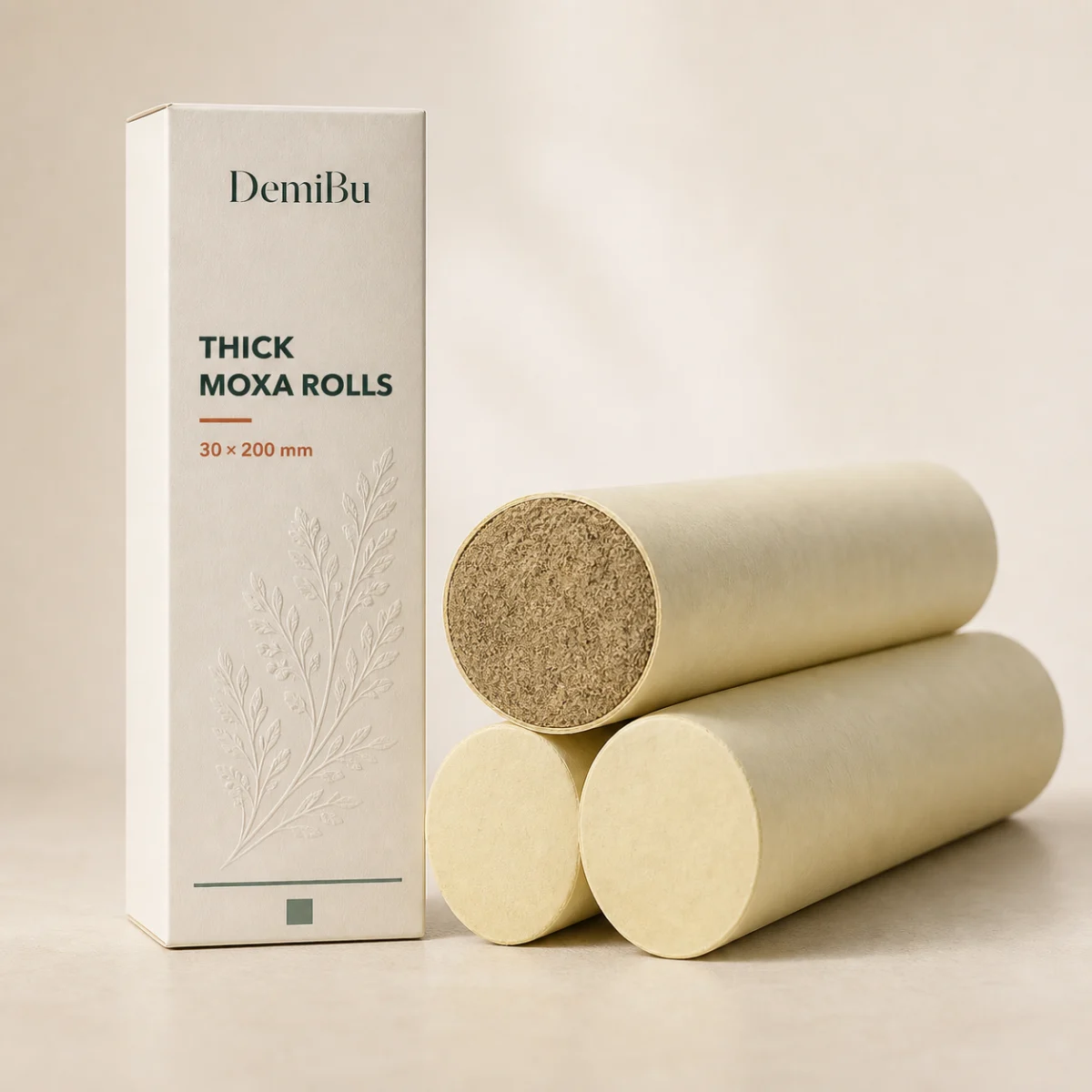
Cited moxa roll dimensions and burn times, plus a controlled, non-clinical sample comparison checklist for wholesale buyers.
Dimensions Shown in the Cited Supplier Listings
The table is a convenience sample of published specifications, not a market census or product standard. It shows dimensions and positioning found in the cited listings on 2026-09-13; other suppliers, regions, and channels may differ. Use it to ask better RFQ questions, not to infer what the whole market offers.
| Diameter shown in listings | Length shown in listings | Positioning described by sellers | How a buyer can use the reference |
|---|---|---|---|
| 12–14 mm | 100–200 mm | Seller-specific positioning varies | Request the holder/box compatibility and exact tolerance |
| 18 mm | 200 mm | Listed by several cited sellers [1][2][3] | Useful comparison point; not a market-frequency claim |
| 25 mm | 200 mm | Seller-specific positioning varies | Confirm whether an existing holder accepts the actual sample |
| 30–40 mm | 200 mm | Large-format listings exist | Specify diameter tolerance, weight, and intended accessory fit |
The table does not make clinical, performance, or market-share claims. It is a buying checklist prompt: an actual sample, specification, and accessory-compatibility record decide your SKU.
Three cited listings show 18 × 200 mm products: a Chinese manufacturer [1], a Japanese retail listing [2], and an Indian trade listing [3]. That repeated appearance makes it a useful comparison point for this small source set; it does not establish a default offering. Record the actual sample’s diameter at several positions, length, weight, wrap, and accessory fit rather than relying on the listing title.
What Actually Determines Burn Time
Burn time is not fixed by diameter alone. The source set shows different declared times for similarly described 18 × 200 mm products [1][2][3]. The factors below are buyer-side comparison fields to control or record; this article does not quantify how much each one changes burn time.
- Measured mass and packing. Record weight per stick and per unit length; do not assume two identical-looking rolls contain the same mass.
- Supplier-declared ratio. Preserve the exact label and supplier explanation, but treat it as a supplier statement rather than a third-party certification. Do not infer burn quality from the ratio alone.
- Storage condition. Record the supplier’s storage instruction, package integrity, ambient temperature, and humidity where known.
- Wrap and construction. Photograph and record the paper, adhesive, core construction, and any specified materials.
- Test conditions. Record the authorized ignition method, orientation, site ventilation, ambient conditions, and measurement intervals. Never reduce or disable required ventilation merely to make samples more comparable.
Published Burn-Time Reference Ranges
Each row below is traceable to a specific published listing, accessed and verified on 2026-09-13. These are supplier-declared figures under unknown test conditions — treat them as a plausibility band, not a performance promise.
| Product (as listed) | Spec | Declared burn time | Other declared specs | Source |
|---|---|---|---|---|
| Pure moxa stick (Chinese manufacturer) | 18 × 200 mm | 1.5 hours | 10 sticks/box × 100 boxes/carton | [1] Made-in-China listing |
| High-refinement stick (Japanese retail) | ≈18 × 200 mm | ≈55 min (full 200 mm burn-out) | 30:1 refining rate, includes wood extinguisher | [2] Goods of Japan |
| Wild mugwort stick (trade listing) | 18 × 200 mm | 1 hour | 10:1 ratio, 10 pcs/box, MOQ 50 boxes | [3] TradeIndia listing |
The three listings show declared burn times from about 55 minutes to 90 minutes for products described as approximately 18 × 200 mm [1][2][3]. Their conditions are undisclosed, so this is a reference range from named listings, not a performance range for your SKU.
Controlled Sample Burn Comparison
This is a commercial sample-comparison record, not an end-user instruction. Conduct it only when the responsible facility has authorized a fire-safe, appropriately ventilated setting, trained adult supervision, and documented ignition and extinguishing controls. No patient, skin, customer-wear, clinical exposure, deliberate smoke inhalation, or untrained observer exposure is permitted. Do not conduct it in an occupied treatment area or use it to substantiate emissions, health, safety, clinical suitability, or regulatory compliance.
- Authorize and document the setting. Before ignition, record the facility authorization, supervisor, sample identity, and the applicable site controls. Stop if those controls are absent or change.
- Inspect and measure without ignition. Record length, diameter at three points, weight, visible condition, batch code, and packaging before the test.
- Use one controlled sample at a time. The trained supervisor selects and documents an ignition and extinguishing method appropriate to the site and actual product; do not improvise a method from a catalog listing.
- Record the commercial observation. Log the buyer-defined timing points, self-extinguishing or breakage observations, and any test interruption. Do not turn a single observation into a product-performance guarantee.
- Record only permitted qualitative observations. Ash and visible-smoke notes may help compare samples for a buyer’s internal specification. Record only incidental odor observations allowed by the site protocol; never instruct deliberate inhalation. These notes do not measure emissions or establish health or indoor-air safety.
- End and secure the test under the site control. The supervisor confirms the product is extinguished and the test area is safe before any next sample is handled.
- Repeat only as the buyer’s quality plan requires. A small screen is not a statistical proof of batch or container variance. Increase sample count and use qualified testing where the purchasing risk requires it.
Set acceptance bands only after you decide what the buyer actually needs from the SKU. For example, you may agree a defined burn-time range and measurement method in the purchase specification. Any threshold is buyer- and SKU-specific; it is not an industry standard or a safety limit. Record the method, sample size, conditions, and tolerance in the purchase agreement.
Packing Conventions
Two cited listings show 10 rolls per box [1][3]. That is not a universal retail convention. Carton-level packing also varies: source [1] lists 100 boxes per carton for one 18 × 200 mm product. Confirm the exact retail pack, carton pack, gross weight, and any moisture-control requirement in the quotation rather than assuming a catalog default.
Turn the Approved Sample Into a Purchase Specification
Do not approve a bulk order by saying only “same as sample.” Give the approved sample an ID and lock the measurable fields that matter to the buyer: material identity, supplier-declared ratio definition, dimensions and tolerances, unit weight, wrap and construction, pack count, holder compatibility, storage statement, batch coding, and the agreed commercial comparison method. Keep appearance, burn behaviour and seller ratio as separate fields; none is a substitute for the others. Any later material change should create a new specification version and, where needed, a new approval sample.
Sources and evidence notes
Public sources help frame terminology, specifications and buyer questions. They do not prove that every factory, formula or destination-market requirement is identical.
- [1]Chinese manufacturer listing, 18 × 200 mm, 1.5 h burn, 10/box × 100/carton — Made-in-Chinaamkclairezxr.en.made-in-china.com · marketplace · accessed 2026-09-13
- [2]Japanese retail listing, ≈18 × 200 mm, ≈55 min, 30:1 — Goods of Japangoodsofjapan.com · industry · accessed 2026-09-13
- [3]Trade listing, 18 × 200 mm, 1 h, 10:1, MOQ 50 boxes — TradeIndiatradeindia.com · marketplace · accessed 2026-09-13
- [4]Internal: Moxa Wool Grades, Ratios & Aging Buying GuideMoxa Sourcing · first party · accessed 2026-09-13
- [5]Internal product: Pure Moxa RollMoxa Sourcing · first party · accessed 2026-09-13
- [6]Internal comparison: Smokeless vs Traditional MoxaMoxa Sourcing · first party · accessed 2026-09-13
How this guide was prepared
Moxa Sourcing Editorial Team
The team translates supplier references, product samples and China-side sourcing workflows into practical English guidance for overseas buyers.
Moxa Sourcing Supply Review Team
The review team checks supplier attribution, commercial boundaries, product specifications and statements that require sample or market-specific verification.
Product availability, MOQ, price and production specifications are reconfirmed against the selected supplier reference. The buyer or importer leads the destination-market decision and retains applicable statutory importer duties; Moxa Sourcing supports the process by coordinating product and supplier evidence, specifications, documents, testing and label inputs, version control and agreed professional partners.