Comparing Samples: Blocking and Randomization
NIST selects an experimental design according to the objective and the factors being investigated.
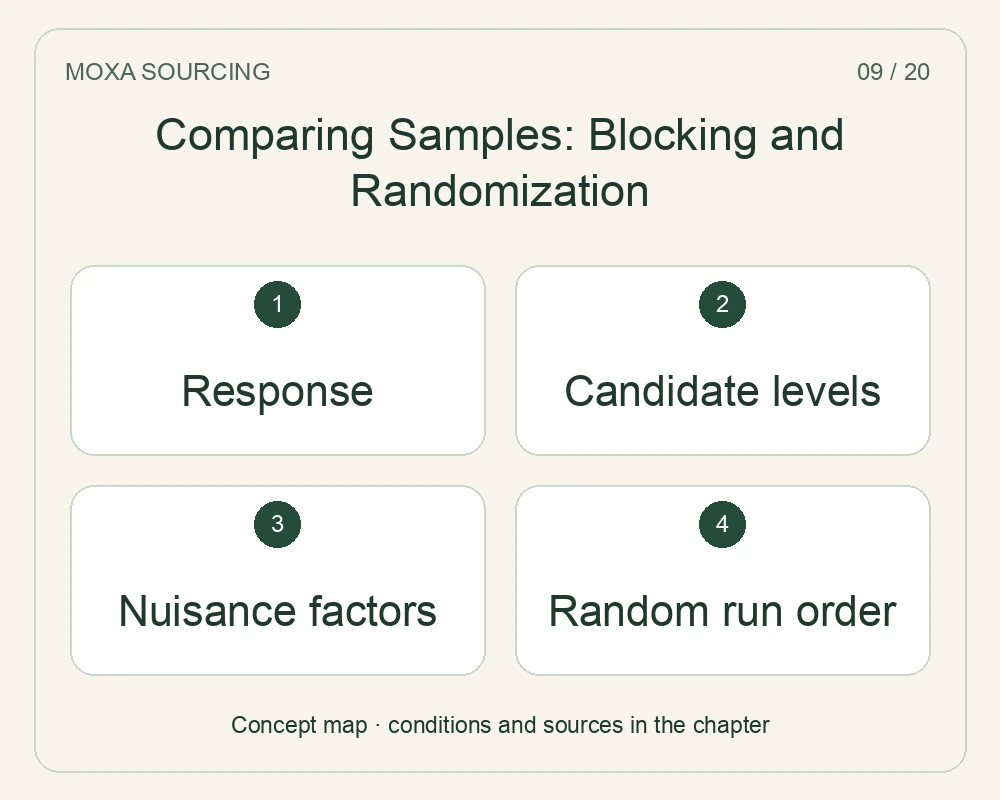
| Evidence or term | What it means here |
|---|---|
| Randomization | Distributes treatment assignments or run order according to the design. |
| Blocking | Groups comparisons around a relevant nuisance factor. |
| Balance | Preserves the planned distribution of observations across compared conditions. |
What does the evidence explain?
Is choosing between candidates the same objective as optimizing a process?
NIST selects an experimental design according to the objective and the factors being investigated. A comparative objective focuses on a factor identified as important before the experiment, even when other influences are present. Screening instead seeks the important effects among many possibilities. Response-surface work investigates interactions and curvature to understand or improve settings. These objectives require different information.
For a sample comparison, write the decision question before deciding how many observations to collect. Comparing named configurations is not automatically a search for an optimum formula or manufacturing process. The latter may require a different design and technical scope. A long list of measurements does not by itself make the study capable of answering both questions. This source describes engineering experiment design, not a proposed clinical study or evidence of therapeutic benefit.
What are the factor, levels and response in a one-factor comparison?
The completely randomized design described by NIST has one primary factor. Its levels are the alternatives being compared, and the response is the measured outcome examined across those levels. The design concerns a specified response and comparison. It does not turn every observed characteristic into an equally reliable conclusion without considering how that characteristic was measured.
In an adapted record, identify the factor and its levels by the actual controlled configurations, then define each response and method. A label such as “sample A” is insufficient if its version changes during the study. Likewise, a general score should not replace the underlying response data when the question concerns a measurable difference. The design description makes the comparison explicit; it does not prescribe the response limits or number of units for a particular product.
Why is grouping all observations of one candidate together not random run order?
NIST describes randomly assigning factor levels to experimental units and determining the run sequence randomly. Always completing one level before starting the next is an example of an unrandomized order. If time-related conditions change during that sequence, the comparison can become entangled with the order in which the candidates were evaluated.
The source describes randomization by software, random-number tables or a physical drawing mechanism. The important feature is an actual random allocation or sequence, not merely a sequence that looks irregular. Preserve the planned and executed order. If a practical interruption changes it, record the deviation so its possible effect can be considered. Randomizing run order is also distinct from selecting a random sample from a production lot; the two operations serve different purposes in the comparison and acceptance workflows.
What does the three-level, two-repetition example illustrate?
The source illustrates three levels, each appearing twice, for six runs. If all six runs were individually labeled there would be six factorial possible orders. Because each level repeats, only ninety distinct level sequences remain: 6! divided by 2! × 2! × 2!. The physical drawing example uses two slips for each level, drawn without selecting a preferred order.
This example explains the difference between permuting individual runs and permuting repeated level labels. It is not a recommendation to evaluate every product with six observations. The relevant sample size depends on the actual question and study design. The example also does not claim that every ninety-sequence design has been carried out; it describes the possible orderings from which a randomization mechanism can select one.
What does balance mean in the described comparison design?
For the one-factor design, balance means the same number of repetitions at each level. NIST notes its role in the sensitivity of subsequent statistical comparisons. The source’s second example has four levels and three repetitions per level, giving twelve runs. The equal allocation is visible in the design before the data are collected.
The run count follows the stated one-factor structure. The page’s expression involving the number of factors is presented with that number fixed at one; it should not be generalized into a rule that multiplying the number of factors by a level count gives every multi-factor design’s size. If observations are lost or additional runs are added, retain the actual allocation. A dataset originally planned as balanced may no longer be balanced when analyzed.
What is a nuisance factor in a comparison?
A nuisance factor can affect the measured response without being the factor of primary interest. NIST gives operator, time of day and room temperature as examples. Calling a factor a nuisance does not mean its effect is negligible. It means the experiment is trying to answer another main question while dealing with that influence.
Identify plausible nuisance factors before collecting observations and decide which can be controlled or recorded. If the comparison uses different operators, settings or dates for different candidates, those differences belong in the record. Otherwise an apparent candidate effect may include an uncontrolled condition. This is a design question, not proof that any particular condition caused an observed difference. The actual data and appropriate analysis are needed to establish what the study supports.
How does blocking make a comparison more interpretable?
Blocking creates relatively homogeneous groups in which the selected nuisance condition is held constant while the primary factor varies. The comparison is then made within those blocks, and the block contribution is accounted for in analysis. The source defines a blocking factor through equal occurrence of every primary-factor level with each nuisance-factor level in the described arrangement.
This is different from putting all of one candidate in one block and all of another candidate in a different block. In that arrangement, candidate and block are not separated by the within-block comparison described here. An adapted plan should show which candidates occur in each block and how allocation is handled. Blocking can reduce the contribution of selected nuisance effects to experimental error, but does not make every uncontrolled influence disappear.
Why use both blocking and randomization?
The two methods address different control opportunities. NIST uses blocking for a few important nuisance variables that can be controlled, with randomization addressing remaining nuisance influences. A randomized-block experiment can be viewed as a set of comparisons conducted within separate blocks. The design should state where randomization occurs rather than simply attach “randomized” to the study title.
For the adapted comparison record, preserve the block definition and the allocation or order within that design. If a condition cannot be held constant, record it when feasible instead of pretending it was controlled. Randomization is not a guarantee that a small dataset will have perfectly identical conditions, and blocking is not a substitute for an appropriate measurement method. The methods help structure the comparison; the limits of the actual study remain part of its interpretation.
What does the twelve-wafer furnace example show about blocking?
The handbook example compares four implant dosages using three wafers at each dosage. Furnace run is the nuisance factor because conditions differ between runs. Putting one experimental wafer in each of twelve furnace runs would add run-to-run variability to the comparison. The blocked arrangement puts four wafers, one at each dosage, into each of three furnace runs.
The resulting layout has four dosage levels by three blocks, with one observation per cell: twelve observations in total. Random allocation determines which wafer of each dosage enters each run. The example shows how the primary comparison is retained within the nuisance condition. Its semiconductor doses, furnace process and quantities are illustrative source facts, not a sample-count recommendation or manufacturing process for mugwort products. An actual study needs its own controlled factor, block and feasible allocation.
Why retain the candidate-by-block table when summarizing results?
The randomized-block source represents the design as a matrix: rows identify primary-factor levels and columns identify block levels. Its estimates distinguish the overall mean, each primary-factor mean relative to the overall mean, and each block mean relative to the overall mean. The layout preserves information about both the comparison and the nuisance grouping.
Collapsing all observations into one total per candidate can hide that structure. Keep the cell-level association even if the buyer-facing summary is short. A mean difference is an estimate to interpret with the relevant model and uncertainty, not automatically a statistically established or commercially decisive difference. The detailed model tests are outside the introductory pages used here. No significance threshold or conclusion about a real set of samples is inferred from the layout alone.
Why leave some study capacity for checks and disrupted runs?
NIST notes that design choice depends on available resources and the desired control of wrong decisions. It recommends not consuming the entire run budget in the initial design, so that relevant additional checks or replacement runs after processing mishaps remain possible. Its example of adding center points concerns checking curvature in a two-level screening design, not a requirement to add center points to every candidate comparison.
An adapted plan should distinguish an authorized replacement for a disrupted run from an unexplained extra observation added after reviewing the result. Preserve the reason for any repeat and its relationship to the original run. A technical mishap may justify another run; simply disliking a result does not make the original observation disappear. This record discipline supports interpretation of the actual design without inventing a universal number of spare samples or a fixed development fee.
FAQ
Is choosing between candidates the same objective as optimizing a process?
NIST selects an experimental design according to the objective and the factors being investigated. A comparative objective focuses on a factor identified as important before the experiment, even when other influences are present. Screening instead seeks the important effects among many possibilities. Response-surface work investigates interactions and curvature to understand or improve settings. These objectives require different information.
Why leave some study capacity for checks and disrupted runs?
NIST notes that design choice depends on available resources and the desired control of wrong decisions. It recommends not consuming the entire run budget in the initial design, so that relevant additional checks or replacement runs after processing mishaps remain possible. Its example of adding center points concerns checking curvature in a two-level screening design, not a requirement to add center points to every candidate comparison.
Sources and scope
Sources: NIST/SEMATECH handbook 5.3.3, 5.3.3.1 and 5.3.3.2. Comparative-design and blocking principles, with clearly identified source examples. No clinical experiment, actual supplier comparison, required product sample count or adopted ANOVA significance rule. NIST design selection NIST completely randomized design NIST randomized blocks