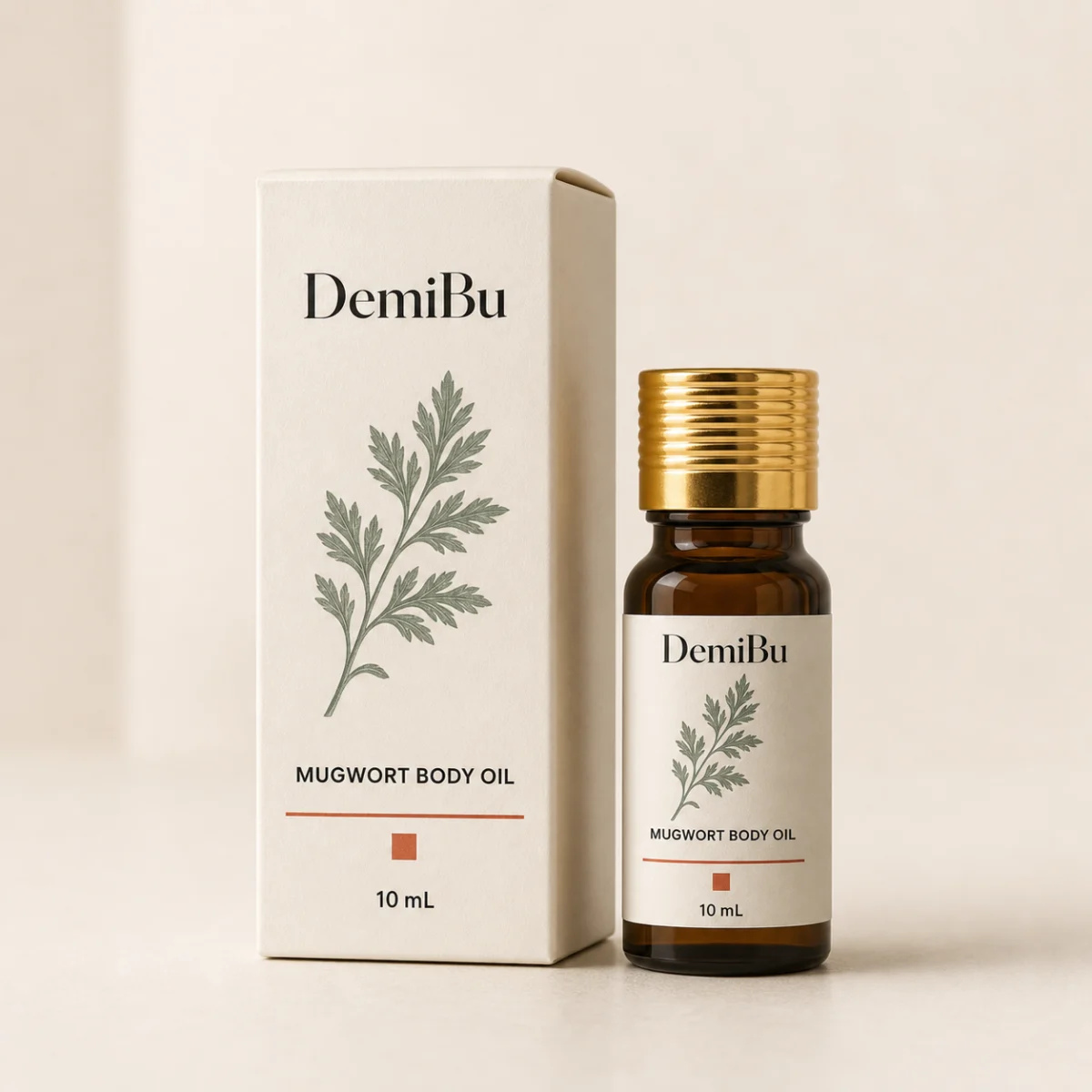
Define a 20 ml mugwort body oil by formula identity, complete INCI, botanical input, fill control, bottle system and component-level MOQ.
Freeze the finished-formula identity before selecting the 20 ml bottle
A buyer must first establish what the liquid is, how concentrated it is and how it is intended to be used; the compact pack cannot answer those questions.
Body oil is a finished-product identity. It usually implies a blend intended for direct application under stated directions, but the supplier declaration must confirm the actual formula and use. Massage oil, aromatic oil and essential-oil ingredient are not interchangeable labels. Ask the manufacturer to state the product type in writing and connect that statement to a formula revision and sample code.
Mugwort is a common name applied to more than one Artemisia material. The formula dossier should identify botanical species, plant part, extraction or processing method, raw-material supplier name and the percentage used. A front label that says mugwort does not reveal whether the formula contains an essential oil, infused oil, extract, fragrance composition or another derivative.
List the complete carrier system. Fixed oils, antioxidants, fragrance materials and other functional ingredients shape appearance, viscosity, oxidation behavior, dispensing and label declarations. The hero botanical may be commercially important, but it is only one line in the finished formula. Never build the INCI by copying a competitor or translating marketing names literally.
Formula release should include version number, batch size basis, percentage composition, manufacturing sequence where relevant, raw-material specifications and change-control owner. The buyer or its qualified assessor may require additional data for the destination. Moxa Sourcing can coordinate the supplier file, but it does not invent missing identity or replace market assessment.
Turn the formula declaration into an INCI and identity dossier
Every name on the ingredient list must be traced to the actual raw material and its composition rather than inferred from the product story.
Product class question: Define leave-on body oil, massage oil, aromatic blend or concentrated ingredient. The file should contain complete formula, concentration and intended-use statement. Keep this limit in view: do not use body oil and essential oil interchangeably.
Botanical traceability question: Record species, plant part, extraction method and supplier material name. The file should contain raw-material specification and formula revision. Keep this limit in view: mugwort is a broad common name.
Formula completeness question: List every carrier oil, antioxidant, fragrance and other component. The file should contain complete ingredient declaration and percentage data needed for assessment. Keep this limit in view: the hero ingredient is not the full formula.
Container-system question: Select bottle material, color, neck, reducer, dropper or pump and tamper feature. The file should contain component drawings, fill trial, compatibility and leakage results. Keep this limit in view: a stock bottle still requires finished-product testing.
Batch release question: Define net contents, fill tolerance, color, odor and visible-particle expectations. The file should contain production-intent samples and written limits. Keep this limit in view: sensory description must not become an efficacy claim.
Commercial-scale question: Separate formula MOQ, bottle component MOQ, decoration MOQ and carton MOQ. The file should contain complete quotation with tooling, sampling and testing. Keep this limit in view: the highest component minimum may control the project.
| Decision | What to choose | Evidence to request | Approval boundary |
|---|---|---|---|
| Finished identity | Define leave-on body oil, massage oil, aromatic blend or concentrated ingredient. | Complete formula, concentration and intended-use statement. | Do not use body oil and essential oil interchangeably. |
| Botanical reference | Record species, plant part, extraction method and supplier material name. | Raw-material specification and formula revision. | Mugwort is a broad common name. |
| Carrier system | List every carrier oil, antioxidant, fragrance and other component. | Complete ingredient declaration and percentage data needed for assessment. | The hero ingredient is not the full formula. |
| 20 ml pack | Select bottle material, color, neck, reducer, dropper or pump and tamper feature. | Component drawings, fill trial, compatibility and leakage results. | A stock bottle still requires finished-product testing. |
| Fill and appearance | Define net contents, fill tolerance, color, odor and visible-particle expectations. | Production-intent samples and written limits. | Sensory description must not become an efficacy claim. |
| MOQ and customization | Separate formula MOQ, bottle component MOQ, decoration MOQ and carton MOQ. | Complete quotation with tooling, sampling and testing. | The highest component minimum may control the project. |
Audit INCI line by line against raw-material composition
A credible ingredient list is reconstructed from supplier documents, formula percentages and applicable naming rules, then reviewed for the destination market.
Create a raw-material table with trade name, supplier, internal code, botanical or chemical identity, composition breakdown, percentage in formula and supporting file. Many blends arrive under a trade name that contains multiple declaration components. If a fragrance or premix is used, request the level of composition data needed by the buyer’s assessor rather than placing the trade name on the consumer label.
Use the current naming references relevant to the destination and formula. The cited FDA ingredient-name resource explains U.S. cosmetic naming conventions, while the EU legislation source supports market-specific review. Neither source makes a particular formula compliant. The buyer or responsible party checks ordering, allergens or other required particulars, language, business information and claims for the exact finished product.
Resolve ambiguity before artwork. If the supplier alternates between body oil, essential oil and massage oil, stop and request a signed formula identity. If the percentage of mugwort-derived material is unknown, mark it unresolved; do not imply concentration through bottle size, color or the word pure. If the botanical species cannot be confirmed, do not guess from a common name.
Compare the consumer-facing product name with the formula table. A diluted ready-to-use blend should not be presented as a neat essential oil. An aromatic fragrance story should not imply that the botanical ingredient performs a clinical function. Directions and cautions must also match the use level and exposure assumptions reviewed by the buyer.
Lock the approved INCI to the same revision as the bulk formula, production sample and artwork. Any substitution in carrier oil, antioxidant, fragrance or botanical input triggers an ingredient-list and assessment check. Change control is particularly important for small private-label runs, where a supplier may view similar materials as commercially interchangeable even when label declarations differ.
- Trade name mapped to actual composition
- Percentage and formula revision for every input
- Botanical species, plant part and process
- Destination naming and label review owner
- Substitution rule linked to artwork change control
Engineer the 20 ml dispensing system around the liquid
Bottle, closure, output and decoration must be tested with the selected formula rather than approved as isolated stock components.
Specify bottle material, color, nominal capacity, brimful capacity, neck finish, supplier code and dimensional drawing. Then select reducer, dropper, pump or other closure based on viscosity and intended directions. A component sold as suitable for oil is not proof of compatibility with this formula, fill process or distribution route.
Run fill trials on production-intent components. Define target net contents, process tolerance, headspace appearance and measurement method. The visible fill line can vary with bottle geometry and component displacement, so cosmetic appearance and legal net-content control are related but distinct decisions. Record results by unit and retain filled controls.
Evaluate closure engagement, dose behavior, cap fit, tamper feature and leakage across orientation and transit conditions. Observe label adhesion and ink or decoration when exposed to the oil. A 20 ml pack has little surface area; typography, batch code and required information should be checked on a physical decorated sample rather than only a screen rendering.
Component color and light protection may be relevant to the buyer’s stability strategy, but a dark bottle does not establish shelf life. The finished-product testing plan must consider the formula in the final market pack. The FDA source on cosmetic testing supports the manufacturer’s responsibility for adequate substantiation; it does not prescribe one universal protocol for this oil.
| Channel | What to prioritize | Primary operational risk |
|---|---|---|
| Beauty retail | Clear finished-product identity, ingredient list and premium compact pack | Therapeutic botanical claims |
| Spa and massage | Usable dispensing, sensory consistency and professional directions | Confusing a concentrate with ready-to-use oil |
| Gift and discovery | Compact size, leakage control and readable information | High component cost and insufficient label space |
Keep cosmetic positioning tied to the exact formula and market
Botanical origin and sensory description do not create permission for treatment or skin-improvement promises.
Review the name, ingredient story, directions, warnings, website, marketplace content and distributor materials together. The body-oil identity should describe the finished blend accurately. Avoid translating traditional-use narratives into disease, pain, circulation, inflammation or skin-structure claims without the appropriate pathway and evidence.
The factory controls manufacturing to the released formula and pack specification and provides agreed batch information. Moxa Sourcing organizes supplier records, samples, component trials, quality checkpoints and shipment coordination. The buyer or importer is accountable for destination classification, safety assessment, responsible-person or importer duties, registration, final label, claims and customs clearance.
A laboratory, assessor, legal adviser or logistics provider is responsible for the specific commissioned service. No single certificate or report proves every aspect of the product. Formula identity, packaging compatibility, safety work, label review and entry documents must be assembled for the selected SKU and intended market.
Reassess when concentration, botanical input, carrier system, fragrance, package, directions or claims change. Current official guidance and qualified local advice should be used before sale. This division of responsibility gives the factory a clear production target without pretending that it can make universal market promises.
| Party | Owns | Does not automatically own |
|---|---|---|
| Factory | Manufacturing, factory controls, agreed batch and product records | Destination classification, buyer advertising or customs clearance |
| Moxa Sourcing | Supplier coordination, samples, specification, quality checkpoints and handoff | Universal compliance guarantee or importer-of-record role |
| Buyer / importer | Market pathway, assessment, registration, label, claims, entry and sale authorization | Factory production execution |
| Testing, legal or logistics provider | The specifically contracted report, advice, filing or transport service | The entire product or commercial decision |
Sources for this section: [3]
Quote formula, components and customization as separate minimums
A 20 ml private-label order is controlled by the economically governing batch or component minimum, not by bottle size.
Ask for the base formula batch size and the finished units it yields at the approved fill. Separately request minimums for bottle color, closure, tamper feature, printing or label, carton and master carton. The formula may support a small run while a decorated component requires far more units. The quotation should show surplus ownership, storage conditions and the validity period of held materials.
Distinguish three development routes: existing formula with stock components and label; existing formula with customized decoration; or modified formula and custom pack. Each route carries different sample, testing, tooling and lead-time needs. Comparing a stock-label price with a full formula-development quote is not a valid supplier comparison.
The RFQ should attach the product identity sheet, target market, intended use, claims boundary, formula questions, 20 ml pack preference, expected order, annual forecast and evidence list. Request both bulk and filled samples where useful. The final approval connects formula revision, INCI, filled sensory reference, bottle system, artwork and acceptance tests.
Before production, resolve every unknown marked buyer decision or sample required. Before shipment, verify identity, fill, appearance, closure, leakage sampling, decoration, coding, carton count and agreed documentation. Retain finished units and the batch file. A substitution needs buyer approval before it reaches the line.
Commercial readiness means the buyer can explain exactly what the product is, declare its ingredients, reproduce its sensory profile and order the same 20 ml pack again. A premium-looking bottle without that identity chain is not a finished private-label proposition.
One practical control is a formula-to-label reconciliation meeting before artwork release. Procurement reads each formula input aloud, the label reviewer identifies its proposed declaration, packaging confirms available space, and the buyer records unresolved market questions. This short gate prevents a design schedule from concealing an incomplete INCI or a misleading product identity.
- Formula batch minimum and expected filled yield
- Bottle, closure, decoration and carton minimums
- Complete formula and raw-material identity file
- Filled-pack compatibility and leakage scope
- Destination review, artwork and change-control owners
Sources and evidence notes
Public sources help frame terminology, specifications and buyer questions. They do not prove that every factory, formula or destination-market requirement is identical.
- [1]Cosmetic Ingredient NamesU.S. Food and Drug Administration · regulator · accessed 2026-08-27
Supports the need for a complete retail ingredient declaration using accepted common or usual names in the U.S.; destination rules still require buyer review.
- [2]Product Testing of CosmeticsU.S. Food and Drug Administration · regulator · accessed 2026-08-27
Supports finished-product safety responsibility and risk-based testing rather than a universal test list.
- [3]EU Cosmetics LegislationEuropean Commission · regulator · accessed 2026-08-27
Official entry point for EU cosmetics legislation, responsible-person, safety and claims requirements; applicability depends on the final formula and market role.
How this guide was prepared
Moxa Sourcing Editorial Team
The team translates product references, product samples and China-side sourcing workflows into practical English guidance for overseas buyers.
Moxa Sourcing Supply Review Team
The review team checks supplier attribution, commercial boundaries, product specifications and statements that require sample or market-specific verification.
Product availability, MOQ, price and production specifications are reconfirmed against the selected product reference. The buyer or importer leads the destination-market decision and retains applicable statutory importer duties; Moxa Sourcing supports the process by coordinating product and supplier evidence, specifications, documents, testing and label inputs, version control and agreed professional partners.