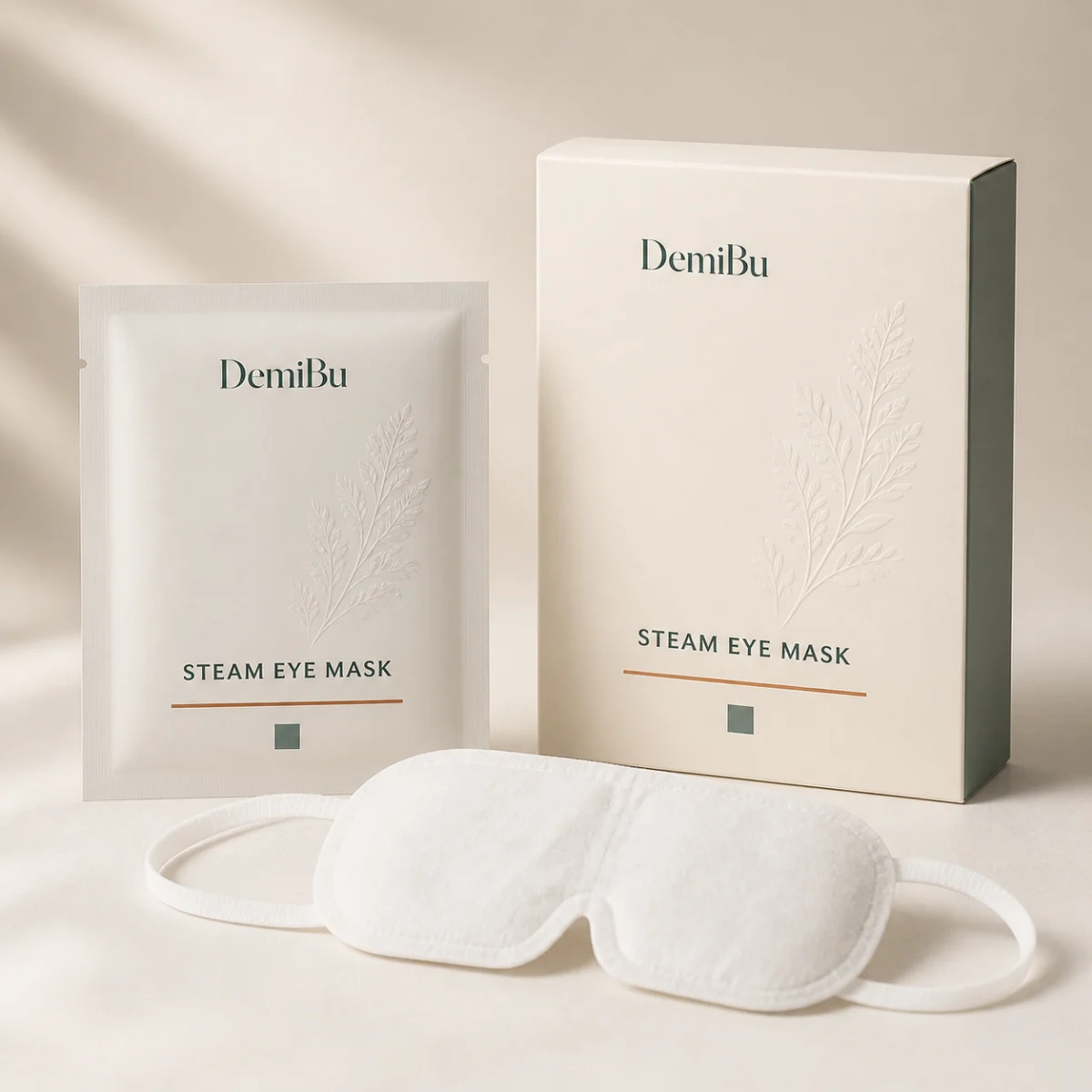
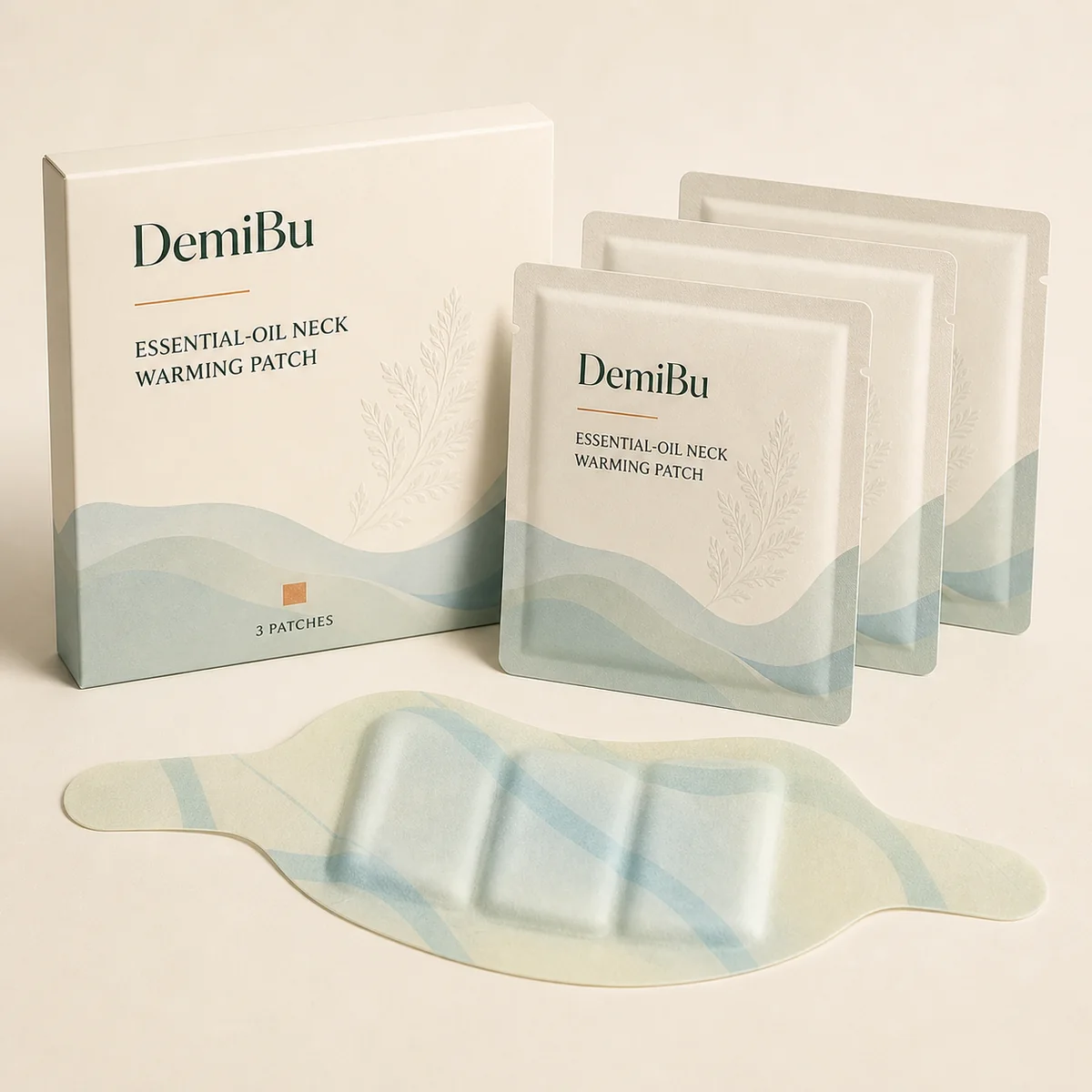
Engineer OEM steam eye mask packaging from the air-barrier pouch outward, then price print minimums, pack counts, cartons and freight constraints.
Start with the sachet because it protects activation
The primary pouch is not optional decoration: it isolates the air-activated mask until the user tears it open.
A carton can look premium while the enclosed product has already lost performance through a weak or damaged barrier. Packaging development should therefore begin at the converted pouch. Define the laminate construction, finished size, seal pattern, seal width, tear notch, corner shape, print treatment and code area. Approve those details on filled and sealed masks rather than on an empty visual prototype.
The chosen mask and pouch form one system. Insert thickness, ear-loop placement and folding pattern affect where pressure falls during sealing and distribution. Fragrance components may also influence material review. Ask the supplier to show the pack-out orientation and identify any no-seal or high-risk zone. A seemingly minor geometry change can require a pouch size or folding adjustment.
Activation checks should use the exact converted sachet after realistic conditioning. Inspect seals, then open the pouch and observe whether the mask begins warming as expected under the agreed product method. The purpose is not to claim a universal temperature or duration; it is to verify that the packaging does not undermine the selected construction. Save sealed retain samples from the approved conversion.
Artwork enters only after the functional envelope is stable. The printable area must leave room for seals, notch, coding and required information. A mockup that ignores these boundaries creates late-stage copy reduction or production defects. Treat every artwork proof as a revision linked to the approved pouch specification.
Convert the packaging idea into a component bill of materials
Every layer needs a component code, drawing, quantity, supplier minimum and approval record.
Functional enclosure — Select a barrier laminate, seal format, tear notch and printable area for one mask. Procurement should collect supplier material declaration, sealed samples and activation checks. The release constraint is that approve the exact converted pouch, not a visual mockup.
Selling unit — Choose single, five-count, ten-count or another multipack from channel economics. Procurement should collect pack-out drawing, unit count, carton dimensions and shelf plan. The release constraint is that more units increase working capital and fragrance variant risk.
Scent navigation — Decide whether each scent gets a separate pouch and carton or shares a master identity. Procurement should collect sKU matrix, color system and production MOQ by print run. The release constraint is that unscented should not be described as hypoallergenic without evidence.
Copy architecture — Place product identity, count, directions, warnings, business information and required market text. Procurement should collect buyer-approved copy deck and regulatory review. The release constraint is that benefit slogans must not displace mandatory information.
Presentation layer — Use inserts, sleeves or sets only after the functional pouch is controlled. Procurement should collect full-set sample, assembly standard and transit test. The release constraint is that the gift insert is part of the claims review.
Distribution case — Specify orientation, count, markings, dimensions and moisture protection. Procurement should collect carton drawing, packed weight and pre-shipment checklist. The release constraint is that shipping configuration affects landed cost and pouch condition.
| Decision | What to choose | Evidence to request | Approval boundary |
|---|---|---|---|
| Primary pouch | Select a barrier laminate, seal format, tear notch and printable area for one mask. | Supplier material declaration, sealed samples and activation checks. | Approve the exact converted pouch, not a visual mockup. |
| Retail count | Choose single, five-count, ten-count or another multipack from channel economics. | Pack-out drawing, unit count, carton dimensions and shelf plan. | More units increase working capital and fragrance variant risk. |
| Variant architecture | Decide whether each scent gets a separate pouch and carton or shares a master identity. | SKU matrix, color system and production MOQ by print run. | Unscented should not be described as hypoallergenic without evidence. |
| Information hierarchy | Place product identity, count, directions, warnings, business information and required market text. | Buyer-approved copy deck and regulatory review. | Benefit slogans must not displace mandatory information. |
| Gift presentation | Use inserts, sleeves or sets only after the functional pouch is controlled. | Full-set sample, assembly standard and transit test. | The gift insert is part of the claims review. |
| Master carton | Specify orientation, count, markings, dimensions and moisture protection. | Carton drawing, packed weight and pre-shipment checklist. | Shipping configuration affects landed cost and pouch condition. |
Price print minimums before multiplying scents and pack counts
The assortment is feasible only when mask production, pouch printing, carton printing, inserts and assembly can be purchased in compatible quantities.
Map the minimum for each component independently. The heating mask may be available at one quantity, while a custom printed pouch, metallic finish, carton, sleeve or leaflet requires another. A quote that shows only finished-unit MOQ hides leftover packaging exposure. Ask how many converted pouches or cartons remain after the planned run and who owns, stores and inspects that balance.
Variant design can multiply minimums quickly. If three fragrances each use a unique pouch and a five-count plus ten-count carton, the project may create nine printed items before master cartons and inserts. Shared visual architecture does not necessarily create a shared print run. Request the minimum by artwork, not by product family, and test whether neutral pouches with labeled cartons provide a lawful and commercially acceptable early route.
Pack count affects more than retail price. It changes carton dimensions, packed weight, shelf depth, parcel tier, units per master carton, damage exposure and the cash tied to each consumer unit. Build a simple landed-cost model for single, five-count and ten-count options using actual pack dimensions. The lowest factory unit price may produce poor parcel or replenishment economics.
Decoration decisions should follow the channel threshold. Foil, soft-touch coatings, rigid boxes and inserts add component lead times and inspection points. They may be justified for gifting, but they are not free signals of product quality. For a first ecommerce launch, a well-sealed pouch, legible carton and consistent variant system often reduce risk more than a complex unboxing structure.
Set an artwork freeze date that accounts for copy review, dieline proof, color proof and coding. Late changes can strand converted material or force a surcharge. If destination wording is not settled, separate design exploration from production release and keep market-dependent panels editable until the buyer signs off.
- Minimum by each printed artwork
- Unused-component ownership and storage
- Pack-out labor and quality checkpoints
- Units per master carton and dimensional freight basis
- Artwork freeze and change-cost rule
Choose travel, retail or gift formats with different pack logic
One product identity can support several presentations, but each presentation has a distinct space, handling and working-capital constraint.
A travel single must communicate product identity, opening step and essential cautions in very limited space. The pouch receives rough handling in bags and hospitality distribution, so seal and abrasion control matter more than decorative carton area. Multilingual projects need a copy plan before print because translation can exceed the available panel.
A retail multipack must make count and scent immediately clear while protecting individual sachets on shelf. Use a SKU grid to test whether colors, names and barcodes remain distinct at normal viewing distance. Adding another retail count can be more expensive than adding units because it creates another carton print run and another forecast.
A gift set combines claims and damage risks across all included products. The insert, sleeve and product arrangement are not neutral: copy may imply outcomes, and a damaged neighboring item can affect the entire set. Test assembly, movement, abrasion and opening under the actual set configuration. Confirm that every sachet remains traceable after outer packaging is discarded.
Do not let channel storytelling alter the underlying specification invisibly. The same mask sold in travel and gift formats should carry the same construction code and supporting record unless a difference is intentional. If scent, fold, pouch or instructions change, create a distinct revision and decide which tests reopen.
| Channel | What to prioritize | Primary operational risk |
|---|---|---|
| Travel single | Minimal volume, immediate identity and robust individual pouch | Small label area and rough handling |
| Retail multipack | Shelf presence, variant clarity and count economics | Too many designs driving print MOQ |
| Gift set | Coherent scent story, insert and unboxing | Set-level language creating sleep or vision claims |
Design the information hierarchy before decorative copy
Identity, count, directions, warnings and business information need protected space before benefit language or botanical storytelling is considered.
Prepare a copy deck outside the artwork file. Separate fixed product facts, variable market text, directions, warnings, business information, coding and optional marketing. Assign an owner and source for every line. This prevents designers from filling empty space with supplier claims or treating draft visual text as approved copy.
Read the front, back, sachet, insert and ecommerce page together. Express and implied claims can arise from product names, eye imagery, bedtime scenes and testimonials. This guide does not adopt sleep, vision, treatment or skin-improvement promises. Warmth, aroma, format and ordinary use can be described only as accurately supported and accepted for the destination.
The factory is accountable for producing and packing against released documents. Moxa Sourcing coordinates component references, samples, specifications, inspection points and shipment handoff. The buyer or importer determines destination classification, required assessment, registration, final labeling, claims, entry and sale. External advisers own only their contracted report or service.
Keep artwork revision, dieline revision and product revision visible in the approval record. If the mask construction changes after copy approval, review any temperature or duration statement. If unit count changes, update front identity, barcode and carton. If the pouch converter changes, reopen the functional checks rather than approving appearance alone.
| Party | Owns | Does not automatically own |
|---|---|---|
| Factory | Manufacturing, factory controls, agreed batch and product records | Destination classification, buyer advertising or customs clearance |
| Moxa Sourcing | Supplier coordination, samples, specification, quality checkpoints and handoff | Universal compliance guarantee or importer-of-record role |
| Buyer / importer | Market pathway, assessment, registration, label, claims, entry and sale authorization | Factory production execution |
| Testing, legal or logistics provider | The specifically contracted report, advice, filing or transport service | The entire product or commercial decision |
Sources for this section: [3]
Compare quotations on total pack architecture
A comparable packaging quote shows component, conversion, assembly, testing, freight geometry and surplus exposure rather than one finished-unit figure.
Send the supplier a packaging schedule with one row per SKU and component. Include mask code, fragrance code, pouch code, retail carton code, insert, barcode, units per retail pack, retail packs per master carton and forecast quantity. Attach controlled dielines or request supplier dielines before design. Ambiguity at this stage becomes a print or pack-out dispute later.
Ask for component-level pricing, tooling, plate or setup charges, proof costs, minimums, overrun tolerance, production lead time and storage terms. Separate stock-material assumptions from custom conversion. Record whether price includes individual insertion, carton assembly, coding, shrink wrap, master carton, inspection preparation and export packing.
Request a fully packed production-intent set. Measure carton and master-carton dimensions and weight, then apply the expected parcel or freight basis. Inspect pouch orientation, scuffing, count, code visibility and opening sequence. A beautiful flat proof does not reveal whether assembly is slow or the set damages itself during transit.
Before the purchase order, freeze a component matrix and approved artwork checksum or revision. Before shipment, inspect assortment, seals, print, coding, pack count, case markings and selected activation checks. Quarantine surplus printed materials from obsolete revisions. Reorders should begin from the released schedule, not from an email attachment with uncertain status.
Packaging is commercially successful when it protects activation, communicates truth, packs efficiently and can be reordered without disproportionate inventory. That is a more durable advantage than maximizing decoration on the first run.
- Component schedule and controlled dielines
- Quote by mask, pouch, carton, insert and assembly
- Surplus print quantity and ownership
- Packed dimensions, weight and case configuration
- Production proof, inspection rule and reorder revision
Sources and evidence notes
Public sources help frame terminology, specifications and buyer questions. They do not prove that every factory, formula or destination-market requirement is identical.
- [1]OEM Steam Eye Mask ManufacturerGuanma Medical Supplies · manufacturer · accessed 2026-08-27
Public manufacturer evidence for mask size, material, fragrance, individual pouch, multipack and private-label customization fields. Therapeutic marketing statements are not adopted.
- [2]Steam Eye Mask Product PageHoda Technology · manufacturer · accessed 2026-08-27
Public manufacturer evidence that disposable steam eye masks are offered as air-activated warming products with configurable scent and pack options; any performance figure remains sample-specific.
- [3]Cosmetics Labeling ClaimsU.S. Food and Drug Administration · regulator · accessed 2026-08-27
Supports the rule that cosmetic claims must be truthful and that disease or structure/function claims may change U.S. product classification.
How this guide was prepared
Moxa Sourcing Editorial Team
The team translates product references, product samples and China-side sourcing workflows into practical English guidance for overseas buyers.
Moxa Sourcing Supply Review Team
The review team checks supplier attribution, commercial boundaries, product specifications and statements that require sample or market-specific verification.
Product availability, MOQ, price and production specifications are reconfirmed against the selected product reference. The buyer or importer leads the destination-market decision and retains applicable statutory importer duties; Moxa Sourcing supports the process by coordinating product and supplier evidence, specifications, documents, testing and label inputs, version control and agreed professional partners.