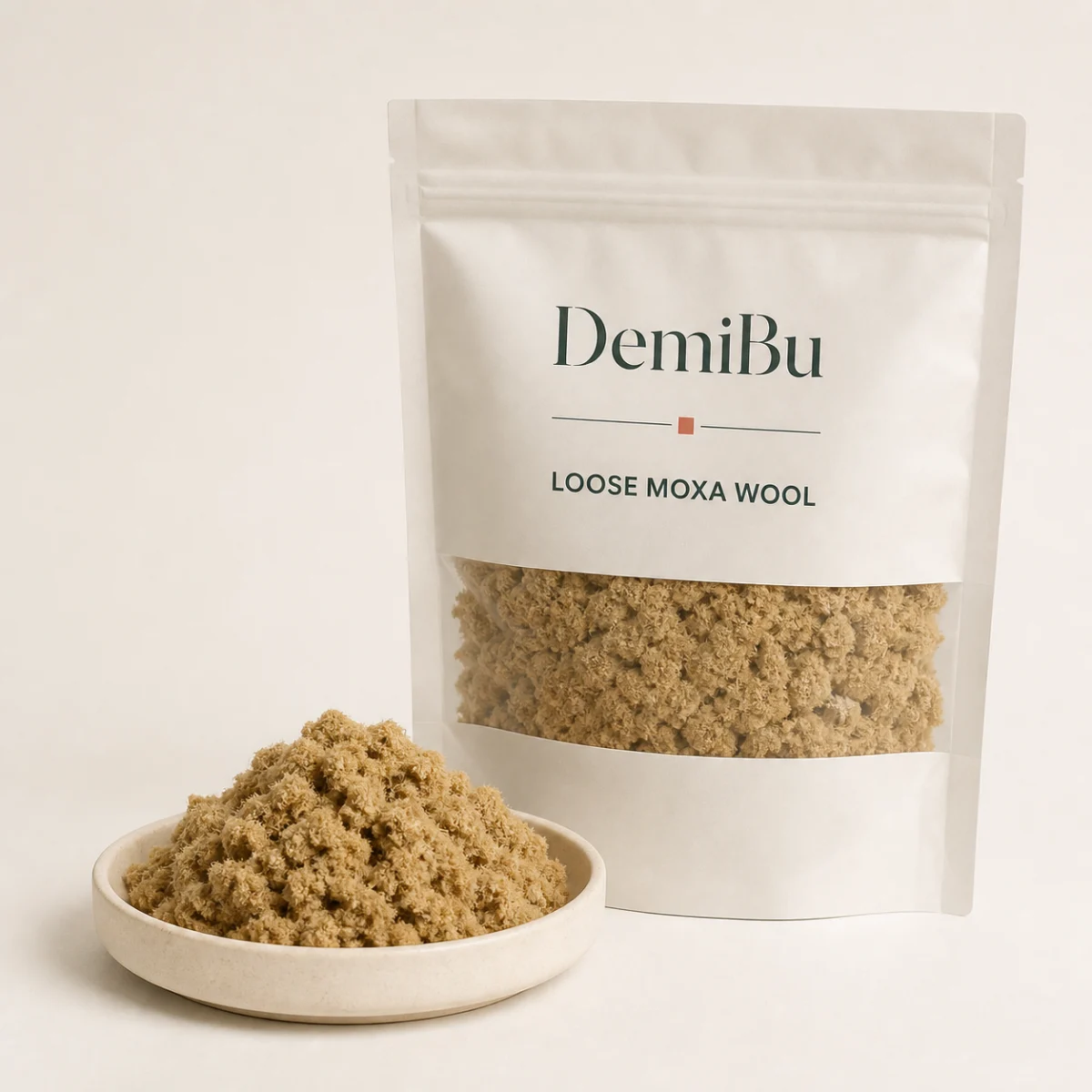
Compare loose moxa wool grades, processing ratios, texture, pack weight, MOQ, sample evidence and batch controls before wholesale purchase.
What is the current wholesale reference?
MB2B-0004 is a supplier-catalog platform identified as SKU MB2B-0004, 10:1 moxa wool and 500 g per bag; all further export and quality fields require confirmation.
The current record comes from specialist manufacturer’s product catalog and gives two useful facts: a 10:1 reference grade and 500 g supplier pack. It does not establish the buyer’s final MOQ, moisture limit, fiber specification, aging year, foreign-matter limit, English label or destination suitability. Those fields belong in the sample and quotation process.
Public retail and distributor pages show why the fields matter. Acubest offers several loose-moxa variants described by quality and color, each at 500 g per bag. Other market sources use grade names and different pack weights. The presence of choices does not prove a standardized global grading system; it tells buyers to ask for the exact product behind the name.
Use the current reference as a baseline for two potential paths. A practitioner-supply buyer may distribute the sealed supplier pack after destination review. A brand or distributor may use the material as an input for buyer-side repacking. Repacking changes responsibility for pack integrity, label, lot traceability, net quantity and release checks.
Before discussing price, identify the exact material, intended channel and whether the buyer wants the supplier pack or a new pack. A quotation for a generic 500 g moxa bag is not comparable if one supplier quotes a different ratio, moisture condition, packaging barrier or sorting quality.
- Supplier SKU MB2B-0004
- 10:1 supplier-defined reference
- 500 g per bag starting pack
- Professional distribution or repacking path
- Open MOQ, batch and destination fields
How should a buyer interpret moxa-wool ratios and grades?
A ratio is a supplier processing reference, not a universal certificate; require its definition and link it to the exact approved sample.
Trade ratios are commonly presented as the amount of starting leaf associated with processed wool output. Yet calculation, input condition, screening and loss accounting can differ. Ask the supplier what the numerator and denominator represent, whether the value is nominal or batch-measured, and which processing stages are included.
Research on different purities and growing years describes ratio and aging language while acknowledging the absence of a unified evaluation index. That is commercially important. It means a buyer should not claim that 10:1 from one supplier is identical to 10:1 from another, or that a higher number guarantees better use performance.
Translate grade into observable attributes: proportion of long fibers, fine particles, coarse fragments, color range, odor, moisture condition and ability to shape for the intended professional workflow. Determine which attributes matter to the customer. A material suited to one indirect format may not be the preferred choice for another use.
Preserve a retention sample and written supplier definition. If a later batch uses a different harvest, aging reference or processing route, the supplier should disclose the change and submit a comparison sample according to the agreed plan.
| Grade term | Question | Control |
|---|---|---|
| 10:1 | How is the ratio calculated? | Supplier definition attached to SKU |
| Golden or premium | Which measurable attributes differ? | Side-by-side approved samples |
| Aged | Which year and traceable record? | Do not publish without evidence |
| Professional grade | Which intended format and handling needs? | Buyer-approved use positioning |
Which sample attributes should be compared?
Compare fiber and fines, color, odor, moisture condition, foreign matter, shaping and pack integrity using multiple numbered samples.
Spread a controlled mass of each sample on a clean contrasting surface. Photograph under fixed light and record visible long fibers, fine powder, coarse plant fragments and unexpected material. Avoid judging a whole 500 g bag from the material visible through one window. Take portions from defined locations and record the sampling method.
Color can support lot comparison but is not a standalone grade. Lighting, camera settings, raw material and processing can shift appearance. Use a physical reference or controlled image standard. Record odor after the same conditioning time and opening procedure; sensory notes do not establish chemical composition or safety.
Assess shaping for the buyer’s intended workflow. Record whether the wool separates cleanly, clumps, sheds excessive fines or forms the required shape with consistent handling. A distributor product page may describe softness and ease of shaping, but the purchasing decision should rely on the selected sample rather than another seller’s description.
Check the bag seal, barrier, net-weight method, label, lot identification and carton. If the buyer will repack, open enough units to understand within-bag and between-bag variation and keep sealed retention units. Any abnormal growth, strong off-odor, wet condition or unknown foreign matter should trigger hold and qualified review.
| Attribute | Method | Decision use |
|---|---|---|
| Fiber and fines | Controlled spread, sieve or documented visual scale | Grade consistency |
| Color | Fixed lighting and reference | Lot comparison |
| Moisture condition | Agreed quantitative method plus screening | Storage and release |
| Shaping | Defined operator task | Intended-format fit |
| Pack integrity | Seal, weight, code and carton check | Distribution readiness |
What can research tell buyers about fiber and waste particles?
Research supports objective sieving and particle-fraction questions, but its method and thresholds should not be copied into a contract without validation for the selected product.
The PubMed-indexed study dried moxa samples, passed them through sieves over a defined period, weighed retained fractions and used microscopy. It observed fibers mainly at one sieve size and smaller particles below another, and it found differences between products. The authors proposed the method as a potential yardstick while calling for larger validation.
For procurement, the study offers a strong principle: replace vague statements such as very clean with a documented sample preparation, sieve stack, duration, weighing rule and result. It does not provide a universal pass/fail limit for MB2B-0004 or every destination. A buyer who wants sieving in the specification should first test approved and representative production samples.
Distinguish fine moxa fibers from unwanted coarse or foreign material. The visual appearance of dust may include legitimate fine botanical particles as well as processing residue. Define categories with photographs or microscopy when needed. Do not make contaminant claims based solely on a tabletop view.
The test should be proportionate. A distributor may use supplier batch data plus incoming screening and periodic third-party verification. A high-risk or tightly specified professional product may justify a more detailed method. The buyer and supplier should agree who samples, tests, retains and resolves deviations.
- Use a defined mass and conditioning procedure
- Specify sieve sizes, duration and weighing rule
- Validate limits on approved samples
- Distinguish expected fine material from foreign matter
- Define escalation and retest rules
Sources for this section: [2]
How are pack weight, MOQ and landed cost compared?
Compare net-weight tolerance, bag material, units per carton, product MOQ, custom-pack minimum and freight dimensions against the same grade.
For the 500 g reference, ask how net weight is controlled and whether the stated weight excludes packaging. Define scale resolution, tolerance and sampling. Record bags per carton, carton dimensions, gross and net weight, liner or barrier, seal and pallet configuration. Loose material can create inefficient volume, so freight comparison needs carton data.
Separate existing supplier bags from private-label or repacking supply. A printed bag may impose a component MOQ higher than the material MOQ. A bulk liner or larger pack may reduce packaging cost but transfer measurement, contamination control, coding and label responsibility to the buyer’s facility.
Request price by the same grade definition and packing. Include samples, testing, inspection and delivery term. If a supplier offers several ratios, each is a separate line. Do not compare price per bag without normalizing net weight and checking whether the samples actually match the named grade.
For a mixed moxa assortment, ask whether loose wool can ship with rolls or cones and how odor, moisture and carton protection are managed. Consolidation can improve logistics, but it should not blur lot identity or expose the material to unsuitable packaging.
| Cost field | Confirm | Why |
|---|---|---|
| Material | Exact grade and net weight | Comparable unit cost |
| Bag | Barrier, seal and print | Protection and component MOQ |
| Carton | Count, dimensions and weight | Freight calculation |
| Quality | Testing and inspection scope | Comparable release evidence |
| Delivery | Incoterm and handoff | Responsibility and landed-cost model |
Which supplier questions close the wholesale decision?
Close identity, grade definition, sample, batch control, packaging, change notification and commercial handoff before issuing a purchase order.
Ask who manufactures the selected grade, the internal SKU, raw-material and aging references that can be substantiated, processing-ratio definition and current pack. Ask which characteristics the factory checks and which records are available. Factory size or a broad product catalog does not replace these answers.
Ask how the approved sample maps to bulk production. Which batch fields appear on the bag and carton? Are retention samples kept? How are moisture, net weight and visible foreign matter controlled? What change in raw material or process triggers buyer notification?
Define the order: MOQ per grade and pack, lead time, price basis, inspection access, nonconformity process, documents and Incoterm. The buyer or importer identifies destination classification, registration, final labels and claims. The factory supplies agreed production evidence and goods; the sourcing team coordinates the China-side workflow.
For MB2B-0004, the next gate is a representative MB2B-0004 sample set and supplier grade definition. Once the buyer approves texture, moisture method, foreign-matter handling and pack, the 10:1, 500 g reference can support a real wholesale quotation without overstating quality or export readiness.
| Gate | Output | Stop condition |
|---|---|---|
| Source | SKU and grade definition | Ratio remains unexplained |
| Sample | Approved units and test record | Variation is unresolved |
| Specification | Limits, pack and change control | Buyer acceptance is vague |
| Order | MOQ, price, inspection and handoff | Responsibilities are undefined |
How should buyers compare supplier capability beyond the sample?
Verify that the supplier can define, preserve and document the selected grade across batches, because a strong sample without repeat-order control has limited commercial value.
Ask the supplier to map its process from received mugwort material through drying or aging reference, crushing, screening, blending if any, packing and lot release. The buyer does not need every confidential parameter, but it needs to know which stages determine the stated ratio and where foreign matter, moisture and net weight are checked.
Review actual records available for the selected SKU: batch code structure, material or grade reference, in-process checks, finished weight, pack and retained sample. Do not accept a generic quality certificate as evidence for every lot. Agree which records accompany each shipment and which can be produced during an investigation.
Evaluate capacity in terms of the buyer’s order, not promotional scale. Can the supplier produce the selected grade and pack within the quoted lead time without substitution? What is the normal batch size? How is a smaller first order scheduled? What happens when the named raw-material reference is unavailable?
Test communication with a sample deviation exercise. Ask how the supplier would respond if moisture, fiber fraction, net weight or bag seal failed. A clear containment, investigation and correction path demonstrates more operational maturity than unsupported claims of perfect quality.
| Capability | Evidence | Buyer decision |
|---|---|---|
| Grade control | Definition, process stage and batch code | Can the sample be reproduced? |
| Quality records | Actual SKU-specific forms | Can deviations be investigated? |
| Capacity | Batch size and realistic schedule | Can demand be met without substitution? |
| Corrective action | Example workflow and responsibility | Can failure be resolved commercially? |
How should a distributor prepare a sample request?
Request enough coded material to compare the selected grade, understand variation and retain evidence before negotiating a production order.
Ask for at least two sealed bags from the intended batch or production route, plus the supplier’s grade definition, pack sheet and available batch information. State whether portions will be used for moisture, sieving, handling or laboratory work. If comparing grades, request them in matched packing and label every sample before opening.
Send the supplier the completed observation report and questions. The sample phase should close with one approved reference, measurable pending fields and a decision on sealed wholesale or repacking. It should not end with several attractive bags and no written conclusion.
Budget sample freight and testing separately from the bulk quotation. Paying for representative evidence is cheaper than selecting a grade by photograph and discovering after shipment that texture, fines, pack or handling does not suit the channel.
- Sealed representative bags
- Supplier grade and batch reference
- Allocated destructive and retention portions
- Written approval or rejection decision
Sources and evidence notes
Public sources help frame terminology, specifications and buyer questions. They do not prove that every factory, formula or destination-market requirement is identical.
- [1]Loose Moxa Wool F-05, F-05A and F-05A1Acubest · distributor · accessed 2026-08-27
Shows several marketed quality and color variants at 500 g per bag and describes loose moxa as processed and screened leaf material.
- [2]Quality of Moxa Wool Contained in Commercial Moxibustion DevicesPubMed · research · accessed 2026-08-27
The study used drying, sieving, weighing and microscopy to compare fibers and waste-particle fractions, while noting the need for larger-scale validation.
- [3]Moxa Wool in Different Purities and Different Growing Years Measured by Terahertz SpectroscopyPubMed Central · research · accessed 2026-08-27
Explains that processing ratios and aging references are used in the market and that no unified index evaluates purity and growing years.
How this guide was prepared
Moxa Sourcing Editorial Team
The team translates product references, product samples and China-side sourcing workflows into practical English guidance for overseas buyers.
Moxa Sourcing Supply Review Team
The review team checks supplier attribution, commercial boundaries, product specifications and statements that require sample or market-specific verification.
Product availability, MOQ, price and production specifications are reconfirmed against the selected product reference. The buyer or importer leads the destination-market decision and retains applicable statutory importer duties; Moxa Sourcing supports the process by coordinating product and supplier evidence, specifications, documents, testing and label inputs, version control and agreed professional partners.