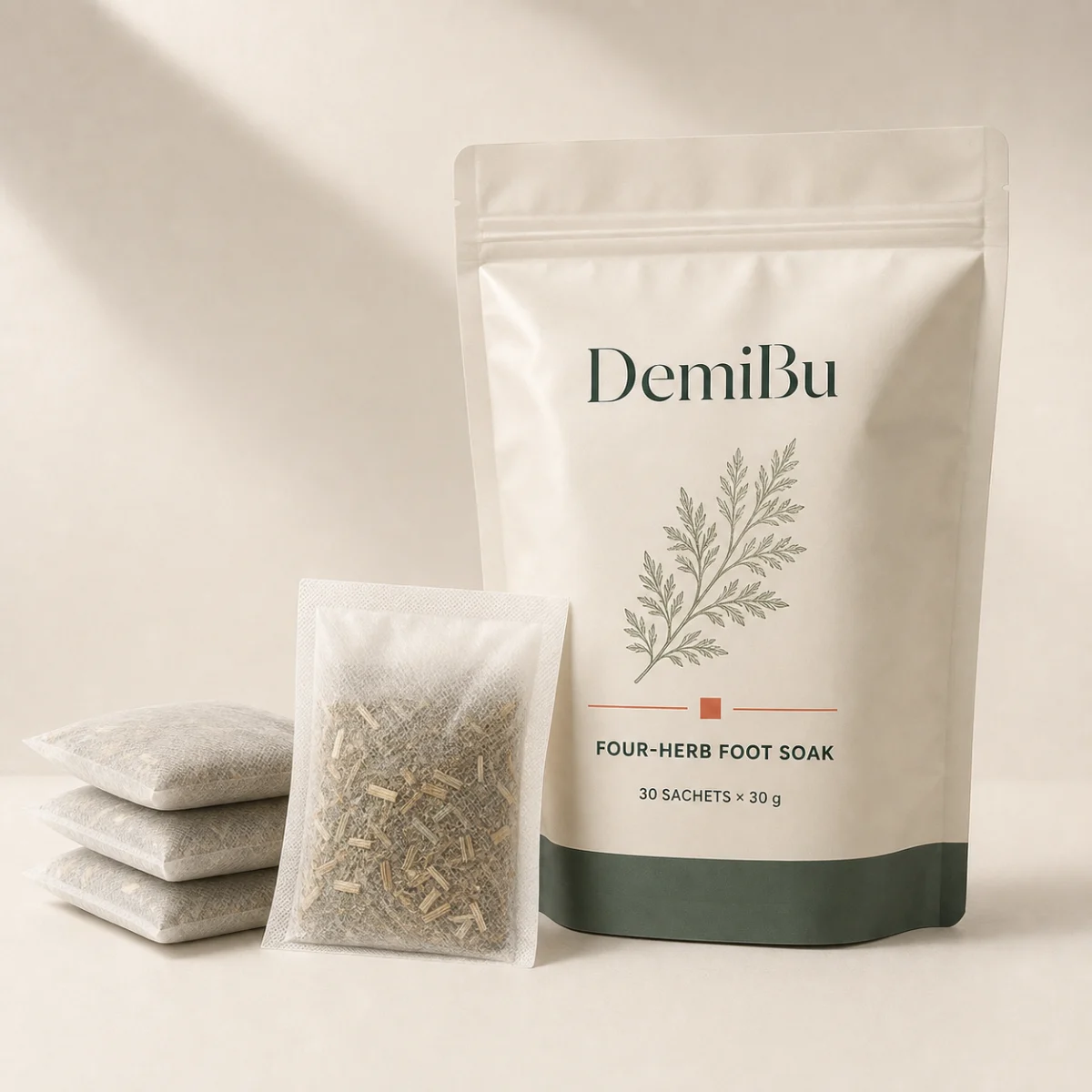
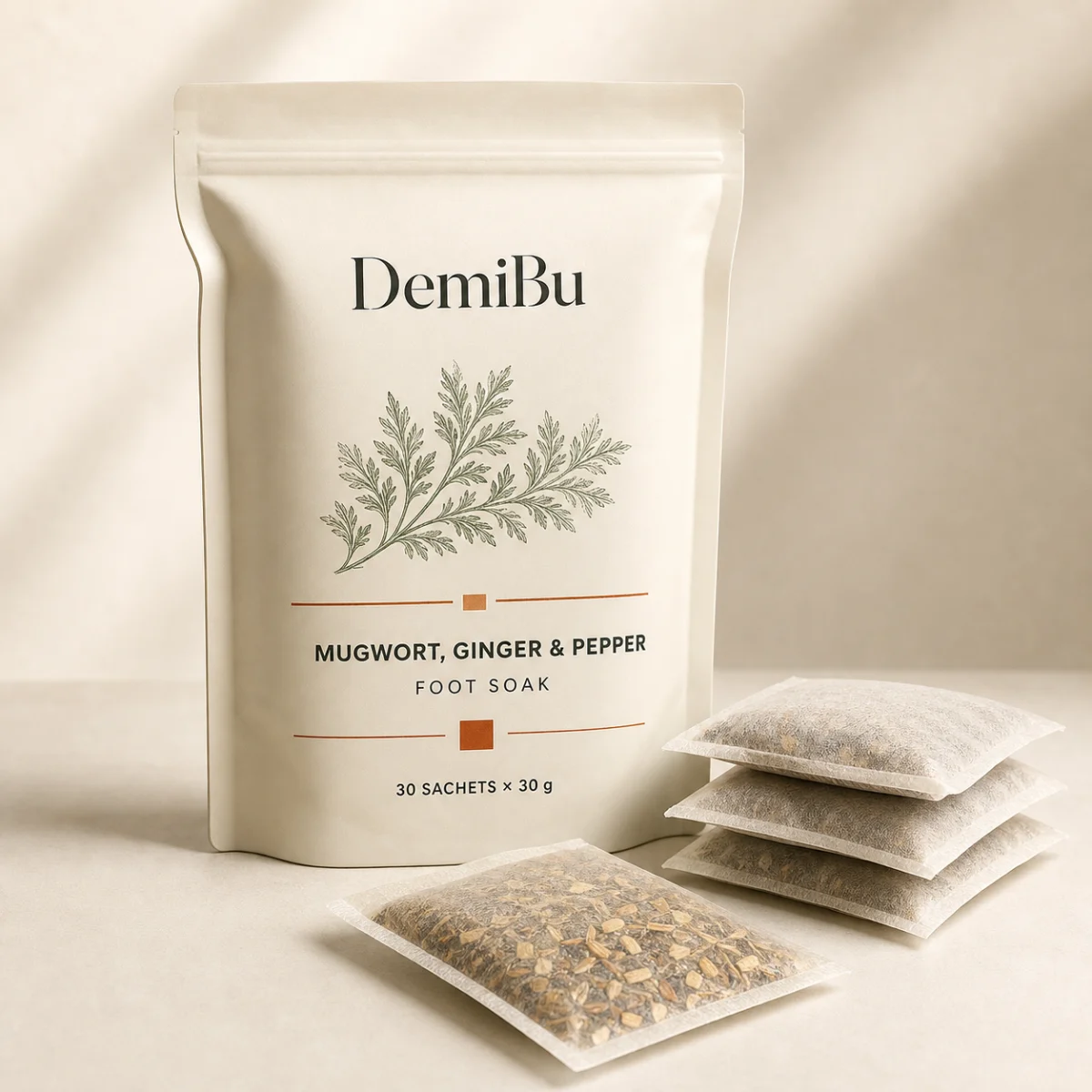
Compare mugwort foot soaks, botanical sachets, liquid doses and overnight patches by formula, exposure, packaging, QC and claims risk.
The first choice is a consumer routine, not a herb list
Dry soak, liquid dose and adhesive patch ask the user to prepare, contact and store the product differently.
Dry sachets place botanical material in warm water. The specification centres on plant identity, powder or cut size, dose, filter bag and moisture protection. A blend adds ratio and supplier complexity. specialist manufacturer’s 6 g × 30 sachet reference is a starting SKU, not proof for every formula.
Liquid doses replace herb containment with formula transparency, preservation, fill and seal questions. Mugwort-and-perilla liquid cannot inherit the dry-sachet quality plan. It needs a complete ingredient record and water-based stability decisions.
Overnight foot patches combine powder sachet and adhesive sheet. Their contact route, assembly, wear directions and claims history differ from a soak. Detoxification language seen in the market is deliberately excluded unless a buyer establishes a lawful pathway and substantiation.
A gift ritual is a merchandising layer, not another formulation. It may pair a foot soak with a towel or simple accessory, but each component retains its own identity, quality file and instructions.
Choose the routine that the channel can explain and replenish. A familiar single-dose soak may be stronger for launch than an elaborate twenty-herb story that no one can document.
| Format | User handles | Specification centre | Trade-off |
|---|---|---|---|
| Single-herb sachet | mugwort powder or cut material in filter bag | botanical identity, particle form, dose, moisture barrier | simple traceability; modest differentiation |
| Botanical blend | mugwort with disclosed companion herbs | full formula, ratios, incoming specifications and blend control | sensory differentiation; greater sourcing complexity |
| Liquid bath dose | water-based extract or concentrate | complete formula, preservation, fill, microbiology and leakage | convenient dose; higher formula and pack risk |
| Two-part foot patch | powder sachet plus adhesive sheet | ingredients, sachet, adhesive, wear method and individual pack | different contact route and claims exposure |
| Gift ritual | foot product plus coherent accessory | component specifications, sequence and full pack-out | higher presentation; multi-SKU coordination |
Treat dry sachets as agricultural materials plus conversion
Plant identity, particle form, contamination risk and moisture matter before fragrance or package graphics.
Record common and scientific names where appropriate, plant part, supplier lot and form. A label such as four herb formula is incomplete until every botanical and ratio is disclosed. Where several sources feed one blend, retain incoming traceability.
Cut size affects containment, water interaction and residue. Fine powder can escape a coarse filter; large pieces alter fill volume. Approve a visual or sieve reference, foreign-matter rule and multiple unit-weight checks.
Testing depends on material, use and destination. The buyer may require microbiological, heavy-metal, pesticide or other contaminant specifications with qualified advisers. Reports must identify the selected botanical, lot or finished formula.
Moisture control continues from ingredient storage through filter-bag filling, outer packing and shipment. Aroma loss, clumping, color shift or microbial growth can result from poor barrier or handling.
The filter sachet deserves its own specification: material, dimensions, pore behavior, seam, fill and wet strength. Tea-bag appearance alone does not prove that powder remains contained during the preparation instructed.
- Botanical and plant-part identity
- Source lot
- Powder or cut reference
- Dose and count
- Foreign-matter rule
- Risk-based contaminant plan
- Filter and moisture barrier
Sources for this section: [1]
Liquids and patches need different specialist factories
Capability in dry herb blending does not prove competence in preserved liquid filling or adhesive assembly.
Liquid foot-bath products require every extract, solvent, preservative, fragrance and functional component to be known. Define fill, pouch material, seal, dilution directions and microbiological plan. Transit review should include realistic orientation and temperature.
Patch construction maps powder sachet, adhesive carrier, release liner and foil pouch. Review ingredient exposure, contact material, assembly, residue and removal. Its market pathway follows intended use, claims and destination rather than the word herbal.
A multi-factory architecture can be a strength. A botanical processor supplies sachets while a patch specialist controls adhesive products. Moxa Sourcing coordinates product IDs, English briefs, samples and handoff without pretending both technologies run on one line.
Gift deadlines should not compress formula approval. If composition, microbiology or contact evidence remains open, keep the product project-led or replace it with a ready component.
Factory comparison must be category-specific. Ask a dry sachet factory about herb processing and filter conversion; ask a liquid filler about hygiene, formula and seals; ask a patch factory about adhesive, assembly and wear.
| Question | Dry sachet | Liquid dose | Patch |
|---|---|---|---|
| Formula owner | herb processor/blender | formulator/filler | powder and adhesive assembler |
| Primary pack | filter plus barrier | liquid pouch | sachet, sheet and foil |
| Key risk | identity, contaminants, moisture | preservation, fill, leakage | contact, adhesion, assembly |
| Sample focus | weight, containment, preparation | formula and seal | wear construction and count |
Sources for this section: [2]
Sell preparation and sensory clarity, not physiological promises
Foot-care merchandising can be specific and persuasive without using detox, circulation, sleep or disease claims.
A useful page explains ingredients, dose, count, preparation and observable aroma, color or residue. Buyers can understand how the product fits an evening routine without a list of unverifiable body outcomes.
Pure mugwort supports a simple source story. A blend can offer a different aroma or seasonal concept, but each herb needs a documented role and formula position. More botanicals do not automatically mean more value.
Review product name, icons, foot diagrams, testimonials, influencer briefs and marketplace bullets as a whole. FDA notes that some treatment or body-function claims can change U.S. classification. Other destinations apply their own rules.
Gift positioning should maintain one sequence. A soak, towel and instruction card can form a coherent ritual. Adding eye masks, patches and pillow only to raise piece count increases claims and assembly complexity.
Traditional use may be described as history when carefully qualified, but should not imply modern proof for the selected SKU. The strongest differentiation is truthful composition, controlled sourcing and simple directions.
- Describe contents and preparation.
- Use bounded sensory observations.
- Avoid detoxification and circulation language.
- Do not promise sleep or disease outcomes.
- Review images and names for implied claims.
Sources for this section: [3]
Packaging follows moisture, leakage or adhesive risk
The primary pack job changes by format, so one foot-care pouch cannot serve as a universal template.
Dry sachets need containment during wet use and protection from moisture before use. Decide whether units are individually wrapped or stored in a resealable outer bag. Repeated opening changes storage exposure.
Liquid doses need compatible film, seal integrity and secondary protection. Inspect contamination in seals, channel leaks, fill, print and carton staining. A dry product shelf-life argument cannot support a water-based formula.
Foot patches need correct pairing of powder sachets and adhesive sheets. Count, liner, assembly and instructions are crucial. Individual foil pouches may protect components but still require product-specific barrier evidence.
Master cartons require SKU, lot, count, dimensions, markings and a mixed-assortment map when relevant. The carton is part of landed cost; heavy or bulky gift accessories can overturn the margin case.
Artwork should state actual net contents and preparation. If the formula or dose changes, update pouch, outer bag, carton and online product data together to prevent mixed instructions.
| Format | Packaging job | Uncontrolled failure |
|---|---|---|
| Dry sachet | contain plant and exclude moisture | escape, clumping, aroma drift |
| Liquid dose | hold formula and resist leakage | loss, contamination, carton damage |
| Foot patch | protect and pair two components | missing pieces, weak adhesion |
| Gift set | retain assortment in distribution | movement, crushing, wrong count |
Use samples to choose the format, then write the RFQ
A sample kit should answer one commercial branch rather than display every herbal package available.
Compare pure mugwort, four-botanical and mugwort-ginger-pepper sachets under one preparation method if the decision concerns blend strategy. Compare dry and liquid formats when convenience and logistics are in question. Evaluate patches separately.
Record identity, dose or fill, count, pack and preparation. Use the same water volume, temperature and time for dry comparisons. Note containment, aroma, color and residue without assigning efficacy.
The RFQ should name format, formula, particle form, dose, count, inner and outer pack, carton, destination, claims position, tests and quantity. Ask for stock, English private-label and custom-formula offers separately.
Responsibility is simple: specialist factories manufacture their formats; Moxa Sourcing coordinates samples, specifications and cross-factory checkpoints; the buyer/importer approves destination classification, ingredient and contaminant review, labels, claims, registration and clearance.
Define the reorder condition before launch: acceptable lead time, minimum batch, shelf-life evidence and lot traceability. A product that cannot be replenished economically should not anchor the range.
Range memo 1: Single-herb sachet asks the consumer to handle mugwort powder or cut material in filter bag. Its technical file must prioritize botanical identity, particle form, dose, moisture barrier. The trade-off is simple traceability; modest differentiation. Confirm that the channel can explain preparation and support this format’s MOQ before allocating inventory.
Range memo 2: Botanical blend asks the consumer to handle mugwort with disclosed companion herbs. Its technical file must prioritize full formula, ratios, incoming specifications and blend control. The trade-off is sensory differentiation; greater sourcing complexity. Confirm that the channel can explain preparation and support this format’s MOQ before allocating inventory.
Range memo 3: Liquid bath dose asks the consumer to handle water-based extract or concentrate. Its technical file must prioritize complete formula, preservation, fill, microbiology and leakage. The trade-off is convenient dose; higher formula and pack risk. Confirm that the channel can explain preparation and support this format’s MOQ before allocating inventory.
Range memo 4: Two-part foot patch asks the consumer to handle powder sachet plus adhesive sheet. Its technical file must prioritize ingredients, sachet, adhesive, wear method and individual pack. The trade-off is different contact route and claims exposure. Confirm that the channel can explain preparation and support this format’s MOQ before allocating inventory.
Range memo 5: Gift ritual asks the consumer to handle foot product plus coherent accessory. Its technical file must prioritize component specifications, sequence and full pack-out. The trade-off is higher presentation; multi-SKU coordination. Confirm that the channel can explain preparation and support this format’s MOQ before allocating inventory.
Range memo 6: Single-herb sachet asks the consumer to handle mugwort powder or cut material in filter bag. Its technical file must prioritize botanical identity, particle form, dose, moisture barrier. The trade-off is simple traceability; modest differentiation. Confirm that the channel can explain preparation and support this format’s MOQ before allocating inventory.
Range memo 7: Botanical blend asks the consumer to handle mugwort with disclosed companion herbs. Its technical file must prioritize full formula, ratios, incoming specifications and blend control. The trade-off is sensory differentiation; greater sourcing complexity. Confirm that the channel can explain preparation and support this format’s MOQ before allocating inventory.
Range memo 8: Liquid bath dose asks the consumer to handle water-based extract or concentrate. Its technical file must prioritize complete formula, preservation, fill, microbiology and leakage. The trade-off is convenient dose; higher formula and pack risk. Confirm that the channel can explain preparation and support this format’s MOQ before allocating inventory.
Range memo 9: Two-part foot patch asks the consumer to handle powder sachet plus adhesive sheet. Its technical file must prioritize ingredients, sachet, adhesive, wear method and individual pack. The trade-off is different contact route and claims exposure. Confirm that the channel can explain preparation and support this format’s MOQ before allocating inventory.
Range memo 10: Gift ritual asks the consumer to handle foot product plus coherent accessory. Its technical file must prioritize component specifications, sequence and full pack-out. The trade-off is higher presentation; multi-SKU coordination. Confirm that the channel can explain preparation and support this format’s MOQ before allocating inventory.
Range memo 11: Single-herb sachet asks the consumer to handle mugwort powder or cut material in filter bag. Its technical file must prioritize botanical identity, particle form, dose, moisture barrier. The trade-off is simple traceability; modest differentiation. Confirm that the channel can explain preparation and support this format’s MOQ before allocating inventory.
Range memo 12: Botanical blend asks the consumer to handle mugwort with disclosed companion herbs. Its technical file must prioritize full formula, ratios, incoming specifications and blend control. The trade-off is sensory differentiation; greater sourcing complexity. Confirm that the channel can explain preparation and support this format’s MOQ before allocating inventory.
Range memo 13: Liquid bath dose asks the consumer to handle water-based extract or concentrate. Its technical file must prioritize complete formula, preservation, fill, microbiology and leakage. The trade-off is convenient dose; higher formula and pack risk. Confirm that the channel can explain preparation and support this format’s MOQ before allocating inventory.
Range memo 14: Two-part foot patch asks the consumer to handle powder sachet plus adhesive sheet. Its technical file must prioritize ingredients, sachet, adhesive, wear method and individual pack. The trade-off is different contact route and claims exposure. Confirm that the channel can explain preparation and support this format’s MOQ before allocating inventory.
Range memo 15: Gift ritual asks the consumer to handle foot product plus coherent accessory. Its technical file must prioritize component specifications, sequence and full pack-out. The trade-off is higher presentation; multi-SKU coordination. Confirm that the channel can explain preparation and support this format’s MOQ before allocating inventory.
Range memo 16: Single-herb sachet asks the consumer to handle mugwort powder or cut material in filter bag. Its technical file must prioritize botanical identity, particle form, dose, moisture barrier. The trade-off is simple traceability; modest differentiation. Confirm that the channel can explain preparation and support this format’s MOQ before allocating inventory.
Range memo 17: Botanical blend asks the consumer to handle mugwort with disclosed companion herbs. Its technical file must prioritize full formula, ratios, incoming specifications and blend control. The trade-off is sensory differentiation; greater sourcing complexity. Confirm that the channel can explain preparation and support this format’s MOQ before allocating inventory.
Range memo 18: Liquid bath dose asks the consumer to handle water-based extract or concentrate. Its technical file must prioritize complete formula, preservation, fill, microbiology and leakage. The trade-off is convenient dose; higher formula and pack risk. Confirm that the channel can explain preparation and support this format’s MOQ before allocating inventory.
Range memo 19: Two-part foot patch asks the consumer to handle powder sachet plus adhesive sheet. Its technical file must prioritize ingredients, sachet, adhesive, wear method and individual pack. The trade-off is different contact route and claims exposure. Confirm that the channel can explain preparation and support this format’s MOQ before allocating inventory.
Range memo 20: Gift ritual asks the consumer to handle foot product plus coherent accessory. Its technical file must prioritize component specifications, sequence and full pack-out. The trade-off is higher presentation; multi-SKU coordination. Confirm that the channel can explain preparation and support this format’s MOQ before allocating inventory.
Range memo 21: Single-herb sachet asks the consumer to handle mugwort powder or cut material in filter bag. Its technical file must prioritize botanical identity, particle form, dose, moisture barrier. The trade-off is simple traceability; modest differentiation. Confirm that the channel can explain preparation and support this format’s MOQ before allocating inventory.
Range memo 22: Botanical blend asks the consumer to handle mugwort with disclosed companion herbs. Its technical file must prioritize full formula, ratios, incoming specifications and blend control. The trade-off is sensory differentiation; greater sourcing complexity. Confirm that the channel can explain preparation and support this format’s MOQ before allocating inventory.
Range memo 23: Liquid bath dose asks the consumer to handle water-based extract or concentrate. Its technical file must prioritize complete formula, preservation, fill, microbiology and leakage. The trade-off is convenient dose; higher formula and pack risk. Confirm that the channel can explain preparation and support this format’s MOQ before allocating inventory.
Range memo 24: Two-part foot patch asks the consumer to handle powder sachet plus adhesive sheet. Its technical file must prioritize ingredients, sachet, adhesive, wear method and individual pack. The trade-off is different contact route and claims exposure. Confirm that the channel can explain preparation and support this format’s MOQ before allocating inventory.
Range memo 25: Gift ritual asks the consumer to handle foot product plus coherent accessory. Its technical file must prioritize component specifications, sequence and full pack-out. The trade-off is higher presentation; multi-SKU coordination. Confirm that the channel can explain preparation and support this format’s MOQ before allocating inventory.
Range memo 26: Single-herb sachet asks the consumer to handle mugwort powder or cut material in filter bag. Its technical file must prioritize botanical identity, particle form, dose, moisture barrier. The trade-off is simple traceability; modest differentiation. Confirm that the channel can explain preparation and support this format’s MOQ before allocating inventory.
Range memo 27: Botanical blend asks the consumer to handle mugwort with disclosed companion herbs. Its technical file must prioritize full formula, ratios, incoming specifications and blend control. The trade-off is sensory differentiation; greater sourcing complexity. Confirm that the channel can explain preparation and support this format’s MOQ before allocating inventory.
| RFQ block | Dry sachet | Liquid/patch |
|---|---|---|
| Identity | botanicals, parts, ratios | complete formula/components |
| Dose | grams and count | millilitres or component count |
| Pack | filter and moisture barrier | liquid seal or adhesive assembly |
| Quality | weight, moisture, contaminant plan | microbiology, leakage/contact |
| Commercial | stock/private label/custom MOQ | formula, component, print MOQ |
Sources and evidence notes
Public sources help frame terminology, specifications and buyer questions. They do not prove that every factory, formula or destination-market requirement is identical.
- [1]Pure Herbal Foot Bath PacksMugwort Wellness · manufacturer · accessed 2026-08-27
Public supplier example of a dry herbal foot-bath format; claims and exact composition still require SKU verification.
- [2]Foot Patch Product PlatformFeifan Patch · manufacturer · accessed 2026-08-27
Public manufacturer example of a two-part foot-patch format and private-label presentation.
- [3]Cosmetics Labeling ClaimsU.S. Food and Drug Administration · regulator · accessed 2026-08-27
Supports the U.S. distinction between cosmetic presentation and claims that may cause drug classification.
How this guide was prepared
Moxa Sourcing Editorial Team
The team translates product references, product samples and China-side sourcing workflows into practical English guidance for overseas buyers.
Moxa Sourcing Supply Review Team
The review team checks supplier attribution, commercial boundaries, product specifications and statements that require sample or market-specific verification.
Product availability, MOQ, price and production specifications are reconfirmed against the selected product reference. The buyer or importer leads the destination-market decision and retains applicable statutory importer duties; Moxa Sourcing supports the process by coordinating product and supplier evidence, specifications, documents, testing and label inputs, version control and agreed professional partners.