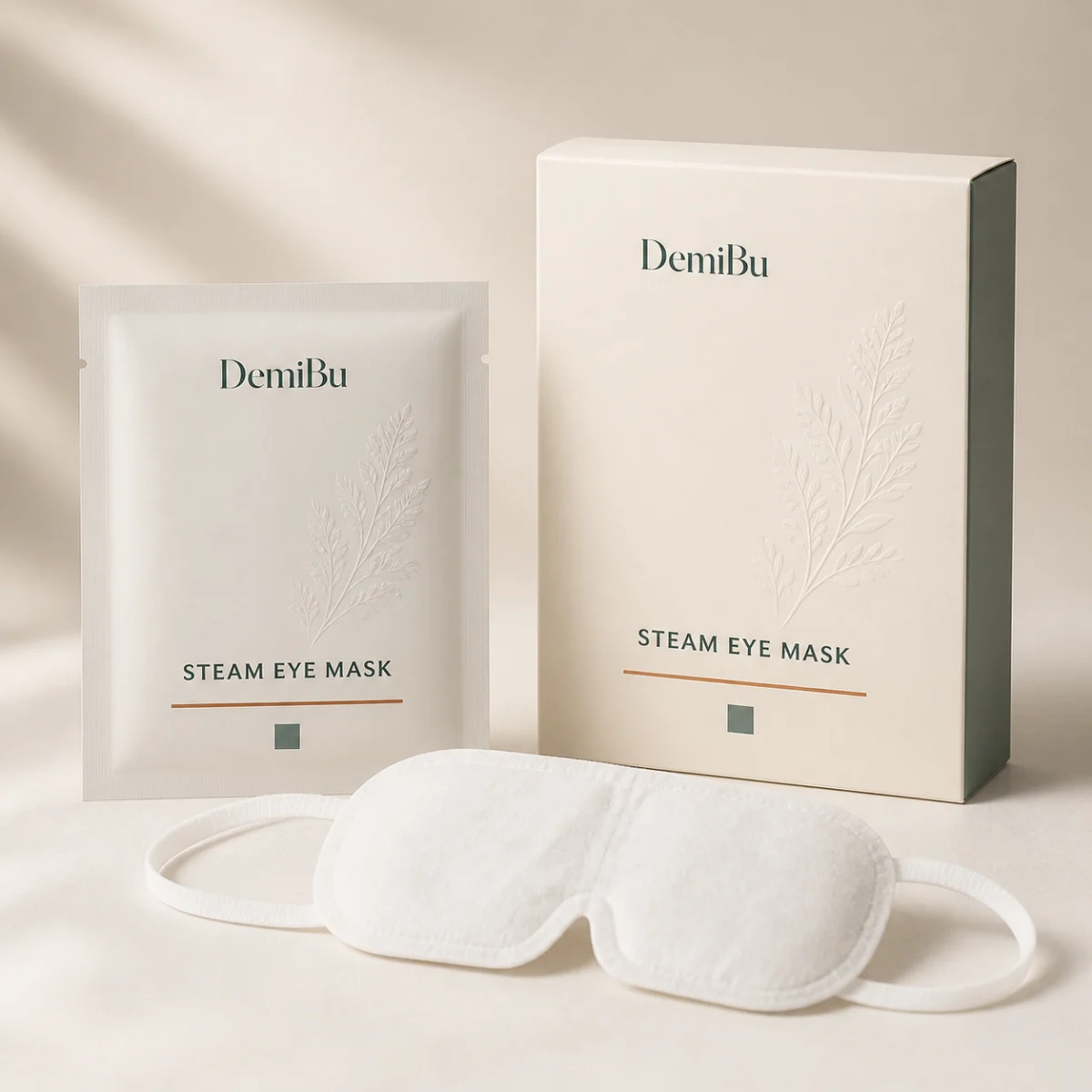
A reproducible steam eye mask quality protocol for heat curves, fit panels, pouch integrity, warnings and production-lot acceptance.
Write the heat protocol before opening the first pouch
A useful thermal result begins with controlled conditions, coded samples and a fixed measurement method; otherwise numbers from different masks cannot be compared.
Define the question precisely. A buyer may need warm-up time, the range maintained during ordinary wear, maximum observed temperature, active duration and cool-down behavior. Those are five different outputs. A single peak number hides whether the mask warms smoothly, fluctuates, heats unevenly or remains active for only a short interval. The protocol should say which outputs determine acceptance and which are recorded only for investigation.
Condition sealed units together and log room temperature, humidity, airflow and storage history. Identify the temperature sensor, equipment ID, calibration status and placement on the finished mask. If a fixture or simulated face is used, describe its material and geometry. Do not compare results from a tabletop measurement with results taken at a different contact condition as if the methods were interchangeable.
Assign every unit a code that links to supplier, sample stage, lot or pilot batch, fragrance and pouch revision. Start the clock at a defined event such as a completed tear opening. Record at fixed intervals through the agreed end point and preserve raw readings rather than only a plotted average. Outliers can reveal pouch damage, insert variation or a handling mistake that an average conceals.
The protocol is a buyer-and-supplier agreement, not a universal standard created by this article. The target range and acceptance limits must be chosen for the selected product and destination review. Public manufacturer pages demonstrate that temperature and duration options are commercial fields, but they do not establish results for Moxa Sourcing’s chosen production lot.
Capture the full curve instead of a marketing temperature
The result sheet must show how the mask moves through warm-up, operating period, peak and decline, with enough units to reveal variability.
Lock the laboratory setting: Fix room temperature, humidity, airflow, sample conditioning and measurement position. The record must contain dated protocol, equipment ID and environmental log. The acceptance note is explicit: do not compare results from different conditions as if identical.
Code a defensible sample group: Use several units across relevant lots or pilot production. The record must contain sample IDs, batch references and raw result sheet. The acceptance note is explicit: a single unit cannot establish consistency.
Segment the time series: Define warm-up, operating range, peak, active duration and cool-down. The record must contain time-stamped temperature series on finished masks. The acceptance note is explicit: avoid one headline temperature without the full curve.
Score wear geometry: Define user range and scoring for coverage, nose space, ear loops and edge pressure. The record must contain anonymous panel record and approved geometry. The acceptance note is explicit: fit is not a medical outcome.
Challenge the air barrier: Condition pouches, inspect seals and check activation after opening. The record must contain seal observations, mass or performance comparison and transit sample. The acceptance note is explicit: barrier failure can cause weak or early heating.
Release the instruction set: Approve stop-use cues, supervision limits and market wording. The record must contain final instruction artwork and buyer sign-off. The acceptance note is explicit: the buyer controls destination classification and label requirements.
| Decision | What to choose | Evidence to request | Approval boundary |
|---|---|---|---|
| Test environment | Fix room temperature, humidity, airflow, sample conditioning and measurement position. | Dated protocol, equipment ID and environmental log. | Do not compare results from different conditions as if identical. |
| Sample size | Use several units across relevant lots or pilot production. | Sample IDs, batch references and raw result sheet. | A single unit cannot establish consistency. |
| Heat phases | Define warm-up, operating range, peak, active duration and cool-down. | Time-stamped temperature series on finished masks. | Avoid one headline temperature without the full curve. |
| Fit panel | Define user range and scoring for coverage, nose space, ear loops and edge pressure. | Anonymous panel record and approved geometry. | Fit is not a medical outcome. |
| Pouch barrier | Condition pouches, inspect seals and check activation after opening. | Seal observations, mass or performance comparison and transit sample. | Barrier failure can cause weak or early heating. |
| Warning review | Approve stop-use cues, supervision limits and market wording. | Final instruction artwork and buyer sign-off. | The buyer controls destination classification and label requirements. |
Investigate fit and pouch failures as separate mechanisms
A mask can meet its heat target and still fail commercially because the geometry is uncomfortable or the pouch allowed premature activation.
Create a fit panel around the intended adult user range and use a short scoring form. Record eye-area coverage, nose clearance, edge pressure, ear-loop tension, symmetry and movement during ordinary wear. Include space for a stop observation, but do not ask panelists whether the mask treats fatigue, improves sight or causes sleep. Fit data concerns geometry and wear experience, not a clinical outcome.
Blind the panel to supplier and fragrance where feasible. Randomize coded samples so branding and scent preference do not dominate construction feedback. Photograph the mask geometry on a neutral fixture or document dimensions separately; panel comments alone cannot tell production which edge, loop or bridge needs adjustment. A revised shape should receive a new drawing and repeat panel rather than inheriting the first score.
For the pouch investigation, inspect seal width, contamination, wrinkles, notch location and visible damage before opening. Compare units kept upright with transit-conditioned units from the intended shipping pack. After the barrier is opened, observe whether activation begins as expected and whether the thermal curve remains inside the agreed rule. A weak result can arise from the heating insert, air exposure or storage history; the nonconformance record should not guess before evidence is reviewed.
Keep thermal, fit and barrier findings in separate columns with a shared sample code. This makes root-cause work possible. If one unit shows low heat and a questionable seal, isolate it and examine retained pouches rather than averaging it away. If several masks pass heat but fail loop tension, the response belongs to geometry or material control, not to the heating formula.
Repeat the relevant checks after changes in heating matrix, insert mass, nonwoven layer, mask dimensions, ear loops, fragrance load or pouch laminate. A cosmetic artwork change may require only print verification, but a converted-pouch change can affect the activation barrier. The change-control record should explain why a test was repeated or why it remained valid.
- Thermal failure: examine insert, exposure and method
- Fit failure: examine dimensions, loops and edge construction
- Barrier failure: examine seal, laminate and handling
- Instruction failure: revise user steps and warning review
Place each test at the correct production gate
Reference sampling, pilot approval, incoming checks and pre-shipment inspection answer different questions and should not share one vague pass label.
A development sample helps select a construction and refine the method. It does not prove that the production line repeats the result. The pilot gate uses production-intent materials, converted pouches and ordinary assembly to show that the proposed specification can move beyond a handmade reference. Record deviations between development and pilot units rather than replacing the earlier file.
Incoming control should confirm identity, count, dimensions, pouch appearance, lot traceability and other fast checks that the factory can apply routinely. It is not a substitute for periodic performance sampling. Decide how many units, which lots and what frequency enter the heat protocol. The sampling rule should reflect order risk and the buyer’s quality plan, not a convenient number chosen after results are seen.
Pre-shipment inspection verifies the packed order: assortment, artwork, carton, quantity, marking and agreed sample-based tests. The inspector needs the method, acceptance limit and decision authority before arriving. Asking an inspector to assess whether heating is good leaves the result open to interpretation and makes supplier resolution difficult.
Retained units from the approved pilot and shipped lot create a comparison point if field feedback appears. Store them under documented conditions and protect the pouches from accidental damage. A retained mask is useful only when its lot, fragrance, pouch revision and storage record are known.
| Channel | What to prioritize | Primary operational risk |
|---|---|---|
| Incoming quality control | Identity, dimensions, count, pouch appearance and lot code | Passing appearance while missing heat-performance drift |
| Pilot production approval | Heat curve, fit, fragrance and packaging on production-intent units | Approving handmade samples that do not represent the line |
| Pre-shipment inspection | Pack-out, artwork, quantity and agreed performance sampling | Testing without a written acceptance rule |
Treat warnings and performance copy as controlled outputs
A measured heat curve supports a bounded product specification; it does not automatically support sleep, vision, pain-relief or treatment messaging.
Review directions and warnings alongside the method. The buyer decides intended wear period, supervision language, stop-use cues, target user exclusions and destination-specific information with qualified advice. The artwork should not tell users to extend wear merely because one sample continued warming after the intended interval.
Marketing may report only figures that match the selected SKU, approved method and market review. A supplier page or competitor pack is not the source for the production claim. If the result varies materially across units, investigate and tighten control before choosing a convenient average. If no approved basis exists, describe the product without the unsupported number.
Responsibility is distributed. The factory manufactures to the released specification and controls the line. Moxa Sourcing coordinates sample identity, protocol questions, production checkpoints and handoff. The buyer or importer approves classification, safety work, label, warnings, claims, customs and sale. Laboratories and legal advisers own the contracted work, not the complete commercial decision.
Reopen the review when mechanism, materials, contact geometry, fragrance, intended user, use duration or claims change. Current destination rules should be checked before final artwork. This article provides a procurement test framework, not a universal safety threshold or market authorization.
| Party | Owns | Does not automatically own |
|---|---|---|
| Factory | Manufacturing, factory controls, agreed batch and product records | Destination classification, buyer advertising or customs clearance |
| Moxa Sourcing | Supplier coordination, samples, specification, quality checkpoints and handoff | Universal compliance guarantee or importer-of-record role |
| Buyer / importer | Market pathway, assessment, registration, label, claims, entry and sale authorization | Factory production execution |
| Testing, legal or logistics provider | The specifically contracted report, advice, filing or transport service | The entire product or commercial decision |
Sources for this section: [3]
Make the test report usable during a factory dispute
A report should allow another reviewer to reproduce the work, see every unit and apply the pre-agreed disposition rule.
The header should identify product code, supplier, lot, production stage, fragrance, pouch revision, test date, operator and protocol revision. Attach environmental logs and equipment details. The raw table should show time against every unit, not only the mean. A chart can summarize the pattern, but it must not replace readings and exception notes.
State the acceptance rule before the result: number of allowable failures, treatment of an obvious handling error, retest conditions and who can approve a deviation. When a unit fails, photograph the pouch and mask, quarantine related samples and record the investigation path. Do not silently delete a result because it disrupts the desired curve.
Link the thermal report to fit-panel data, seal observations, instruction revision and the retained sample location. That evidence chain lets procurement distinguish a performance change from a pack or geometry problem. It also gives the factory a precise corrective-action question instead of a subjective complaint.
For the RFQ, ask the supplier which existing construction is closest to the target, what method it currently uses, what variables can be controlled and what changes require a new pilot. Quote testing, special conditioning and inspection separately. A lower unit price is not comparable if it omits the evidence needed to release the order.
The final output is a production decision: accepted, conditionally accepted with a named action, rejected pending investigation, or resampled under a corrected method. Preserve the signed result and retained masks with the purchase order. That discipline turns heat performance from promotional language into a repeatable sourcing control.
- Protocol revision and equipment identification
- Unit-by-unit readings and full curve
- Fit and pouch observations linked by sample code
- Pre-agreed acceptance and deviation authority
- Corrective action, retest and retained-sample location
Sources and evidence notes
Public sources help frame terminology, specifications and buyer questions. They do not prove that every factory, formula or destination-market requirement is identical.
- [1]Wholesale Disposable Steam Eye MaskFeifan Bio · manufacturer · accessed 2026-08-27
Public manufacturer example confirming that heat profile, material, fragrance and packaging are distinct OEM decisions. Benefit claims on the source page are excluded.
- [2]OEM Steam Eye Mask ManufacturerGuanma Medical Supplies · manufacturer · accessed 2026-08-27
Public manufacturer evidence for mask size, material, fragrance, individual pouch, multipack and private-label customization fields. Therapeutic marketing statements are not adopted.
- [3]Cosmetics Labeling ClaimsU.S. Food and Drug Administration · regulator · accessed 2026-08-27
Supports the rule that cosmetic claims must be truthful and that disease or structure/function claims may change U.S. product classification.
How this guide was prepared
Moxa Sourcing Editorial Team
The team translates product references, product samples and China-side sourcing workflows into practical English guidance for overseas buyers.
Moxa Sourcing Supply Review Team
The review team checks supplier attribution, commercial boundaries, product specifications and statements that require sample or market-specific verification.
Product availability, MOQ, price and production specifications are reconfirmed against the selected product reference. The buyer or importer leads the destination-market decision and retains applicable statutory importer duties; Moxa Sourcing supports the process by coordinating product and supplier evidence, specifications, documents, testing and label inputs, version control and agreed professional partners.