How to Test a 20 ml Mugwort Body Oil Sample
A production-minded sample plan for 20 ml mugwort body oil covering sensory anchors, fill, dispensing, compatibility, leakage and transit.
Quick Executive Answer
2026 Buyer Quick Summary (How to Test a 20 ml Mugwort Body Oil Sample): A production-minded sample plan for 20 ml mugwort body oil covering sensory anchors, fill, dispensing, compatibility, leakage and transit. Anchor all 2026 China purchase specs to active standards (GB/T 40975-2021, GB/T 40976-2021, ISO 20759:2023, T/YQAC 0003-2022, or GB 44246-2024), verify physical arrival samples before deposit, and confirm destination compliance early.
Approve the 20 ml mugwort body oil as a formula-and-pack system. Use coded filled samples to anchor odor, color, viscosity and after-feel; verify target fill and closure output; then challenge upright, side and inverted units under defined time, temperature and transit conditions. Inspect label adhesion and neighboring gift components, document every failure, and connect short observations to the buyer’s formal stability and safety plan.
Sources, access dates and the facts they support are listed below.
Use the evidence to shortlist references, approve samples and request a scope-based wholesale or OEM quote.
A production-minded sample plan for 20 ml mugwort body oil covering sensory anchors, fill, dispensing, compatibility, leakage and transit.
Write a failure-oriented sample plan before judging aroma
The test plan should try to reveal leakage, dispensing, decoration and compatibility problems rather than merely confirm that a hand sample looks attractive.
Define the exact sample configuration: formula revision, batch or pilot reference, target fill, bottle supplier code, closure code, liner or reducer, tamper feature, decoration, label adhesive, retail carton and parcel or gift-set arrangement. A loose bottle filled at the office cannot represent a production-intent pack. Every changed component gets a new configuration code.
Separate tests into sensory, fill, closure function, leakage, surface compatibility and distribution. Assign the number of units, orientation, conditioning, observation times, pass criteria and decision owner before work begins. This avoids changing the rule after a preferred bottle fails. Photograph the starting condition and number each unit so observations remain traceable.
Include controls. Keep an upright unit under ordinary conditions while challenge units are placed on their side, inverted or transit-conditioned. If the formula or closure changes, retain the earlier configuration for comparison where practical. A control helps distinguish a pack failure from a broad formula change or an unusually harsh conditioning event.
The plan is a procurement screen, not a universal shelf-life protocol. Short-term compatibility and leakage observations can expose obvious defects, but they do not establish long-term stability, safety or sale authorization. The buyer’s qualified program must define the finished-product work required for the exact market and intended use.
Use a failure-mode matrix for the 20 ml system
Each observation should point to a component, process or evidence question that can be investigated before purchase.
Sensory drift or mismatch is the failure to expose. Define color, odor intensity and character, viscosity, spread and after-feel. Examine dated sealed samples and an anchored scoring sheet. Interpret the result narrowly because sensory approval is commercial, not clinical evidence.
Inconsistent presentation or quantity is the failure to expose. Define target net contents, tolerance and fill appearance. Examine calibrated fill checks across production-intent units. Interpret the result narrowly because a high or low fill line can be a pack or process issue.
Uncontrolled dose or poor engagement is the failure to expose. Measure dropper, reducer or pump behavior and cap engagement. Examine cycle tests, dose observation and torque or fit record where suitable. Interpret the result narrowly because the closure must match viscosity and intended use.
Oil outside the sealed system is the failure to expose. Test upright, side and inverted orientations plus transit-conditioned samples. Examine documented duration, temperature and pass/fail observations. Interpret the result narrowly because one desktop sample does not represent distribution.
Decoration damage and unreadable coding is the failure to expose. Check adhesion, scuffing, oil exposure, legibility and batch coding. Examine finished decorated components under intended storage. Interpret the result narrowly because oils can undermine labels and inks.
Unsupported shelf-life inference is the failure to expose. Connect sensory and packaging observations to the buyer’s formal stability and safety plan. Examine protocol, checkpoints and accountable reviewer. Interpret the result narrowly because a short sample observation cannot establish shelf life.
| Decision | What to choose | Evidence to request | Approval boundary |
|---|---|---|---|
| Sensory reference | Define color, odor intensity and character, viscosity, spread and after-feel. | Dated sealed samples and an anchored scoring sheet. | Sensory approval is commercial, not clinical evidence. |
| Fill control | Define target net contents, tolerance and fill appearance. | Calibrated fill checks across production-intent units. | A high or low fill line can be a pack or process issue. |
| Closure output | Measure dropper, reducer or pump behavior and cap engagement. | Cycle tests, dose observation and torque or fit record where suitable. | The closure must match viscosity and intended use. |
| Leakage | Test upright, side and inverted orientations plus transit-conditioned samples. | Documented duration, temperature and pass/fail observations. | One desktop sample does not represent distribution. |
| Label and decoration | Check adhesion, scuffing, oil exposure, legibility and batch coding. | Finished decorated components under intended storage. | Oils can undermine labels and inks. |
| Stability bridge | Connect sensory and packaging observations to the buyer’s formal stability and safety plan. | Protocol, checkpoints and accountable reviewer. | A short sample observation cannot establish shelf life. |
Challenge closure output, engagement and leakage separately
A cap can feel tight and still leak, while a leak-free component can dispense an unsuitable amount for the intended directions.
Start with dispensing. For a reducer, observe drop formation, flow interruption and variability across repeated uses. For a dropper, examine bulb recovery, pipette pickup and dose consistency. For a pump, record priming, output and clogging. The buyer decides the useful output for its directions; the test records behavior without claiming a therapeutic dose.
Check engagement with the component supplier’s dimensional or torque guidance where applicable. Record cross-threading, cap height, loosening after cycles, liner impression and tamper-feature behavior. Do not tighten challenge samples differently to make them pass. If the process requires a controlled application setting, include that value in the production specification and inspection plan.
Run orientation checks with filled, decorated, production-intent units. Place coded bottles upright, on the side and inverted for the planned intervals and temperatures. Use absorbent witness material or a defined visual method, weigh units where the protocol calls for it, and record oil at the neck, threads, liner, label or carton. A clean desktop bottle is only one condition.
Add movement and pressure representative of the shipping pack. A closure may survive static inversion but loosen when a bottle repeatedly contacts its carton or neighboring product. Pack units in the real retail and master configuration, condition them, apply the chosen transit method and reinspect before opening. Save any leaked unit and adjacent materials for investigation.
When a failure appears, quarantine the configuration and identify likely branches: fill level, bottle-neck tolerance, closure fit, liner, application setting, formula viscosity, temperature, handling or damage. Change one controlled variable where possible. Replacing several components at once may produce a passing sample without revealing the cause or protecting the reorder.
- Dispensing behavior is not seal integrity
- Cap engagement is not transit resistance
- Static inversion is not parcel simulation
- A corrected sample needs a new configuration code
Test the bottle inside its actual sales journey
Direct parcels, spa shelves and gift sets expose the same 20 ml bottle to different neighboring materials and handling patterns.
For direct-to-consumer parcels, use the proposed secondary containment, insert and mailer. Examine cap security, label abrasion, oil transfer and damage after the selected transit conditioning. Consider hot or cold distribution conditions in the buyer’s risk plan. The aim is to reveal pack weakness, not to claim universal performance from one courier simulation.
For spa or boutique retail, inspect repeated opening, tester handling, shelf staining and legibility. A public tester may need a different control and replacement policy from sealed retail stock. That operating decision belongs to the buyer; the factory still needs a clear filled-pack specification and decoration standard.
For gift sets, orient the bottle beside the actual neighboring components. A small leak can ruin textiles, paper inserts, cartons or other cosmetics even if the oil bottle itself remains saleable. Inspect dye transfer, absorption, odor migration and movement within the set. The insert copy and component identity should remain accurate after unpacking.
Translate the channel result into pack requirements: secondary bag, insert restraint, divider, cap protection, orientation mark or case count. Added packaging has cost and waste implications, so it should respond to an observed risk. Retest the corrected production-intent configuration before approving the purchase order.
| Channel | What to prioritize | Primary operational risk |
|---|---|---|
| Direct-to-consumer parcel | Prioritize leakage, cap security, label abrasion and secondary containment | Individual parcel handling |
| Spa or boutique retail | Prioritize dispensing, shelf appearance and sensory consistency | Open testers and handling controls |
| Gift set | Prioritize orientation, neighboring components and insert accuracy | Oil leakage damaging the full set |
Keep sensory and compatibility results within their evidence limits
Odor, spread and pack observations are commercial quality records; they do not prove treatment, skin improvement or long-term safety.
Anchor sensory review to sealed coded samples. Define color, odor character and intensity, viscosity, spread and after-feel in neutral language. Record panel conditions and disagreements. Avoid converting preferences into claims such as soothing inflammation, improving circulation or repairing skin. Those outcomes are not established by a sourcing scorecard.
Connect short checks to the formal program rather than overstating them. A week without visible change cannot establish shelf life. An oil-resistant label during a desktop trial does not prove performance across all storage. The buyer’s stability and safety plan should define protocol, checkpoints, packaging configuration and accountable reviewer for the destination.
The factory manufactures the released formula and pack and supplies agreed records. Moxa Sourcing coordinates samples, failure questions, specification and China-side checkpoints. The buyer or importer leads assessment, classification, final label, claims, registration and customs. Laboratories and logistics providers own only their commissioned test or service.
Reopen affected work when formula, fragrance, viscosity, fill, bottle, closure, decoration, carton, distribution route, directions or claims change. A prior pass belongs to a named configuration. Change control is what turns a successful sample into a repeatable order rather than an anecdote.
| Party | Owns | Does not automatically own |
|---|---|---|
| Factory | Manufacturing, factory controls, agreed batch and product records | Destination classification, buyer advertising or customs clearance |
| Moxa Sourcing | Supplier coordination, samples, specification, quality checkpoints and handoff | Universal compliance guarantee or importer-of-record role |
| Buyer / importer | Market pathway, assessment, registration, label, claims, entry and sale authorization | Factory production execution |
| Testing, legal or logistics provider | The specifically contracted report, advice, filing or transport service | The entire product or commercial decision |
Sources for this section: [3]
Close sampling with an acceptance report and retained set
The final record should state exactly which configuration passed, what remained provisional and what work belongs to the buyer’s later market program.
Prepare a cover sheet with supplier, formula revision, component codes, fill target, artwork revision, sample stage, date and reviewer. Attach raw sensory scores, fill measurements, dispensing observations, orientation logs, photographs, transit setup and decoration findings. Summaries are useful, but they should not replace unit-level evidence.
Classify every result as accepted, rejected, conditionally accepted with a named correction, or outside the sample scope. List deviations and the person authorized to close them. If the bottle passed static checks but parcel work is pending, say so explicitly. Do not use an overall approved stamp that hides an unfinished gate.
Retain at least the approved configuration and representative production or pilot units under documented storage. Preserve matching empty components and labels where root-cause work may require them. Identify the location and disposal date. A photograph of the golden sample cannot reveal later leakage, odor change or liner interaction.
Turn the accepted results into purchasing controls: formula and bulk appearance, bottle and closure codes, fill rule, application setting where relevant, decoration standard, packaging arrangement, sample frequency, leakage method and disposition authority. The supplier can then quote and manufacture against a clear target.
Before shipment, apply the agreed checks to units drawn from packed production. Verify identity, quantity, fill appearance, closure, leakage sampling, label and coding, retail pack and case. Preserve the report with the purchase order and retain set. A failed point should produce a documented decision before release, not a promise attached to the next batch.
Add a reconciliation checkpoint after all challenge units return to room conditions. Compare mass where included in the method, cap position, visible residue, label edge lift, carton staining and aroma outside the closed bottle. A unit that appears dry immediately after conditioning may reveal slow seepage later. Record the delayed observation time in advance so reviewers do not extend only the failures they want to explain.
Procurement should also calculate the cost of a failure at destination: replacement of one bottle, damage to the whole gift set, customer-service handling and loss of neighboring inventory. That estimate helps decide whether a secondary seal, bag or divider is economical. It does not change the pass result; it tells the buyer which corrective route deserves priority.
- Configuration cover sheet
- Raw unit-level observations and photographs
- Explicit open and closed deviations
- Released purchasing and inspection controls
- Retained filled and empty component set
References, tools and next steps
Sources and evidence notes
Public sources help frame terminology, specifications and buyer questions. They do not prove that every factory, formula or destination-market requirement is identical.
- [1]Product Testing of CosmeticsU.S. Food and Drug Administration · regulator · accessed 2026-08-27
Supports finished-product safety responsibility and risk-based testing rather than a universal test list.
- [2]Good Manufacturing Practice Guidelines and Inspection Checklist for CosmeticsU.S. Food and Drug Administration · regulator · accessed 2026-08-27
Supports written formula, filling, packaging-material, label-control and batch-record expectations for cosmetic manufacturing.
- [3]Cosmetic Ingredient NamesU.S. Food and Drug Administration · regulator · accessed 2026-08-27
Supports the need for a complete retail ingredient declaration using accepted common or usual names in the U.S.; destination rules still require buyer review.
How this guide was prepared
Moxa Sourcing Editorial Team
The team translates product references, product samples and China-side sourcing workflows into practical English guidance for overseas buyers.
Moxa Sourcing Supply Review Team
The review team checks supplier attribution, commercial boundaries, product specifications and statements that require sample or market-specific verification.
Product availability, MOQ, price and production specifications are reconfirmed against the selected product reference. The buyer or importer leads the destination-market decision and retains applicable statutory importer duties; Moxa Sourcing supports the process by coordinating product and supplier evidence, specifications, documents, testing and label inputs, version control and agreed professional partners.
How to Test a 20 ml Mugwort Body Oil Sample FAQ
Answers about specifications, customization, samples and ordering.
Is one leak-free upright bottle enough to approve the pack?
No. Use several coded production-intent units and challenge side, inverted and distribution conditions under a written method. Include the actual closure, fill, decoration and secondary pack.
Should dispensing and leakage be one pass criterion?
Keep them separate. A closure can seal but dispense poorly, or dispense well and leak during transport. Both must meet the buyer’s intended-use and distribution requirements.
Can a short compatibility check establish shelf life?
No. It can reveal early pack problems, but shelf life and safety require the buyer’s appropriate finished-product program for the exact formula, pack and market.
What happens after a component change?
Assign a new configuration revision, identify affected tests and repeat them before release. Do not let a new closure, label, formula or fill inherit approval from the previous combination without a change assessment.
Continue from research to product evidence
Each canonical product page shows its source reference, starting specification, sample questions and available buying path.
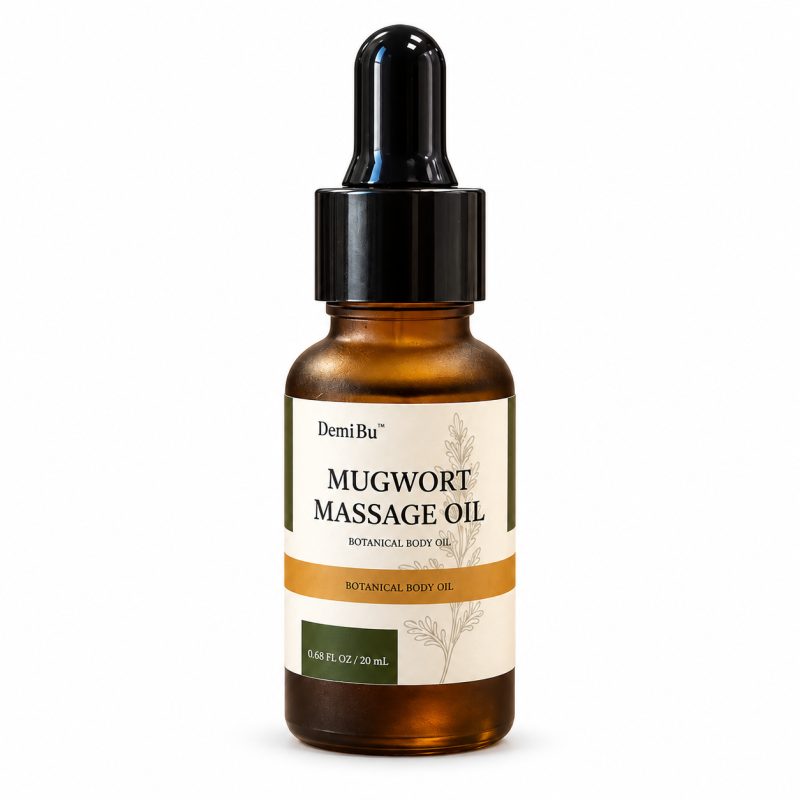
DemiBu Mugwort Massage Oil, 20 mL
Our DemiBu ready-to-use body massage oil combines olive, grape seed and mugwort oils in a 20 mL dropper bottle with a matching carton. An existing branded example for body-care, massage and wellness-kit projects.
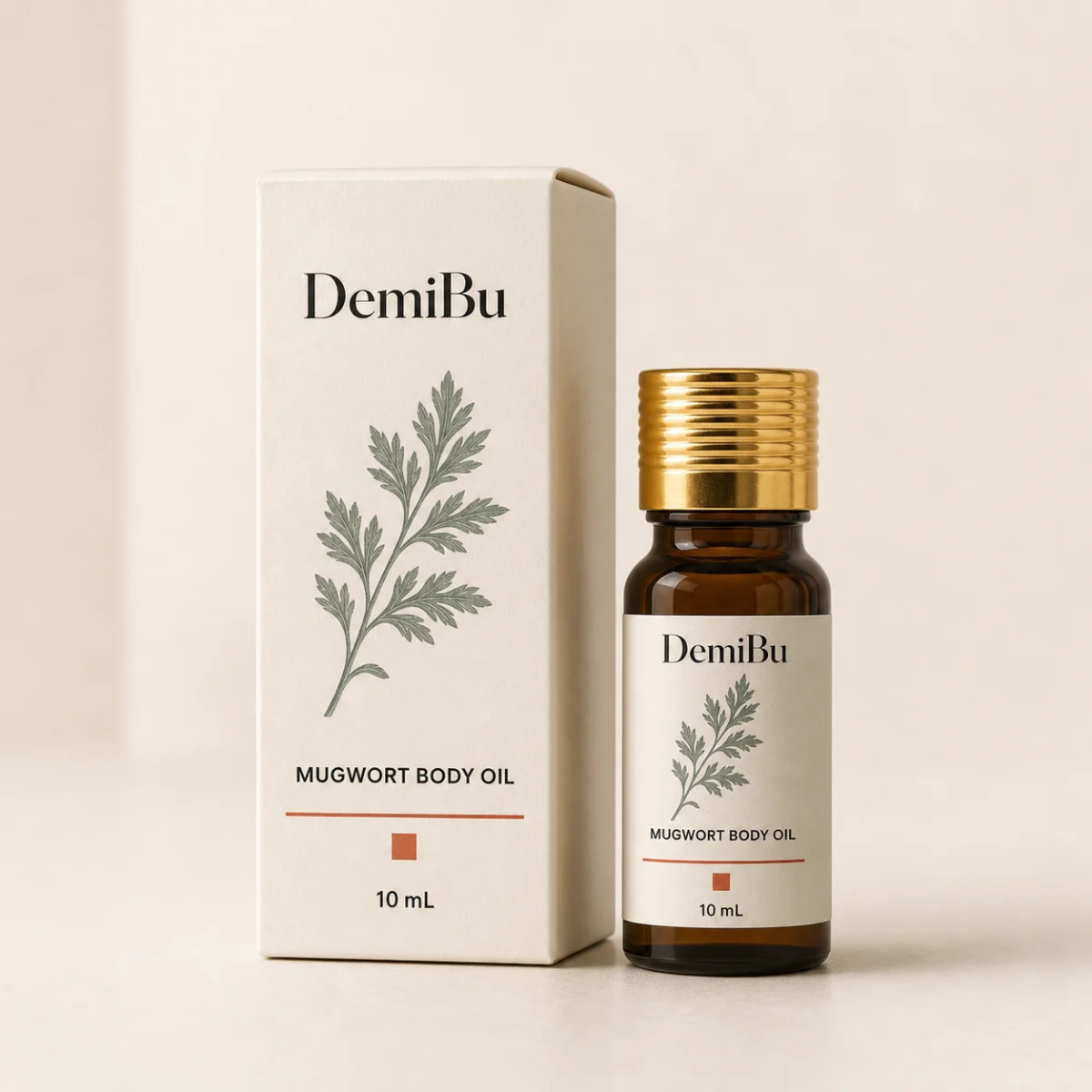
10 ml Mugwort Body Oil Trial Size
Low-volume sample and travel format suited to trial kits, spa sampling and focused private-label launches.
Continue the buyer decision
Read adjacent guides without duplicating the product record.
Apply this guide to a real product and destination
Product, market, quantity, packaging and timeline are enough to begin.
Comparing an oil formula or choosing a private-label bottle?
Ask about product identity, ingredients, sample differences or packaging. Start with your question; the page reference is included.
2026 Mugwort Body Oil & Essential Oil Safety Matrix (Thujone, Dilution & Pairing)
| Oil Parameter | Ready-to-Use Body / Gua Sha Oil | Pure Steam-Distilled Essential Oil |
|---|---|---|
| Species & GC-MS Proof | Artemisia argyi (0.5%–2.0% safe dermal dilution) in plant carrier + Vitamin E | 100% A. argyi oil — mandatory GC-MS verifying low thujone (never bitter wormwood A. absinthium!) |
| EU / US Compliance | EU CPSR + CPNP + IFRA allergens; US MoCRA listing | IFRA 51st Amendment conformity + Air/Sea transport MSDS + strict dilution warnings |
| High-Repeat Retail Pairing | Bundle with 316 steel or Bian stone Gua Sha tools or Scalp Combs | Aromatherapy diffuser & formulator bulk supply |
| Live Product Platforms | 10 ml · 20 ml · 50 ml · 100 ml Ginger Oil | Request GC-MS & Sample Kit |
Additional Buyer & Technical FAQs (2026 Update)
Why is GC-MS thujone testing critical when sourcing mugwort body oil or essential oil?
A batch GC-MS chromatogram proves the oil was distilled from authentic Artemisia argyi rather than high-thujone Artemisia absinthium (wormwood) and provides exact allergen percentages required for EU Cosmetic Product Safety Reports (CPSR).
What dilution range works best for private-label mugwort massage and gua sha oils?
0.5% to 2.0% GC-verified Artemisia argyi essential oil (often paired with ginger oil) inside stable non-comedogenic plant carrier oils plus tocopherol antioxidant delivers pleasant herbal warmth and safe daily skin tolerance.
How do you prevent mugwort body oil from turning rancid or leaking during export?
Specify UV-blocking amber glass droppers or lockable pumps with induction liners, add 0.2% natural Vitamin E antioxidant, run 45°C/30-day stability checks, and include up-to-date transport MSDS.
Is mugwort body oil suitable as a repeat refill for gua sha and scalp comb kits?
Yes—pairing a durable gua sha tool or sandalwood scalp comb with 20 ml, 50 ml, or 100 ml mugwort massage oil turns a one-time tool buyer into a recurring botanical refill customer.