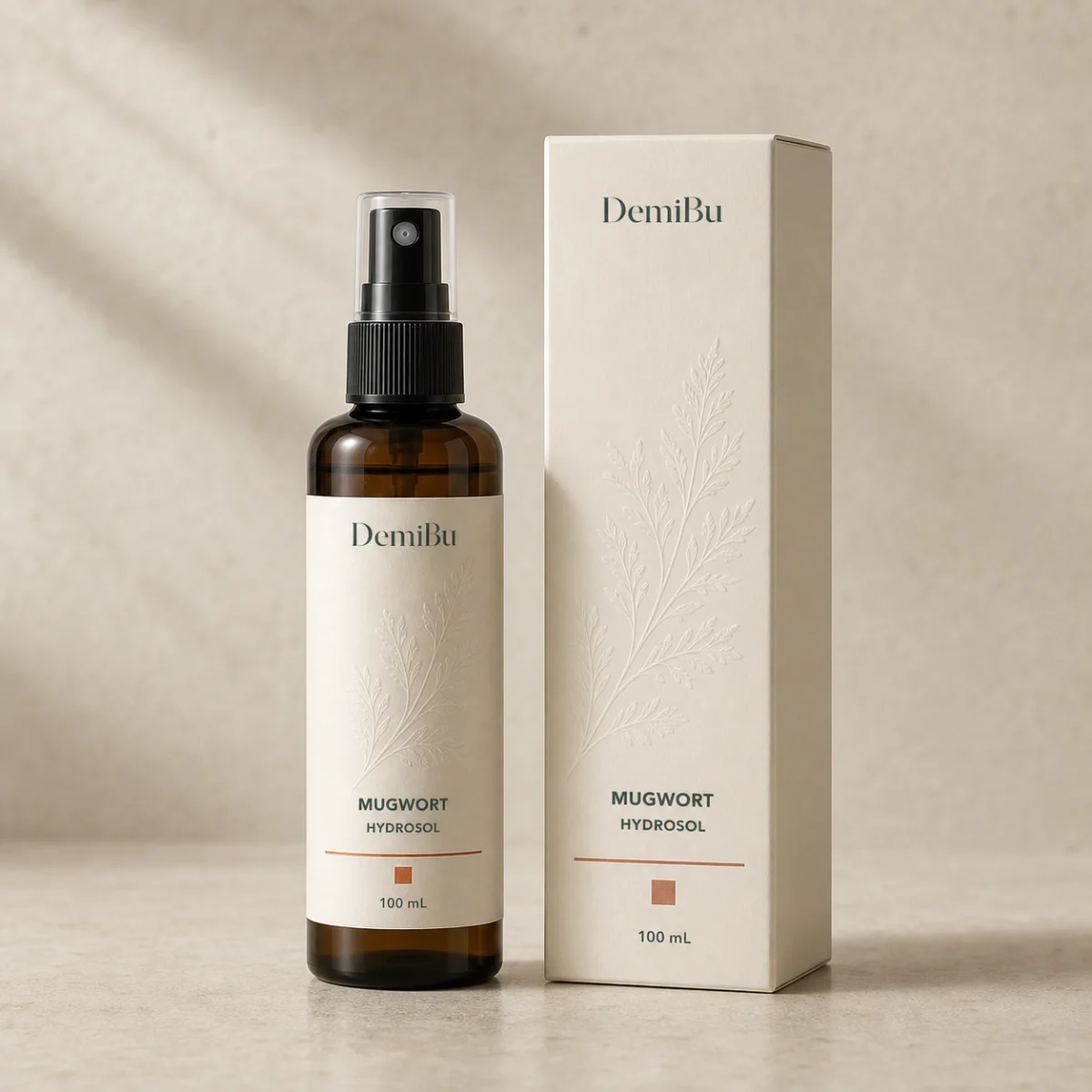
Understand mugwort hydrosol through distillation, botanical identity, ingredient nomenclature, preservation and storage—without importing unsupported claims.
Hydrosol names a distillation phase, not a complete retail formula
Mugwort hydrosol is the aromatic water phase collected in steam or hydrodistillation; the term alone does not reveal species, strength, additives or market use.
During steam or hydrodistillation, volatile material travels with water vapor and the condensate can separate into an oil phase and an aqueous phase. The cited research review uses hydrosol for that aqueous fraction and distinguishes it from essential oil. This definition explains origin, but it does not turn every clear botanical liquid into a hydrosol.
A mugwort infusion is made by steeping botanical material in water. A botanical extract may use water, alcohol, glycerin or another solvent and can be supplied at a defined ratio. Distilled water with fragrance is a compounded mixture. A toner or mist is a finished-use category that may contain a hydrosol as one ingredient. These terms should not be treated as synonyms in sourcing records or ingredient copy.
Botanical identity remains necessary because mugwort is a common name applied to more than one Artemisia species in commerce and tradition. Ask for the supplier’s scientific name, plant part and raw-material description. The buyer should not infer species from an English front label or from a photograph of leaves.
Concentration language also needs care. The water phase may contain small amounts of water-soluble and dispersed volatile constituents, but a seller’s 1:1, pure, double-distilled or concentrated language can mean different things unless the process and basis are defined. Request a process narrative and controlled product description rather than comparing adjectives.
The definition does not establish purity, preservation, microbiological quality, shelf life or a benefit. Published chemical or biological observations on other materials, species, processes or laboratory conditions cannot be transferred to a selected retail SKU without relevant evidence.
That distinction keeps sourcing language technically useful.
It also prevents silent category drift in later artwork.
Sources for this section: [1]
Follow the material through distillation to understand what can vary
Species, plant part, harvest condition, loading, water, equipment and separation choices can all change the character of the collected aqueous phase.
A useful process map begins at botanical receipt. Record species, plant part, source region if commercially relevant, drying or fresh condition, storage and lot identification. Then record preparation and loading, still type, steam or water contact, approximate operating basis, condensation, separation, collection window, filtration and bulk storage. The goal is traceability, not disclosure of every factory trade secret.
Two batches described as mugwort hydrosol can differ because the botanical material differs, because a different cut or plant part was loaded, or because the collection fraction and dilution differ. Sensory consistency should therefore be defined against samples and an agreed range. A stronger odor is not proof of higher quality, and a colorless liquid is not proof of purity.
| Term encountered | What it can reasonably mean | Question that resolves ambiguity | |—|—|—| | Mugwort hydrosol | aqueous distillation phase from a named Artemisia material | which species, plant part and process produced it? | | Mugwort water | commercial common name with uncertain process | is it distilled, infused, extracted or compounded? | | Distillate | material collected through a distillation step | which fraction and what happened after collection? | | Essential oil water | informal description | does it mean hydrosol or water with added oil/solubilizer? | | Facial mist or toner | intended-use product category | what is the complete finished formula? |
Post-distillation handling matters. The hydrosol may be filtered, stored, transported as bulk, diluted, preserved or combined with other ingredients before filling. The supplier should state at which stage the sample and certificate apply. A raw hydrosol record cannot automatically describe a finished formula made later.
Process knowledge supports purchasing decisions such as whether the product story truly depends on distillation, whether lot sensory variability is acceptable, and which records should link botanical input to filled product. It is not a reason to publish proprietary parameters that the factory has not agreed to disclose.
A sampling record should say whether the bottle contains source hydrosol, a bench formula or the final filled product. Otherwise reviewers may compare an undiluted distillate with a preserved retail formula and attribute the difference to crop or quality. Use versioned sample labels that identify batch, date, formula status and package status.
When suppliers offer several mugwort waters, request a side-by-side identity grid rather than relying on scent. List species, plant part, fresh or dried input, production route, post-processing, dilution, preservation, bulk pack and minimum quantity. Fields that the supplier cannot confirm should remain blank and influence qualification. Unknown is different from none.
The dossier should also reconcile commercial units. Raw hydrosol may be quoted by kilogram, while finished mist is quoted per 100 ml bottle. Account for process loss, density basis if relevant, bulk container residuals, filling variation and retained samples. This prevents buyers from treating raw-liquid price as the dominant finished-product cost when pump and packaging can be substantial.
Change notification matters because botanical and process descriptors may drift without a dramatic visual difference. A new species source, plant part, collection window, filtration step, dilution or pre-preservation arrangement should trigger written review. The buyer can then decide which documents, sensory comparisons or product tests need updating rather than automatically repeating everything.
| Observed name | Production identity to verify | Ingredient implication | Classification mistake to avoid |
|---|---|---|---|
| Mugwort hydrosol | aqueous phase collected from steam or hydrodistillation of named material | may be one input or the finished liquid depending on formula | assuming the term reveals species, purity or preservation |
| Mugwort infusion | botanical material steeped in water | water-based infusion with its own complete composition | calling every botanical water a hydrosol |
| Mugwort extract | material produced with a stated solvent and extraction basis | extract nomenclature depends on the actual material | substituting extract identity for distillate identity |
| Mugwort essential oil | separate hydrophobic distillation phase | oil identity and concentration differ from hydrosol | treating hydrosol as diluted essential oil |
| Facial mist or toner | finished intended-use category | requires the entire finished ingredient declaration | using a retail category as the technical formula |
| Distilled water plus fragrance | compounded water system | each intentional ingredient remains visible | marketing the mixture as source hydrosol without process support |
Sources for this section: [1]
Translate product identity into ingredient nomenclature carefully
The front-panel name, technical material name and ingredient declaration serve different purposes and must be reconciled for the destination.
A marketing name can be Mugwort Hydrosol or Botanical Mist while the controlled formula may contain several ingredients. Ingredient declaration should follow the appropriate nomenclature, order and market requirements for the finished product. The scientific botanical name used in a technical specification does not automatically determine the exact label string in every jurisdiction.
Begin with a complete formula statement from the manufacturer. Identify the hydrosol input, added water, preservation system, chelator, solubilizer, fragrance or other intentional addition if present. Ask whether any supplied blend arrives pre-preserved. Otherwise an ingredient can disappear from the buyer’s view because it was introduced upstream.
INCI is often used loosely to mean ingredient list, but the buyer should avoid guessing a name from an online database and pasting it into artwork. Names depend on what the material actually is. A distillate, extract, oil and leaf powder from the same plant are not interchangeable. FDA’s ingredient-name guidance supports correct declaration for U.S. cosmetics while leaving the manufacturer and marketer responsible for accuracy.
Maintain three linked records: the supplier formula, the market label declaration and the artwork version. A change in formula must trigger a label review. A change in the front name can trigger an intended-use or claims review even when the formula stays the same. Version control prevents a distributor sheet from carrying an older declaration.
Identity claims such as single botanical, no added fragrance or preservative-free need support from the complete supply chain and final formula. They should not be inferred from a hydrosol raw-material name.
Sources for this section: [3]
Preservation is a formula-and-package decision, not a marketing preference
Water-rich botanical liquids require a microbiological strategy based on formulation, manufacture, pack, shelf life and consumer use.
Hydrosol can become contaminated through botanical raw materials, processing water, equipment, bulk storage, filling, packaging or consumer contact. FDA’s microbiological safety information highlights these routes and the role of effective preservation and controls. It does not declare a particular preservative mandatory for every product or validate a specific system.
A preserved formula should identify the system in the controlled formula and be evaluated in the actual product context. A proposal without added preservative needs equally serious review of process, packaging, storage, intended life and use. Preservative-free is not synonymous with gentle, pure or safe, and should not be treated as a shortcut around evidence.
Packaging changes the exposure pattern. A spray pump limits open pouring but can have backflow, seal and repeated-use issues. A refill bottle can introduce transfer contamination. A tester in a spa or retail setting can be handled differently from a personal unit. Preservation decisions therefore cannot be made from liquid identity alone.
Product testing is risk-based. FDA notes that manufacturers are responsible for establishing product safety and may use available toxicological and other testing information. The buyer should agree with qualified parties on microbiological specifications, preservation evaluation, stability, compatibility and batch verification appropriate to the exact formula and destination rather than demand a generic certificate bundle.
Record conclusions and limitations. A development sample result applies to the tested batch and conditions. A challenge or preservation evaluation does not replace good manufacture. An end-of-line test does not fix contaminated inputs. A shelf-life statement needs an evidence basis beyond an attractive bottle date.
Storage language should reflect evidence and the unopened/opened distinction
Temperature, light, time, package and consumer handling all belong in a hydrosol storage plan.
Ask how bulk hydrosol is stored before filling, how long it may be held, what container is used and what release checks apply. Then distinguish the finished unit’s unopened storage from its after-opening use. A supplier statement about refrigerated bulk does not automatically mean the retail bottle must be refrigerated, and the reverse is also true.
Real-time and accelerated observations should record formula and package attributes at defined intervals. Useful observations can include appearance, odor, selected analytical controls, microbiology, closure condition, leakage, spray function and label integrity. Conditions and acceptance criteria should be stated before results are interpreted.
Light protection can be relevant to a formula or brand presentation, but amber packaging should not be sold as proof that the contents are stable. Clear, amber or opaque bottles each require compatibility and consumer-use review. Storage copy should be supported by the approved product plan, not inherited from a generic essential-oil label.
Expiration date, best-before period and period-after-opening conventions differ by product and market. The buyer or responsible party should select the appropriate expression after reviewing applicable rules and supporting data. Factories should not be asked to print an arbitrary life merely to complete artwork.
Consumer instructions should explain closure, storage and any avoidance conditions supported by the review. Avoid promising that refrigeration makes an otherwise unsupported formula safe. If the project has no validated after-opening period, mark it as an open decision rather than disguising uncertainty with natural imagery.
Use an identity dossier to keep education separate from claims
A short dossier can document what the product is, how it is made and what remains unknown without assigning biological benefits.
The dossier should include botanical identity, plant part, process description, source hydrosol record, complete finished formula, preservation status, sensory reference, package configuration, proposed use, directions, storage basis, quality plan and destination copy. This creates a shared vocabulary for the brand, factory, laboratory and importer.
For external education, describe hydrosol as the aqueous distillation phase and distinguish it from oil, infusion and extract. Do not promote antimicrobial action, treatment, inflammation reduction, skin improvement or other biological outcomes from the cited review. The source is being used for definition and process context only.
The single responsibility boundary is as follows: the selected factory controls production to the approved written specification and provides agreed records; Moxa Sourcing coordinates supplier questions, samples and quality activities within scope; the buyer or importer approves classification, safety assessment, ingredient declaration, preservation conclusion, claims, label, registrations, customs and release for the exact SKU and destination.
A buyer comparing samples should use coded units and a fixed evaluation sheet. Record appearance, odor character and intensity, spray feel only if the same package is used, and any visible change over time. Sensory preference can select a commercial direction but does not establish safety or efficacy.
Once the dossier is complete, the name hydrosol becomes useful because it points to a known process and material. Before that, it is merely a category word. Good procurement turns the word into a traceable product definition.
The identity dossier can also support search and sales accuracy. Product pages should use the same species, format, size and formula-status language as technical records. Search copy may answer what hydrosol is, but it should not convert definitional authority into an efficacy promise. When the formula changes, update the product page, FAQ, distributor sheet and image captions together; a technically correct carton beside an outdated online description still creates a misleading product record.
Sources and evidence notes
Public sources help frame terminology, specifications and buyer questions. They do not prove that every factory, formula or destination-market requirement is identical.
- [1]Unlocking the Potential of Hydrosols: Distillation, Composition and Research ReviewPubMed Central, U.S. National Library of Medicine · research · accessed 2026-08-27
Supports the definition of hydrosol as the aqueous phase produced through steam or hydrodistillation and its distinction from essential oil; biological findings are not used as product claims.
- [2]Microbiological Safety and CosmeticsU.S. Food and Drug Administration · regulator · accessed 2026-08-27
Supports the need to control water, raw materials, preservation, packaging, storage and consumer-use contamination for cosmetic products.
- [3]Product Testing of CosmeticsU.S. Food and Drug Administration · regulator · accessed 2026-08-27
Supports finished-product safety responsibility and a risk-based testing plan rather than a universal test list.
How this guide was prepared
Moxa Sourcing Editorial Team
The team translates product references, product samples and China-side sourcing workflows into practical English guidance for overseas buyers.
Moxa Sourcing Supply Review Team
The review team checks supplier attribution, commercial boundaries, product specifications and statements that require sample or market-specific verification.
Product availability, MOQ, price and production specifications are reconfirmed against the selected product reference. The buyer or importer leads the destination-market decision and retains applicable statutory importer duties; Moxa Sourcing supports the process by coordinating product and supplier evidence, specifications, documents, testing and label inputs, version control and agreed professional partners.